Paseo Túnel de Minería, Calle Constitución, and Barrio de Analco, Durango

After the city museum, I crossed the street to enter the Paseo Túnel de Minería, a mining tunnel reproduction and museum.

Here’s one of many tourist maps you can find around Centro:

IMGP2690

Tunnel entrance elevator at Plaza de armas:

IMGP2691

It’s quite a ways down!

IMGP2692

I was once again told that the museum is temporarily closed and that there is instead an exhibit on child exploitation and sex trafficking. I said I still wanted to go in and they let me go down the stairs. But at the bottom, they had an English speaker (sort of — I think my Spanish was better!) make sure I really did understand what I was getting into.

The special exhibit has you start at the end. Most of the mining information stuff has been blocked off, but you can still get some of the info. Really, I wanted to do this just for the tunnel itself, so there was plenty there to make the journey worthwhile.

The tunnel was actually pretty spooky!

IMGP2709

There were information panels and displays all along it. Very disturbing information, of course, but informational.

IMGP2710

You can see here how they covered up some of the mining stuff:

IMGP2711

Near the end, there, there was a very powerful animated film about a young girl getting recruited through her Facebook account. I was very lucky in the early days of the Internet to never get into a situation like this! After the film, there was a man handing out information on resources for women and children caught in a bad situation and how witnesses can report things.

This wasn’t a fun part of the day at all, but I came out knowing that Mexico is working to protect the rights and liberties of its women and children, and that is something that was well worth knowing.

I came back above ground at Plaza de armas, so I decided to stroll down the pedestrian Calle Constitución to go check out the oldest neighbourhood in Durango, Barrio de Analco.

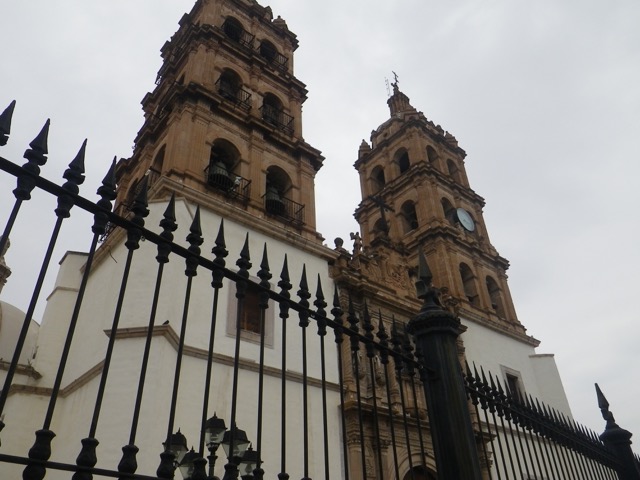
I couldn’t get enough of this building at the corner of Constitución and 5 de febrero! Love the flying buttresses!

IMGP2712

And the church bell!

IMGP2713

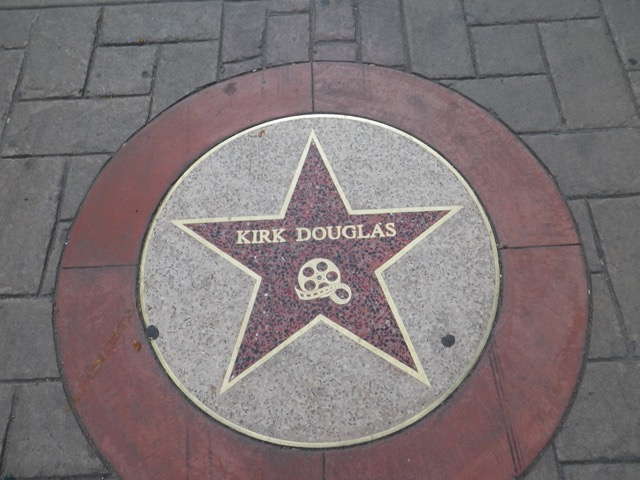
This bit of Calle Constitución is modeled after the Hollywood Walk of Fame, with stars for all the famous actors who have filmed something in Durango. It is a lot more attractive and cleaner than the original walk of fame. 🙂

IMGP2714

Finally, an actor I really like!

IMGP2715

There was a craft market as well as a man selling tacos from a cart. They smelled divine…

IMGP2716

Ah… the best actor of all time. So happy to see his name here:

IMGP2717

There was a bit of a park at the end of the street:

IMGP2718

And a pedestrian overpass that no one was using!

IMGP2719

The main street in the Barrio de Analco was lined with well preserved old houses, a real feast for the eyes:

IMGP2720

IMGP2721

IMGP2722

But get off the main road, and you pretty much have slum, not unlike in Maz’s own Centro:

IMGP2723

It still has its own charm!

IMGP2724

Coming back to Constitución, I thought that it would be nice to have that apartment upstairs!

IMGP2725

The crowd around the taco guy had dissipated a bit, so I got in line! I just wanted a snack since I had big plans for lunch. But it was just past noon (I swear time stood still in Durango) and I had a long walk to lunch, so sustenance was required! $8 for a carne asada (BBQed beef) taco, with lots of different salsas and toppings, including chopped cabbage. I liked that the seller wore a face mask and changed his gloves to handle money. I eat from carts all the time in Maz and have never been ill, but sometimes find the hygiene standards could be a bit better.

I was just about to take my first bite when a man said in perfect, but heavily accented English, “Oh, you didn’t get to Mexico yesterday!”

I turned to him, a little bewildered, and asked him what he meant. “Number one, you’re eating from a cart. Number two, you just ordered; didn’t care what he was selling. Number three, you just started piling on toppings without examining anything and when we warned you that the green stuff was spicy, you added more!”

We had a chat as I ate my very delicious taco and he asked why I picked that cart, only because it was, in his opinion, the best tacos in that part of Durango! “Easy,” I told him. “It’s the one that had the biggest crowd!”

Sated, I headed back towards 20 de noviembre for the very long walk to the Emir restaurant. I was surprised to pass a truck that had a parking ticket!

IMGP2727

The restaurant was very easy to find, just well past the Soriana and 5KM from my hotel according to Siri (I doubt it was really that much…). Emir is an ‘Arabic’ restaurant, the only one in Durango. Went for their mysterious (no description) ‘Lebanese platter’ (not quibbling over the fact that the Lebanese are not Arabs). Some time later, this arrived:

IMGP2729

Growing up in the Montreal-Ottawa corridor with its huge Lebanese population, I’m very familiar with the cuisine and disappointed by attempts made to recreate it away from that region. Oh, I sometimes scratch the itch, but I really need to go back east to reach full satisfaction. So imagine my surprise that this was by far the best, never mind most satisfying, Lebanese spread I’ve had outside of Montreal-Ottawa! In Durango, Mexico! My only disappointment was that the fried ball that looks like an American football wasn’t a falafel (but it was still delicious). I was amazed by my willpower when I turned down more pita, but caved at the offer of baklava and Turkish coffee! This was a meal I will remember for a very, very, very long time. Total cost was something like a mere $220 with the tip.

The walk back to the hotel was rather necessary and I had a nap when I got there, but that was mostly because I didn’t get much sleep the night before because of all that coffee!

My day was far, far from done!

Getting My Bearings in Durango

By the time I was settled into my hotel room, it was about 3:00 p.m. on Thursday. I decided to go out and get my bearings. That was easy to do since Durango’s Centro is laid out in a perfect grid pattern and all streets are well marked. There are also frequent maps with a ‘you are here and points of interest are here, here, and here’ being noted, as well as directional signage on all the main street corners (Plaza de armas is that way, Walk of Fame is this way, turn here for the Francisco Villa museum, etc.).

Within minutes, I knew that Durango was much more tourist friendly and accessible than Maz is and that Maz’s failures in that regard are not a reflection of Mexico, but of the Maz city planners. My Mexican education continues!

Walking a few blocks up 20 de noviembre, I found the main basilica, which is in front of Plaza de armas. I’ll just get it out right here that the architecture in Durango is gorgeous. This is a very, very, very old city (founded in 1563!!!) and the architecture reflects that, with a lot of Baroque influence.

IMGP2616

IMGP2617

IMGP2618

A block from the Plaza de armas, I spotted the Museo de la ciudad 450 (city museum), something that I knew was on my ‘must see’ list:

IMGP2619

IMGP2620

I found the Mercado Gómez Palacio a few blocks later,, a bewildering and disorganized warren of stalls! Rather fun and disorienting to poke through, but I have to say that it’ll make me better appreciate Maz’s mercado! I picked up a new apron (something that was on my list to buy in Maz, so why not make it a souvenir?!). Very inexpensive, only $85.

IMGP2621

More oggling of architecture happened:

IMGP2622

IMGP2623

IMGP2624

I love how colourful Mexico is. I want this pink washing machine in my house in Mérida when I get there!

IMGP2625

And another exquisite building!

IMGP2626

IMGP2627

Tacos al pastor!

IMGP2628

The fabric store (Parisina) is housed in not-so-shabby digs!

IMGP2629

Check out the McDonald’s!

IMGP2630

Back at Plaza de armas, I was dumbfounded to discover that this rotunda holds a tourist information bureau! I got tons of info as well as several maps. Why doesn’t Maz have anything like this?!

IMGP2631

Corner of Constitución and 5 de febrero:

IMGP2632

IMGP2633

Vancouver Donuts on 5 de febrero!

IMGP2634

This is a palace that holds several cafés as well as the Francisco (Pancho) Villa Museum:

IMGP2635

A cappuccino sounds good… But it’s late. Maybe another time.

IMGP2636

I passed the Museo de arqueología (archeology) on the way back to my hotel (again, it’s right in front of the Palacio parking where Moya was staying). I was tempted to go in, but decided to save it for the next day.

IMGP2637

Back on 20 de noviembre on the corner of Zaragoza looking towards my hotel:

IMGP2638

Church across the street from my hotel:

IMGP2640

I love Mexican alleyways!

IMGP2641

Another not too ugly building!

IMGP2643

On the street behind my hotel, I found a used book store and couldn’t resist going in. Oh, that universal smell of old paper! I browsed a bit and then asked if they had Mexican poetry books. The owner, who must have been 100 years old, pulled out a gorgeous and huge leather-bound tome. It was only $150, but way too massive, so I asked if he had something smaller and less expensive. Without hesitating, he pulled out a slim anthology of modern Mexican poetry, for just $75. Sold!

I took my treasure and headed back to have that cappuccino! I love how Mexicans put cinnamon in their coffee! I read for quite a bit as I savoured my treat. There’s sugar in the picture, but I didn’t put any in. I only like milk in my coffee.

IMGP2644

I then headed back to the hotel to research dinner options. One of the best rated options in all of Durango was Fonda de la Tía Chona, just a few blocks from my hotel (but of course!). It’s next to this building, which I found very charming in a Sleeping Beauty’s castle tucked away behind the thorns kind of way:

IMGP2646

Here’s the outside of the restaurant:

IMGP2647

The menu is a bit bewildering as it’s laid out like a newspaper, with dish listings peppered between interesting articles. I ordered a XX beer and didn’t have time to order my main before I was brought free appetizers! Spicy and very yummy pickles:

IMGP2648

And taquitos!

IMGP2649

The decor was very traditional. I really like the white walls and dark wood and would like to find something like that in Mérida.

IMGP2650

IMGP2651

I ordered chicken mole for dinner and am sad to say I was disappointed at what I got for the price I paid. 🙁 The food was good (although I found the stringy chicken a little rubbery), but I’ve had mole that was at least as good as this for less money. The sauce was most chocolatey mole I’ve ever had, and that’s just a statement of fact, not a value judgment. Every mole is different!

IMGP2653

I was on vacation, so I ordered dessert and coffee (yes, I was to regret all that late day coffee when I hit the sack!). My espresso was perfect and I was ‘disappointed’ (and by that I wasn’t) that ‘cheesecake’ in Mexico is exactly like cheesecake back home, with a Graham cracker crust and filling made from Philadelphia cream cheese. Worth the calories, let me tell you! I really don’t do dessert that often anymore and was thrilled that I was happy with this:

IMGP2654

Dinner was expensive, but it wasn’t, $260 (just 20CAD for beer, a main, dessert, and coffee!).

Needless to say, I needed to walk off at least part of dinner! Since my hotel was on a main street, I did not hesitate to go exploring after dark!

IMGP2655

IMGP2657

IMGP2659

I wound up back at Plaza de armas, where I found a jewelry vendor who helped me remedy the fact that I managed to leave home without any earrings! These pressed flowers behind glass were bargained down to a mere $75 and were worn all weekend!

IMGP2663

I continued quite a ways down 20 de noviembre to a huge Soriana to pick up bananas and water. Those of you on Facebook might remember that I posted that I got lost in it. I’m not kidding! I had to get help to find the bananas and then required an escort to get to the cash registers! Both purchases wound up making sense over the weekend, although the bananas weren’t always a morning food! The hotel gave me bottles of water every day, but I’d run out by this morning (departure day) and was glad I had more.

When I got back to the hotel, I laid out one of my maps and set to work getting a rough idea of what I wanted to see and do in my two days in Durango, although absolutely nothing was set in stone.

IMGP2664

I also spent some time in that squashy armchair writing in a journal about my day, hence why my memories are so clear. 🙂

The Hotel Posada San Agustín, Durango

The Hotel Posada San Agustín, where I stayed for three nights in Durango, is in the heart of Durango’s historic Centro, right on 20 de noviembre, a main thoroughfare through the district, and walking distance to just about everything, including the Plaza de armas, where a lot of tours start from. I have rarely had the privilege of staying in the heart of a tourist zone and really appreciated being able to go back to my room for a break without having to make a huge effort to get there, never mind being in such a beautiful and architecturally interesting building! The neighbourhood was super quiet at night, with my only complaint being that the church right next door rings its bells at 7:00 a.m.!

The hotel is located a block from Zaragoza (all Mexican cities apparently have the same names).

IMGP2639

You enter into the first of two gorgeous courtyards:

IMGP2615

I was greeted warmly and checked in promptly, with my request for a standard room being honoured. They have suites, and I debated upgrading to a ‘junior’ one for a mere $50 more, but decided to stick to my original plan. My most pressing question once I had my key (and remotes for the TV and AC) was what to do with my truck. I was told I’d have to drive around the block and park it in the Palacio lot across from the archeology museum, get a ticket, and then the hotel would stamp my ticket whenever I wanted to take my truck out. The clerk drew me a map to make sure I was understanding her correctly. The lot was super easy to find and quite convenient to the hotel, although I wish I’d dropped my luggage first!

Moya spent the whole weekend parked  here, safe and sound, with 24-hour security:

IMGP2689

Back at the hotel, I crossed the first courtyard and went through the second (That floor! Those arches!):

IMGP2614

My room was upstairs at the back (my request), so I had to climb these lovely stone steps:

IMGP2612

The room was definitely ‘cozy’, but absolutely perfect for my needs. My bed had quite possibly the only comfortable mattress in all of Mexico (Croft thinks I could be right because he’s never encountered one!):

IMGP2792

There was a desk/vanity area:

IMGP2793

I liked that there was a switch for a light in the closet that automatically turned it on and off:

IMGP2794

This was my favourite part of the room, the chair and ottoman! I had something similar in my T or C apartment and is what I wish I had here:

IMGP2795

(BTW, I had that EXACT same carpet in my mobile house in Quebec. I see it a lot in m/hotels in Canada and the U.S. and am beyond amused that it’s also used in Mexico!)

The bathroom was adequate, with good hot water and pressure in the shower! The window opens to the stairwell!

IMGP2797

This fancy working phone by the toilet made me laugh:

IMGP2798

And I loved the phone by the bed!

IMGP2799

What I didn’t like about the room would be easily fixable. Since there is only a tiny window to the outside (above the desk), they put in a glass block wall by the door to let in natural and hallway light. But the hallway light is on all night and the roll down shade doesn’t cover the entire window. I ended up having to use the duvet to fully block the light.

I also didn’t like that there was a family of about 50 people (only mildly exaggerating) staying in the suite next to my room and they were LOUD coming in at night. No concept of indoor and outdoor voices and footsteps, but that’s a Mexico thing. If they hadn’t woken me up every night, I would have slept very well since the room was dark and quiet until 7:00 a.m. and the bed was comfortable!

The hotel wifi was terrible (would work for a while, then quit, then work again), but I needed to use up my Banda Ancha, so that didn’t bother me too much. I would have been disappointed if I needed to work.

I really enjoyed my stay at this hotel. It has a very cozy and homey atmosphere. I liked going down to the front courtyard in the morning to drink their surprisingly decent coffee (and an orange juice) and sit in a comfy chair to read the newspaper. The location was beyond perfect. I rather planned my days in a figure 8-type pattern so I could pop in in the late afternoon and have a rest. Durango taxis are apparently super cheap, but I never needed one.

Pecos National Historic Park

John pointed out to me yet another national monument/park just a short distance from Santa Fe, the Pecos National Historic Park. Yesterday promised to be, and was, a gorgeous day, so I decided to go check it out. I got a late start because I was working on the project from hell (most projects of that type would have taken me three hours and it took seven), so I only arrived around 12:45.

The website made it seem like there was a lot to do, with two trails and two tours, but they were still on their winter hours and their Civil War trail was closed. There was a tour at 1:30 of a ranch house owned by Academy Award winner Greer Garson, a benefactor of the park, but that didn’t interest me. Despite that, even if I had had to pay the $3 admission fee, I would have come out of there feeling that I got my money’s worth. If you like history and are interested in ruins, Pecos is a must-do for Santa Fe!

The drive there felt longer than it was because there was a bike marathon thingamabob along a good part of my route to I-25 and instead of being able to drive 50MPH, I had to drive 25MPH. But I eventually got there!

Made it!

Made it!

Look at what I found in the parking lot, a car with a license plate from ARGENTINA!

A license plate from *Argentina*!!!

A license plate from *Argentina*!!!

I’ve heard that Argentinian Spanish is very different from European and Mexican, but this was too interesting to ignore, so I went up to the couple and said in Spanish, “Wow, big journey! How long have you been traveling?”

This is Spanish speaking territory, so they weren’t shocked by the Spanish and replied, “Two years!”

We then had a bit of a chat about their trip. They are arriving in Alaska this summer. I gave them some suggestions (do not miss Dawson City!) and answered their questions about the Alaska Highway. We could understand each other just fine! And just as I was leaving some time later, they came to grab me to act as an interpreter because they were having trouble with a Ranger’s accent. I’m really starting to feel like I speak Spanish now that I’ve communicated with folks from four different Spanish speaking countries (Spain, Mexico, Chile, and Argentina) and been understood. So cool!

But enough about that, you want to hear about Pecos!

Pecos is one of the most important Native pueblos of the area, home to some 2,000 people.  Archeologist Kidder found here perfectly preserved layers of history that enabled him to sort out timelines, tribes, and categorize pottery with methods that are still used today. He considered Pecos the place that helped to make sense of the until then scattered and conflicted information about the peoples of the region and work out a plausible chronology.

A 16th century report of the pueblo describes it as the “greatest and best” of the Indian pueblos, and is, “most thickly settled.”

You learn all of this in the visitors’ centre little museum, which does a good job of setting you into the context of Pecos. Then, you head outside to see the ruins.

From the visitors’ centre, there is a trail (accessible) that takes you around the ruins of the pueblo all the way to the ruins of 17th century and 18th century churches built by the Spaniards determined to bring Christianity to these ignorant savages.

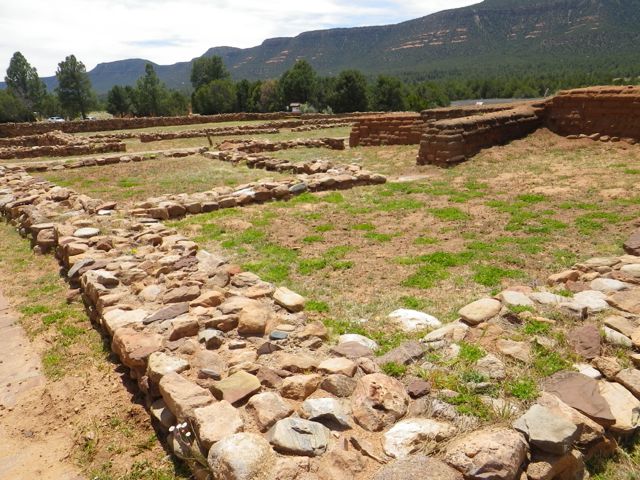
I was surprised by how much there was to see. The pueblo had been like a large fortress, made of 700 rooms, four to five stories high, around a central courtyard, with the upper stories linked by balconies and walkways. It must have been quite a sight!

The pueblo would have had a wall all around it.

The pueblo would have had a wall all around it.

IMGP1730

The church in the distance.

The church in the distance.

The trail is a bit of a treasure hunt if you are loaned the trail brochure, several sheets of laminated paper with tons more information than you find on the sparse placards scattered throughout the site. I had fun looking for all the numbered markers.

I was loaned this trail guide.

I was loaned this trail guide.

Snow in the distance.

Snow in the distance.

Wheelchair accessible path.

Wheelchair accessible path.

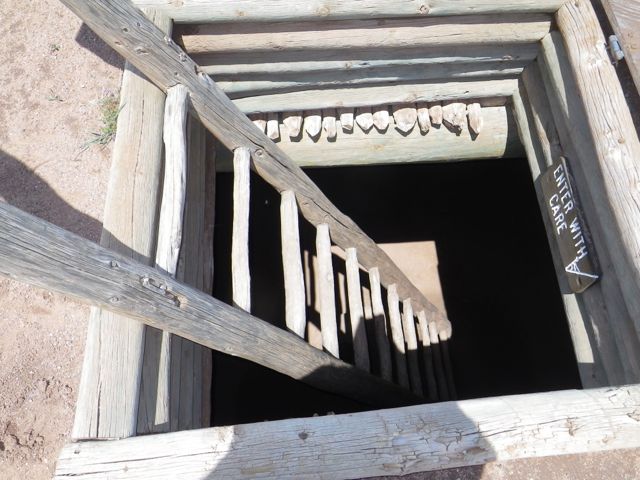
Kivas were circular holes in the ground accessible via ladders. The entrance led to a ceremonial chamber where much of daily living, including weaving, was done. There are two kivas on the tour that you can actually enter!

Entrance to a kiva.

Entrance to a kiva.

Hey, you can really go down!

Hey, you can really go down!

I can never resist stuff like this.

I can never resist stuff like this.

Surprisingly light down there.

Surprisingly light down there.

Ceiling.

Ceiling.

This hole represents the journey of the Pecos people to this world.

This hole represents the journey of the Pecos people to this world.

Masonry of the kiva walls.

Masonry of the kiva walls.

Foundations are all that remain of what were four or five story buildings.

Foundations are all that remain of what were four or five story buildings.

Kivas.

Kivas.

There was a trash heap here.

There was a trash heap here, a goldmine for archaeologists.

So much open country.

So much open country.

You could have seen all around from up here.

You could have seen all around from up here.

More snow in the distance.

More snow in the distance.

This sign made me laugh.

This sign made me laugh. See how uneven the word uneven is?

Up a few stairs for a view!

Up a few stairs for a view!

Looking from the top of the stairs across another kiva.

Looking from the top of the stairs across another kiva.

Contemporary descriptions make it sound like a medieval castle, both in its construction and occupation, with all manner of trades, such as weaving and pottery, being practiced, and there being music.

What the pueblo might have looked like.

What the pueblo might have looked like.

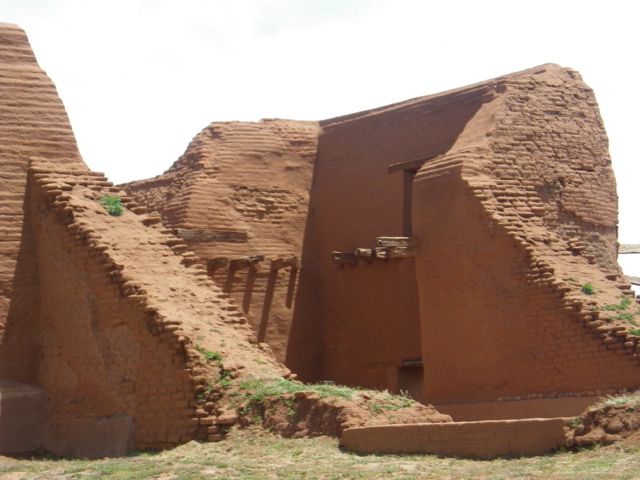
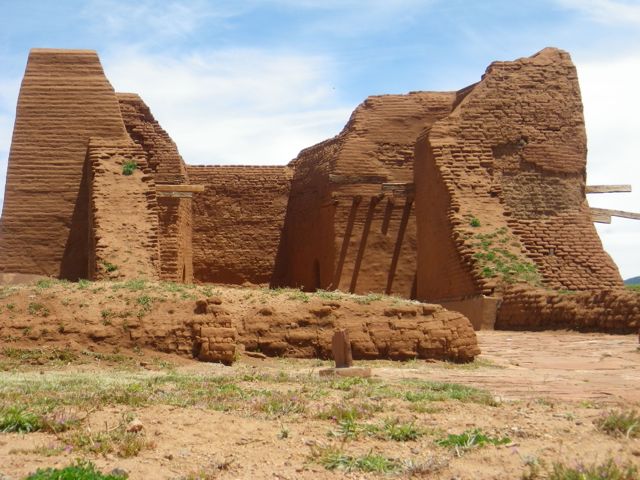
Then, you get to the churches. What we see are the foundations of the 1625 church and the ruins of the 1717 church walls. The first church was destroyed in a 1680 revolt by the Natives, but they didn’t keep their independence for long.

Approaching the church.

Approaching the church.

What remain are bits of the newer church.

What remain are bits of the newer church.

It would have been white washed.

It would have been white washed.

Foundation of the older church.

Foundation of the older church.

You can see a lot of details of the construction.

You can see a lot of details of the construction.

The grass is trying to reclaim it.

The grass is trying to reclaim it.

The Pecos leaders gave each pueblo a knotted rope. Each knot represented a day. When there were no more knots, it was time to attack the Spaniards.

The Pecos leaders gave each pueblo a knotted rope. Each knot represented a day. When there were no more knots, it was time to attack the Spaniards.

I was shocked that we could enter the ruin and walk around! This is where I spent most of my visit, admiring the architecture.

I couldn't believe I could go in!

I couldn’t believe I could go in!

More foundations of the old church.

More foundations of the old church.

Entering the newer church.

Entering the newer church.

Narrow passageway...

Narrow passageway…

...into a courtyard.

…into a courtyard.

Another doorway to explore.

Another doorway to explore.

And another.

And another.

Look at the two angles of the masonry joining together.

Look at the two angles of the masonry joining together.

This buttress is perfectly preserved.

This buttress is perfectly preserved.

I like how the park uses these wooden fences to gently corral guests.

I like how the park uses these wooden fences to gently corral guests.

I should have asked if the flagstone is original or at least a replica of what would have been used.

I should have asked if the flagstone is original or at least a replica of what would have been used.

Also curious about the stairs.

Also curious about the stairs.

You can really see the detail of the masonry work here.

You can really see the detail of the masonry work here.

Vigas (wooden ceiling beams).

Vigas (wooden ceiling beams).

The construction is just like that of a medieval keep, with a flared base to distribute the weight of the building (and I thought my medieval history degree was never going to be useful in the real world!).

The construction is just like that of a medieval keep, with a flared base to distribute the weight of the building (and I thought my medieval history degree was never going to be useful in the real world!).

Two-toned masonry.

Two-toned masonry.

This drain is original! The holes in it are perfectly round!

This drain is original! The holes in it are perfectly round!

Oodles of foundations.

Oodles of foundations.

Another kiva.

Another kiva.

What is it with me and pokey places?

What is it with me and pokey places?

Oh, just like the other one.

Oh, just like the other one.

This would have been a turkey coop, with a cobblestone floor for easy cleaning.

This would have been a turkey coop, with a cobblestone floor for easy cleaning.

The directional signs made me laugh.

The directional signs made me laugh.

This would have been a 16th or 17th century residence or part of a farm.

This would have been a 16th or 17th century residence or part of a farm.

One last glimpse of the church.

One last glimpse of the church.

Pecos’ last inhabitants left the pueblo in 1838 and joined up with related tribes nearby in Jemez, where their descendents live to this day.

This boardwalk goes over the Santa Fe trail.

This boardwalk goes over the Santa Fe trail.

The visitors' centre had lovely architecture.

The visitors’ centre had lovely architecture.

Pecos pueblo taught me a lot about the geography of the region, the local peoples, the influence of the Spaniards on the development of the region, and more. I am leaving Santa Fe with a much better understanding of the history of this region and how it ties in to the history of my part of the continent. Thanks for another great recommendation, John!

Now, it’s time to move on. Work kept me up very late, two hours past my bedtime, last night, so I am up very late this morning and nowhere near ready to hit the road yet, but I am going! Next stop is Bandelier National Monument and then I’m pointing Moya towards South Dakota. I doubt I will get out of New Mexico today, but tomorrow will be a driving day.

A Very Full Afternoon in Santa Fe

This afternoon, I drove to downtown Santa Fe to see what was what. John gave me a few street names about a mile from downtown as possible free parking spots. On the way, my ‘you need gas’ light came on and then came a nearly hour-long search for fuel. I am throwing my GPS into the Santa Fe River! It kept directing me to gas stations that haven’t existed in years or to turn the wrong way down one ways, all the while directing me through super narrow European-style streets. Not the introduction to Santa Fe I wanted. 🙁 I finally found fuel and put in 17 gallons. HOLY MOLY. The tank holds 19.5 and I’ve never put in more than 16 gallons or so. I was running on fumes! But I’m glad I found gas early in the day because my afternoon was going to take on an unexpected twist.

But first, I parked where John told me to park and hoofed it down the Old Santa Fe Trail, a busy thoroughfare that takes you to downtown. I passed the visitors’ centre and popped in for a walking map.

Courtyard of the visitor's' centre.

Courtyard of the visitors’ centre.

Front of the visitors' centre.

Front of the visitors’ centre.

Since it was getting late in the day, I decided to go straight to the history museum. But I still passed some interesting stuff on the way.

The oldest church structure in the United States (early 17th century).

The oldest church structure in the United States (early 17th century).

IMGP1529

Another beautiful church.

Another beautiful church.

Loretto Chapel, home of the miraculous staircase.

Loretto Chapel, home of the miraculous staircase.

Remember that miraculous staircase…

Yet another gorgeous church, and very ornate inside.

Yet another gorgeous church, and very ornate inside.

The history museum.

The history museum.

As it turned out, my pass for the New Mexico History Museum was good not only for that museum, but also for the Palace of the Governors! I’ve already gotten more than my money’s worth out of the CulturePass!

The history museum was smaller than I expected, but that’s just a statement of fact, not a valuation. It was really good and had a lot of interesting exhibits. The main exhibit is the history of New Mexico from prehistory to now. It’s a part of North American history I’m not familiar with, but it’s really no different from the history in my part of Quebec, only with different actors.

I enjoyed an exhibit about a top secret facility related to the Manhattan project, one about the Civil War, and one about what was probably the first chain of dining and hotel establishments in the west, Harvey House. I was going through this exhibit when I got a text from John asking me to call when I could, and another saying that there was no emergency. We are on the same wavelength! 😀

I called when I could and as it turned out, he had some free time and was wondering if he could join me. We had made tentative plans to hang out on Tuesday, but he wasn’t going to be free and the weather is promising to be miserable. I told him where I was and he said he’d text when he was closer.

I then went upstairs to the temporary exhibits and saw one on camera obscuras and pinprick photography, as well as one about the Virgin Mary.

Then, I went into the courtyard to check out the printing presses and go across to the Palace of the Governors.

Courtyard between the history museum and the Palace of the Governors.

Courtyard between the history museum and the Palace of the Governors.

Courtyard between the history museum and the Palace of the Governors.

Courtyard between the history museum and the Palace of the Governors.

Nothing says May more to me than lilacs. I will be planting a lilac tree at Haven!

Nothing says May more to me than lilacs. I will be planting a lilac tree at Haven!

This building was originally constructed in the early 17th century to be Spain’s seat of government, and then was adapted and remodeled to suit other needs as the years went by. There was an interesting exhibit that showed different stages of development on plexiglass that you could layer to see the changing floor plan.

This was an expansive building taking up a full block and full of white plaster walls and dark ceiling beams. I’m really digging that decorating scheme. 🙂

There were lots of interesting exhibits about settlement and governance in New Mexico, religion, and, my favourite, hide paintings, that is scenes of New Mexico life painted on animal skins.

John still hadn’t arrived when I was through at the Palace of the Governors, so I headed out to explore the immediate area.

Across from the Palace of the Governors.

Across from the Palace of the Governors.

The area really reminded me of Plazuela Machado, only much more touristy (which will make my Maz friends laugh). John says that Santa Fe used to have a ‘real’ downtown, but now, it’s all for the tourists and full of expensive shops and restaurants.

Plaza.

Plaza.

Front of the Palace of the Governors.

Front of the Palace of the Governors.

IMGP1541

John texted me just as I finished my tour of the plaza to let me know he was at the entrance to the history museum. We met up and headed across the street to the Museum of Art, which was once the ‘fine arts’ museum. We just did a quick tour since it was getting very late and I’ll actually be able to go back if I want.

The art museum.

The art museum.

Egyptian obelisk in the courtyard of the art museum.

Egyptian obelisk in the courtyard of the art museum.

I really liked what I saw on our dash through it. The museums in Santa Fe are all very small, but they pack in a lot! There was a photograph exhibit that we both liked that featured the subject at a young age, then as an adult.

When we came out, John asked if I was thinking about food, which I was. I hadn’t had lunch and planned on having linner after doing the museums. He suggested we go to a burger joint owned by friends of his called Santa Fe Bite. The restaurant used to be a 10-seater located outside the city limits, but now it’s a proper downtown restaurant. I wouldn’t have thought to go in since I figured it was just a basic diner attached to a hotel. It pays to play tourist with a local guide!

I ordered just a basic burger with lettuce, tomato, pickles, and onions. It was really good! The meat was lightly seasoned and juicy while the homemade bun was buttery and chewy. I had the whole bun, but I left most of the delicious kettle chips. John had a spicy-looking chili with cornbread. Best of all, his friend was working and they were able to have a quick catchup. Serendipity!

From the diner, it was decided that we would walk to John’s car and that he would take me back to my truck.

We stopped at the Loretto Chapel on the way and since it was past closing, we were allowed to very quickly go into the chapel and get a picture of the miraculous staircase without paying the museum admission fee.

The miraculous staircase. Can you see why?

The miraculous staircase. Can you see why?

I love spiral staircases and knew about this one, but didn’t realise it was in Santa Fe. It is an engineering marvel! Can you see why?

The chapel is lovely, too.

Another beautiful chapel.

Another beautiful chapel.

We went into another church, the third one I saw on the way to downtown, and then made it to his car. Before going to my truck, we drove to Fort Marcy Park. It’s a sinuous uphill walk to a viewing platform on the site of an old fort, with plaques all the way up detailing the history of New Mexico.

A place I wouldn't have found on my own.

A place I wouldn’t have found on my own.

Breathtaking views of Santa Fe.

Breathtaking views of Santa Fe.

Breathtaking views of Santa Fe.

Breathtaking views of Santa Fe.

Quite a climb, but worth the effort.

Quite a climb, but worth the effort.

Breathtaking views of Santa Fe.

Breathtaking views of Santa Fe.

We then got back to my truck and I followed him most of the way home, where he detoured to show me the site of an old pueblo that was excavated in the 1970s. It felt like a place of immense power. What amazed me the most was all the potsherds just lying around on the ground. I had to take a picture of an incredible find, but, of course, left it behind!

Black on white potsherd. What a find!

Black on white potsherd. What a find!

The day didn’t start off too well, but definitely improved! It was a wonderful afternoon and I was once again grateful for a local guide.

Now, I have TONS of work to do in the next couple of days, so I will probably hunker down at home for a bit. But John’s not ready to kick me out (I think…), so I may extend my stay a bit to go on a field field trips in the environs.