Kasha-Katuwe Tent Rocks National Monument

The nice thing about blogging about your travels is that when you get suggestions from local guides, they know what you like and can steer you in the right direction. When John told me to check out Kasha-Katuwe Tent Rocks National Monument I knew this was a must-do. It’s about an hour southish of Santa Fe, but only 45 miles, so not a huge time or gas commitment.

Long-time readers will find today’s pictures look a tad familiar. Indeed. Today was much like being back in the Alberta Badlands around Drumheller or Writing-On-Stone Provincial Park. The hoodoos here look different, more like Bedouin tents than mushrooms, but the stratified cliffs and scrub brush around them had a definite feel of ‘home.’

The weather looked iffy this morning. The forecast said no rain, but it rained hard mid-morning for a bit. When I saw that it was clearing somewhat, I decided to go and hope for the best. I’d done some research and thought that there was only a couple of short and easy hikes there, but it turned out that one was actually quite challenging, with a steep ascent and some scrambling. I definitely wasn’t dressed for that, nor do I have any rain gear, but I made do. I need to replace my hiking kit, but wanted to wait to make sure the weight loss held before I invested. Let’s just say that a major shopping trip at Cabela’s is in store for me this summer… I need everything, including a new small pack with an internal frame and, of course, rain gear. I may have to cave in the next couple of days and go buy something cheap at Walmart just to get me home.

But at any rate, I left around 10:30 this morning and had a leisurely drive to the tent rocks monument. There was a bit on the interstate, but most of it wasn’t.

Let me pause here to say I took about 500 pictures today, but managed to trim it down to 57… 🙂

This vehicle made me laugh. The side of it had 'Official TARDIS chaser' painted on it and the license plate was T4RDIS.

This vehicle made me laugh. The side of it had ‘Official TARDIS chaser’ painted on it and the license plate was T4RDIS.

Entering the monument.

Entering the monument.

The fee station for the monument is about four miles before the parking lot. A Ranger took note of my pass number and gave me a receipt to leave on my dashboard as well as an information pamphlet. If you don’t have a pass, the cost is $5 per carload.

Very promising view from the parking lot.

Very promising view from the parking lot.

The parking lot was a bit of a disaster, with parking spots poorly marked. I finally slid into a space that I could get out of easily and hoped for the best.

This little ball of rock dominates the landscape.

This little ball of rock dominates the landscape.

There are two trails, the gently sloping cave loop and the challenging canyon hike, which takes you through a narrow slot canyon, then has you scramble 630 feet in elevation to the top of the canyon for breathtaking views. I suggest doing the canyon hike then going back to the parking lot by the cave loop since that’s just an additional 0.2 miles.

I suggest doing the canyon trail, then returning to the parking lot by the cave loop.

I suggest doing the canyon trail, then returning to the parking lot by the cave loop.

The layers include sand and volcanic rock.

The layers include sand and volcanic rock.

The tent rocks, or hoodoos, were formed from volcanic eruptions layering pumice, ash, and tuff.

First time I've seen a rest area before a trail. Had my lunch there!

First time I’ve seen a rest area before a trail. Had my lunch there!

Love the contrast of the greens and oranges.

Love the contrast of the greens and oranges.

Entering the slot canyon.

Entering the slot canyon.

Looks like the cliff got attacked by a woodpecker!

Looks like the cliff got attacked by a woodpecker!

Amazing that the tree is still standing.

Amazing that the tree is still standing.

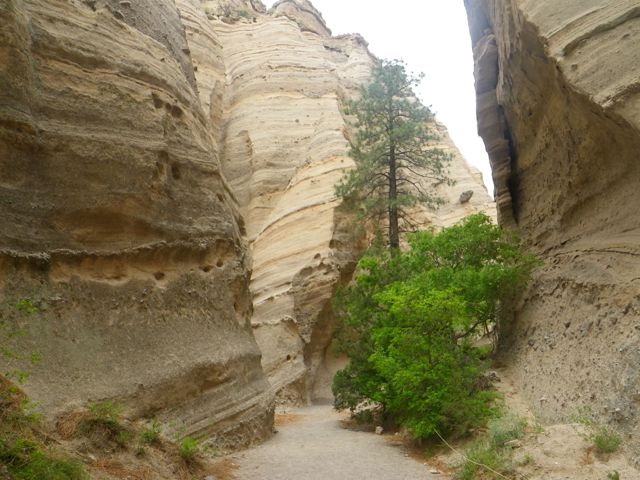
The slot canyon bit of the hike was memorable and probably not for the claustrophobic.

Neat plant.

Neat plant.

Cacti.

Cacti.

Going deeper into the slot canyon.

Going deeper into the slot canyon.

Narrow path!

Narrow path!

Another neat dead tree.

Another neat dead tree.

Not feeling a strong urge to experience Vermilion Cliffs National Monument...

Not feeling a strong urge to experience Vermilion Cliffs National Monument…

Not dressed for hiking, but at least I was comfortable!

Not dressed for hiking, but at least I was comfortable!

The puddle was a fun obstacle to cross.

The puddle was a fun obstacle to cross.

Looks like a castle with turrets.

Looks like a castle with turrets.

This one looks like an evil gnome!

This one looks like an evil gnome!

Some freestanding hoodoos.

Some more hoodoos.

You eventually start to climb out of the slot canyon to its rim and the hike gets progressively harder.

Beautiful with a barren quality.

Beautiful with a barren quality.

This tree seems to have something jackrabbit-like sitting in its branches.

This tree seems to have something jackrabbit-like sitting in its branches.

Bit of a scramble.

Bit of a scramble.

Um, wow.

Um, wow.

More flowers.

More flowers.

Look at them!

Look at them!

A lot of the trees here have twisted trunks like this one.

A lot of the trees here have twisted trunks like this one.

People started to turn back near the end, which was a shame. I can’t leave a trail unfinished and it wasn’t that hard, although there was one place where I had to pull myself up and my bad knee just would not follow the way it needed to and I thwacked it pretty hard on a boulder. I had to be extra careful after that, especially on the trip down, since the joint felt a little loose. Definitely time for me to shop for some sort of brace and I need to add hiking poles to my Cabela shopping list!

Climbing higher.

Climbing higher.

Still not at the top.

Still not at the top.

Prickly things.

Prickly things.

These red flowers really popped.

These red flowers really popped.

Still climbing.

Still climbing.

What a view!

What a view!

I eventually got to a plateau that still wasn’t the top, but gave a good preview of what was to come if I kept going. Knee not withstanding, I was in good shape, just a little out of breath from the altitude, but not excessively so. This is good acclimatization for Colorado!

This hoodoo has a hole through it.

This hoodoo has a hole through it.

Another dead tree reincarnated as a statue.

Another dead tree reincarnated as a statue.

Fuzzy flowers.

Fuzzy flowers.

What a climb, but so worth it!

What a climb, but so worth it!

Such wide open country.

Such wide open country.

Cactus flower.

Cactus flower.

When I got to the top, I took a trail that went a little downwards to the very edge of a cliff and took a breather. I bought a watermelon yesterday (99 cents!) and a few cubes were exactly what I needed.

A much needed treat at the summit!

A much needed treat at the summit!

So huge.

So huge.

Climbing down this bit was the end of the road. I'm standing just off from a sheer cliff edge.

Climbing down this bit was the end of the road. I’m standing just off from a sheer cliff edge.

Hard to believe I was one of those ants an hour or so before!

Hard to believe I was one of those ants an hour or so before!

The trip down was slow. There was an older lady with a similar knee issue who got hurt at the same spot I did, so we watched out for each other all the way down.

Heading back out.

Heading back out.

It started to thunder and the sky looked ominous as I made my way back through the slot canyon. Seeing that I was picking up speed, a guy said quite rudely to me, ‘Relax, it’s just water.’ He obviously has never heard of flash flooding, nor did he read the signage at the trail head that said to get the hell out of the slot canyon in the exact conditions we were witnessing. Luckily, there was no rain!

I emerged from the slot canyon and took the cave loop back to the parking lot. At the junction of the two trails, it’s .5 miles to the parking lot the way I came or .7 by the cave trail

Colourful grass on the cave loop.

Colourful grass on the cave loop.

Low and behold, there was actually a cave on the trail!

Caveat (cave-ate) with soot on the ceiling.

Caveat (cave-ate) with soot on the ceiling.

Looking back to the cliffs.

Looking back to the cliffs.

This one looks like a mushroom.

This one looks like a mushroom.

Such interesting plants here!

Such interesting plants here!

This hike was a bit of a climb, but not a strenuous one.

Looked like a camp from afar!

Looked like a camp from afar!

This one looks evil. Can you see his eyes, nose, and creepy grin?

This one looks evil. Can you see his eyes, nose, and creepy grin?

Back at the parking lot, I decided to drive the 3.5 miles to the Veterans’ Lookout. Imagine my shock that the road there was in very poor condition, almost as bad as the Isla road, and there was no warning about that! I was fine in my truck, but I feel bad for someone in a small car or, worse, an RV towing something since there’s no place to turn around until the top.

But the drive up was worth it!

View from the veterans' lookout.

View from the veterans’ lookout.

Surprisingly nice facility at the end of a terrible road.

Surprisingly nice facility at the end of a terrible road.

I love the vegetation around here.

I love the vegetation around here.

What an utterly amazing and unexpected day! It just goes to show that you can research something and still not ‘get it’ without being on site. I had no idea that I would do such serious hiking today, and what a treat it was! Kasha-Katuwe Tent Rocks National Monument is a place of incredible power and definitely worth a half day trip from Santa Fe or a day trip from Albuquerque. You can still get a heck of a lot out of the monument even if you can’t hike. The cave loop is not challenging and a good part of it is wheelchair accessible. You can also hike a little ways into the slot canyon to get a feel for it even if you are not able to climb up .

Finally, I saw this car in a parking lot in town and fell in love with the colour. 🙂

What a pretty shade of orange!

What a pretty shade of orange!

New Mexico CulturePass and the Santa Fe Museums of International Folk Art and Indian Arts & Culture

John told me about a $20 pass to several Santa Fe museums. I looked it up and it didn’t seem like a sure deal to me. I’d have to tour three museums to get my money’s worth and I’d only have four days to do it. Well, my information was out of date. I learned at my first stop today that there is now a $25 (out of state resident price) New Mexico CulturePass that gives admission to 15 museums throughout the state. I won’t be hitting any more beyond Santa Fe, but if I visit at least three museums here, I’ll have saved $2 and if I hit all four, I’ll have saved $9 (so basically pay for three admissions, get one free).

But the best part is that the pass is good until this day next year. So when (because it is nearly surely a when) I come through NM next year, I can use the pass in Las Cruces and a few other places! I actually didn’t miss anything not having the pass earlier this month; the museums are really scattered. I think ABQ is the only place I passed that had a museum where I could have used the pass and I visited the museum anyway!

Two of the museums for which I could use my pass were located across from each other, so I visited both today. There are other museums in the immediate vicinity (walking distance), but unfortunately they are not included with the pass.

Museum courtyard

Museum courtyard, International Folk Art to the right, Indian to the left.

Entrance to the museum of International Folk Art.

Entrance to the museum of International Folk Art.

I started my day at the Museum of International Folk Art, recommended by John. It was a lot smaller than I expected, but if you read everything, you could be there all day.

I started in a gallery about pottery from the Southern US, mainly the Carolinas, and got hypnotized by a video of a potter at work. There were lots of really gorgeous pieces and these are just some of my favourites.

Face jug.

Face jug.

I love the detailing. The drips are semi-intentional and come in the firing process.

I love the detailing. The drips are semi-intentional and come in the firing process.

Exquisite!

Exquisite!

Gorgeous pitchers.

Gorgeous pitchers.

This is a jug that may have been designed to be tied to a saddle.

This is a jug that may have been designed to be tied to a saddle.

Next, there was a small exhibit about the immigrant experience. There was a gut wrenching poem by a teenage girl who came to Santa Fe with her family from Mexico and has experienced discrimination. It finished with, and I am paraphrasing, “You call us wetbacks for coming across the river. What should we call you for coming across an ocean?”

Then came the most important collection, from the Girard family, a collection of toys, textiles, and other memorabilia from around the world (but mostly Mexico) arranged in thoughtful vignettes. This is where you could lose most of a day!

These are just a few things that caught my eye:

Gorgeous textiles.

Gorgeous textiles.

Cabinet after cabinet of wonders in the Girard wing.

Cabinet after cabinet of wonders in the Girard wing.

Angels on top, demons below.

Angels on top, demons below.

No placards in the Girard exhibit. Instead, you use a catalogue to look up the exhibits that interest you.

No placards in the Girard exhibit. Instead, you use a catalogue to look up the exhibits that interest you.

Beautiful tapestry from Ethiopia.

Beautiful tapestry from Ethiopia.

I spent about an hour at this museum, but actually went through twice. It was really more of a museum for me to feast my eyes on than to spend a lot of time reading. I’d consider it a must visit if you like quirky objects, textiles, and handicrafts. The gift shop is really interesting to poke through, too, and I found some Mexican blouses for only 40USD that are similar to the one I bought at the Mercado for 19USD… 😀

Next, I checked out the museum café, but there was a long line up and the current exchange rate made it rather pricey (eg. $12 for a hamburger and fries), so I decided to pass. My budget is fine, and I can’t stress that enough, but I have two late invoices that are awaiting payment and so I must remain extremely frugal. And even if I wasn’t experiencing cash flow crunch, I’d rather spend 20CAD on a pretty souvenir, like earrings, or a memory, like visits to museums. So I decided I could wait to eat and headed to the Museum of Indian Arts & Culture.

Entrance to the Museum of Indian Art & Culture

Entrance to the Museum of Indian Arts & Culture

No photography is allowed in this museum, so I’m going a little by memory. The first gallery is about the history and present day situation of all the Native New Mexican tribes. It’s a really beautiful part of the museum, but full of tight little alcoves where you have to wait for people to read everything before you can do the same. The museum wasn’t crowded today and I still had to wait in line at every single exhibit in this gallery. It got a little tedious.

Next, there was a small gallery with Native pottery. Different techniques from the European tradition, but equally beautiful.

Then, there was my favourite exhibit, art by David Bradley. He paints vibrant pictures that look very cheerful until you examine them more closely and realise that they are scathing commentary on how Natives are treated in the US today.

After, there was a small gallery about Native music, drums, rattles, flutes, and the like. There was another hypnotic film. I love the drumming!

Finally, there was an exhibit about turquoise, where I learned a lot about the mineral/gem and ogled a lot of jewelery made with it, silver, and coral. I was once again really glad that I bought my turquoise earrings in Cerillo!

This was another excellent museum well worth visiting. I like that it presented a balanced view of the Native American experience.

It was snowy and cold when I came out, but I made one final stop at the sculpture garden, which featured statues of strong beautiful women.

Entrance into the sculpture garden.

Entrance into the sculpture garden.

I was struck by her obvious strength.

I was struck by her obvious strength.

And hers.

And hers.

And hers.

And hers.

Today was museum weather. I hope that the promised warmth tomorrow materializes so I can check out downtown! There is another museum there I’d like to do, in addition to just walking around.

Gila Cliff Dwellings National Monument

The Gila (hee-la) Cliff Dwellings were used as shelter by  humans for thousands of years. In the late 1200s, they were used by the Mogollon peoples, who built homes with property masonry within the natural cave walls.

Think on that for a second.

As many of you know, I majored in medieval history, with a focus on the Scottish Wars of Independence, the ‘Braveheart’ era of the late 1200s. While all of that was going on across the pond, the Native American peoples of the American Southwest were building structures that exist to this day. Like Casa Grande, the Gila Cliff Dwellings have shattered my view of world history.

One of the main reasons I was so eager to visit the Gila Cliff Dwellings is that unlike Montezuma Castle, you can actually go inside the dwellings!

I made it! What a drive!

I made it! What a drive!

When you arrive at the end of highway 15, you have to turn left for the dwellings. Silly me, I went straight to check out the visitors centre, where I was told I should end with them and their little museum rather than start. Okay, back to my truck I went.

It was a bit more of a drive to get to the trailhead for the dwellings. There, a park ranger gave me the spiel about only bringing water and not touching the walls, as well as giving me a map and info about the trail.

The access fee is $3 (exact change only), that you put in an envelope that you slide into a box, or you can put your info and parks pass number on a card and put that into the box.

It’s about a mile round trip to the dwellings and there is quite a bit of ascent and descent over rough terrain. You need to be moderately fit and nimble to get up there.

The walk takes you through a narrow canyon to a view point where…

Bridge at the trailhead.

Bridge at the trailhead.

Over a river that was the lifeblood of the region.

Over a river that was the lifeblood of the region.

Starting to climb.

Starting to climb.

The cliffs in the area all look like they were carved by people.

The cliffs in the area all look like they were carved by people.

Another of several bridges.

Another of several bridges.

More stairs.

More stairs.

… you turn around and, boom, there are the dwellings!

First glimpse of the dwellings!

First glimpse of the dwellings!

Yet more stairs.

Yet more stairs.

Still more stairs.

Still more stairs.

Lots o' stairs.

Lots o’ stairs.

Oh!

Oh!

The caves were naturally carved out of the cliff faces.

The caves were naturally carved out of the cliff faces.

Signs of human inhabitants.

Signs of human inhabitants.

This would have been a kitchen.

This would have been a kitchen.

Incredible. Medieval-era ruins in North America of comparable construction!

Incredible. Medieval-era ruins in North America and of comparable construction!

The walls didn't go to the top to let the smoke out.

The walls didn’t go to the top to let the smoke out.

Prickly stuff. :)

Prickly stuff. 🙂

Corn was grown up here.

Corn was grown up here.

Coming to the cave where you can actually go in.

Coming to the cave where you can actually go in.

More stairs!

More stairs!

Climbing up into a massive room.

Climbing up into a massive room.

The room was so large it didn't feel claustrophobic at all.

The room was so large it didn’t feel claustrophobic at all.

Looking down into a room.

Looking down into a room.

Signs of construction everywhere.

Signs of construction everywhere.

The soot stained ceiling dates back thousands of years, to well before the Mogollon people.

The soot stained ceiling dates back thousands of years, to well before the Mogollon people.

They used stones, mortar, and wood for construction.

They used stones, mortar, and wood for construction.

More stairs!

More stairs!

Coming into another room from the last staircase.

Coming into another room from the last staircase.

This is the staircase you have to go down to leave the dwelling.

This is the staircase you have to go down to leave the dwelling.

You can climb this ladder to look over a wall.

You can climb this ladder to look over a wall.

There were several rooms within the cave.

There were several rooms within the cave.

The quality of construction is amazing.

The quality of construction is amazing.

There was a guide at the end of the dwelling who had tons of information. She pointed out glyphs, hand prints, and other bits of interest. One thing that was really interesting is a huge slab of stone that predates the Mogollons that fell from the ceiling. The Mogollons built around it, but you know the stone fell before their time because the underside of it is black with soot and it sits above a grinding stone that you can just barely see underneath it.

Can you see the little glyph painted in red? There were lots of those all around the cave.

Can you see the little glyph painted in red? There were lots of those all around the cave.

This corn is SEVEN HUNDRED YEARS OLD.

This corn is SEVEN HUNDRED YEARS OLD.

To leave the dwelling, you can either go back to the entrance and take the stairs, or you can go down a ladder.

This is the ladder you can take to exit, just like the cliff dwellers would have done.

This is the ladder you can take to exit, just like the cliff dwellers would have done.

I did the ladder. It wasn’t scary since it was well secured to the cliff face. But the rungs were far apart and slippery, so I took my time.

What a vista.

What a vista.

More construction.

More construction.

Spiny lizard posing for me.

Spiny lizard posing for me.

Looking back at the ladder.

Looking back at the ladder.

Steep climb down!

Steep climb down!

After I was reunited with my keys and had a small picnic, I went back to the visitors’ centre to view some artifacts and watch a movie. I learned a lot about the history of the region, but there’s a lot of conjecture since looters and raiders didn’t leave a lot behind to tell us the story of this place.

One compelling bit of info is that there are no burial grounds or trash piles around the dwellings. This speaks to them being places of transition and temporary housing, more than being a permanent settlement.

Another interesting fact is that there was no war around this time, or at least no evidence of it. People died young of infection. They ground the corn with stone, stone got in their food and wore down their teeth, their teeth got abscesses and the infections spread. Something like only two out every eighteen people lived to age twenty.

IMGP1265

Essentially a medieval artifact...

Essentially a medieval artifact…

Visiting the Gila Cliff Dwellings takes effort because of the long and difficult drive there, but they are very much worth the detour. I am so glad I was able to visit them!

Casa Grande Ruins National Monument

In 1998, I was fascinated (okay, obsessed) with Scottish medieval history and took a month to backpack around Scotland. In my world, the oldest ruins I could visit dated from the early 17th century. In Glasgow, I stepped into a cathedral that dated back to the 12th century. Weeks later, I walked through Cawdor Castle, built in the 14th century, and continually inhabited since.

I had absolutely no idea until today that sometime between the building of these structures, the ancient peoples of North America’s Sonoran desert were constructing equally impressive structures that would endure through the centuries. One of the most impressive remains of this civilization are the Casa Grande structure and surrounding village site, preserved as the Casa Grande Ruins National Monument.

In one of the harshest environments in the world, these ancient people built the kind of civilization that existed all over the world at this time. Why am I so surprised to find such evidence in North America? The well-constructed buildings, impressive system of irrigation ditches, and beautiful artwork, in the form of jewellery, pottery, and weaving, point to a civilization that had evolve well beyond basic subsistence levels.

It is not known exactly what the Casa Grande structure was used for, perhaps as an administrative centre or food storage facility. It is so well constructed that no repairs or maintenance have needed to be done on the structure since it was deemed a protected site in the late 19th century!

This morning’s excursion to the Casa Grande ruins was a revelation. I’m thrilled that I took the detour!

Montezuma Castle National Monument

On the way to Phoenix tonight from Sedona, I stopped at the Montezuma Castle National Monument. Name for the Aztec ruler, even though there is no connection, this is an apartment-type complex carved out of the hills. It was built 1,000 years ago by people now called the Sinagua (for the Sierra Sin Agua mountains), who farmed the valley below, and eventually abandoned the site. To put this place into an historical context, it was built sometime in the middle to the end of Europe’s Middle Ages.

Until the 1950s, you could actually climb up and explore the ruins, but today you have to stand below and gaze up in awe while walking a short loop. Admission is $5 unless you have an interagency pass. 🙂

Of all the information panels, the one that struck me the most said that while the structure was made solidly and there were obvious signs of maintenance and repair, it was ultimately designed to be returned to the Earth when it was no longer needed. How many more of these structures existed, but have left no trace?

There was a nice diorama showing a cross-section of the complex. It really is built like a castle, complete with a fortified keep.

This site was amazing and I wish I had more time to write about it, but the Starbucks is about to close. I invite you to follow the link at the beginning of the post to get more information.