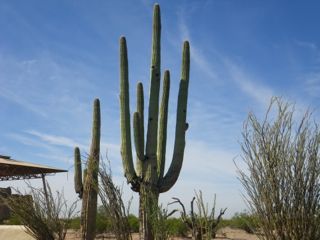
For this afternoon, I wanted an activity that would get me out of the truck (so not too far from Coolidge in the direction of Tucson), but which would still be outdoorsy. I found the Arizona-Sonora Desert Museum, which sounded like the perfect way to wile away an afternoon. To get there, my GPS routed me through Saguaro National Park, a route I would have avoided had I not had my parks pass as it costs $10 to enter this park for a week. I pulled over a few times to enjoy the view of all those hills covered in one saguaro cactus after another. It looked positively like an alien landscape!
Later, at the museum, I asked someone there all my questions about the saguaros. First of all, the g has the Spanish pronunciation, so it is more like sa-wah-ro than sa-gwa-ro. Next, the root system really interested me. The saguaros have a lot of roots, most of which are just below the surface and the radius of the roots equals the height of the cactus. So if you have a 10′ cactus, the roots extend 10′ all around it. The older the root, the more woody it is. The saguaros are firmly rooted, but sway in the wind. They get their first spear (arm) when they are about 75 to 100 years old and they live a long time!
The desert museum admission is just shy of $20 and you need at least two hours to see everything. I stayed 2.5 hours and that was just enough to view everything except hike the desert loop to the coyotes because it was just too dang out. Anyway, I see coyotes all the time back home, so I decided to see the (indoor) snake exhibit a second time instead. 🙂
This museum is really a zoo and botanical garden. You get to see all the animals of the Sonoran desert as well as the plants, insects, and geology. It is beautifully laid out.
I arrived around 1:40 and was told to hoof it down to the rear of the site to catch the raptor show at 2:00. This was an incredible experience! Several types of trained raptors, including peregrine falcons, Harris’ hawks, and barn owls fly over and near the crowd. One hawk swooped so close to me that I had to duck! The show lasted a half hour and we learned about how these birds thrive in a desert environment.
After that, I just wandered the site with my map, looking at what was interesting, from the aviary to the big cat canyon, the mineral dump where I was able to find a treasure to take home to the hummingbird garden, the bee and butterfly habitats to the cactus garden, and more. There was lots and lots to see and plenty of cool buildings to duck into when I had enough of the unrelenting sun. There was also a conveniently located café selling ice cream at a reasonable price. 🙂
The museum takes good care of its guests by not only providing a lot of sources of good drinking water for refilling bottles, but also sunscreen in every bathroom!
My camera ran out after the black bear. I got some more pics with my iPhone, but I forgot to bring the transfer cable into the bunk with me. All you’re missing is pictures of prairie dogs, several rattlesnakes, and every more saguaro-covered hills. In other words, not much. 🙂
I learned so much today about this desert that extends as far north as B.C.’s Okanagan region. The saguaro-savvy staff member and I talked about about that and she explained that prickly pear-type cacti do well in colder climates, hence why we have them in Canada. She was surprised that we have them as far east as southern SK, though.
From the museum, I took a twisty road to Tucson, stopping along the way to soak in the view. It’s been another full rich day!
-

- In Saguaro National park.

-

- View from an observation deck at the museum.

-

- Agave, from which tequila is made.

-

- falcon

-

- falcon

-

- barn owl

-

- hawk


-

- ‘teddy bear cactus’

-

- Bobcat

-

- ocelot


-

- I saw one of these coatis, but it was too fast for my camera!


-

- Yes, that’s a beaver, just like we have back home. 🙂

-

- Not sure what he was, a ground squirrel?

-

- I loved how this big sheep poked its head out a little, noticed the crowd, and then gave us a good view of it!

-

- Sunscreen dispenser in the bathroom. I had put some on this morning and was glad to refresh it!

-

- Tortoise hiding under a rock.


-

- I am touching the Allende meteorite, probably the oldest thing I will ever touch. IT IS OLDER THAN EARTH ITSELF! Wow!

-

- I found these stones in the mineral dump.

-

- I added this piece of what I think is calcite to my medicine pouch.

-

- This big cat was vocal!

-

- Black bear.