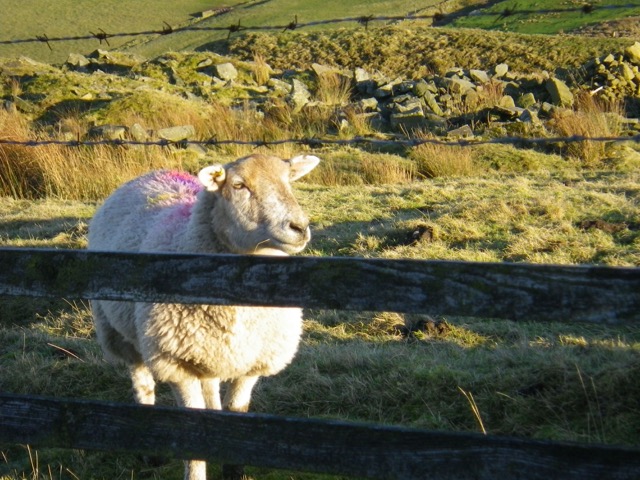
A Day in Lewes — a Castle, an Ancient House, Priory Ruins, a Great Pint, and the South Downs, Oh My!

Today, I decided to head to the nearby town of Lewes (pronounced just like Lewis) to visit its castle (and other sites) and get a chance to walk on the famous South Downs. I headed out around 9:30 this morning to catch a 10:08 train to Brighton and then the first train to Lewes. Since my Airbnb is right near the train station, I was very early, even after collecting my ticket, and on top of that my train to Brighton was delayed. So I headed down to the Barclay’s to do a withdrawal so I wouldn’t have to do that in Lewes.

Standing on the platform, I could look up the stairs to the locked gate onto the pedestrian bridge.

Not sure I would want to live somewhere called “Bad House”…

Brighton train station was quite impressive!

I didn’t have to wait for a train to Lewes so I ended up having a very quick trip. It was one stop to Brighton and then four or five to Lewes.

Looking out over Brighton from the train to Lewes.

I still can’t get over the daffodils in early March!

The Lewes train station was similar to Hove’s.

I headed uphill from the train station to find the High Street and the tourist information centre.

I liked the turquoise trim on this house.

The lady at the tourist information centre was super helpful. I asked her about walking on the South Downs if I had only an hour or two and she gave me a map, a leaflet, and excellent directions for what sounded like exactly the perfect walking option. I decided to start my day with the castle, though, and she sent me in direction of it.

This narrow street rather reminded me of a Shrewsbury shut.

From the High Street, there’s a sign saying to turn right for the castle. You do so and, boom, there’s its gate!

I bought a combination ticket for the castle and an old Tudor house for £12.50. The lady who sold me the ticket gave me directions to the house and then a route to another location that would let me do a nice circle back around to the High Street to find lunch after.

It is very, very, very late, so I’m not going to get into the very complicated history of this castle. It’s been built and rebuilt many times and has had many owners so it’s not really that old.

Stocks.

My first destination was the top of the barbican, over the entrance gate.

That “guy” scared the heck out of me when I came into the room!

I had fun trying to figure out how to use a medieval crane.

Ah… the famous chalk hills of Sussex, or the South Downs. I first learned about them when I was reading the Sherlock Holmes stories as this area is where he retired.

Shame it was so misty. I was tempted later in the day, when the sky cleared, to ask if I could come back up, but I was too tired and foot sore.

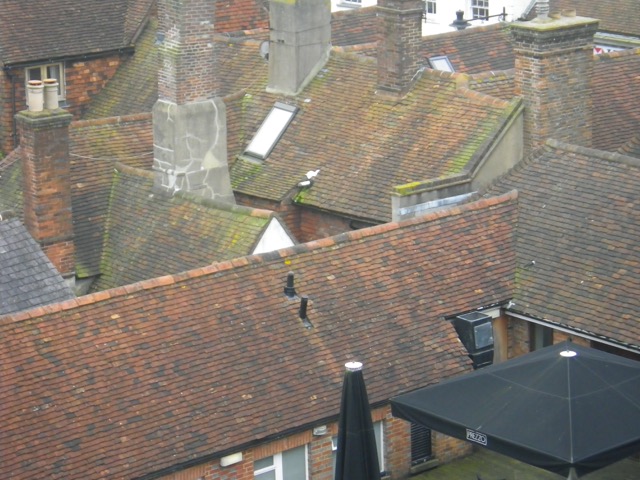
The castle is made of local flint.

Looking out over the bowling green, the lumpiest in England! Thomas Paine (Rights of Man) played there in the 18th century when he lived in Lewes!

Remains of an old cooking fireplace, when this part of the castle would have been indoors.

I headed inside to climb to the very top of the castle.

Looking out to Lewes prison.

It was surreal to be here! This isn’t even the most famous view of the chalk hills and I didn’t feel any need to go seek it out.

After the castle, I did the little attached museum. This tapestry was impressive.

Mirror

Swords

Flint tools

This is apparently what a medieval felt hat would have looked like.

The floors in the upstairs of the museum was embarrassingly creaky!

After the museum, I continued down the High Street.

Little did I know I would be back to the Brewers Arms.

The 15th century bookstore, where I had to turn off the High Street.

I passed what looked like a pretty garden and was thrilled that it was open to the public.

My tour of this lovely garden done, I continued on, passing yet another lovely church.

My next destination of Anne of Cleves House. She was one of Henry VIII’s wives. She won this house in their divorce settlement, but never actually lived here although she might have visited. I have so much information about this house that I may come back and do a page about it when I’m not so knackered. There’s no way I can do it justice tonight. It’s a fine example of a Tudor manor, but it was much improved upon over the years and does not resemble its original form.

The entrance is the former great hall.

From there you can go right (left looking at this picture) into the east bedroom.

It was a really vast and voluminous space. Two ladies and a little girl were there and we had a chat about the history of building and how mind boggling it is that it took so long for Western society to start using insulation. We also had fun playing with those costumes!

This could serve as a chair, table, or chest!

The floor of the parlour was incredibly uneven and not level!

I find that expression hilarious.

Remember his thoughts on Shrewsbury?

This represents an avalanche in Lewes in the 19th century.

Hops!

The tour of the house ends with the garden.

I found the Anne of Cleves House was very interesting to walk through. It smelled exactly as it should, so musty and old, and the exhibits were interesting. But I paid £1.50 extra for a leaflet that had pretty much the same information as on the walls and it was not laid out in a logical manner. I found that the museum could have done a better job with it and to help guests through the rather confusing layout.
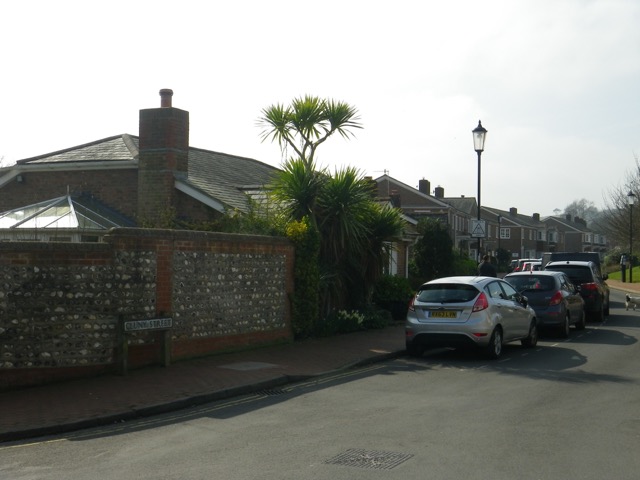
more palm trees!

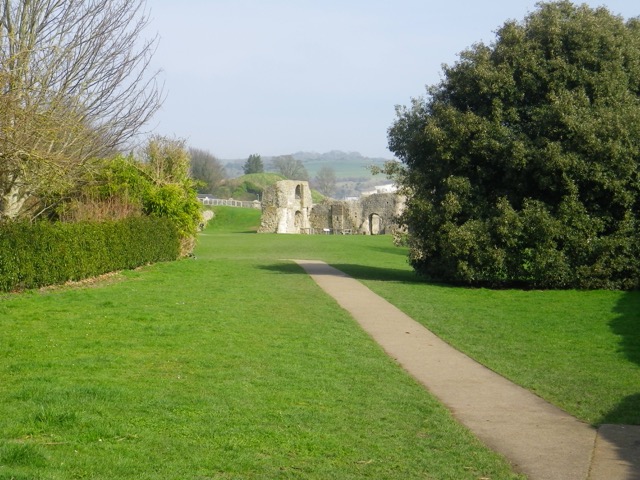
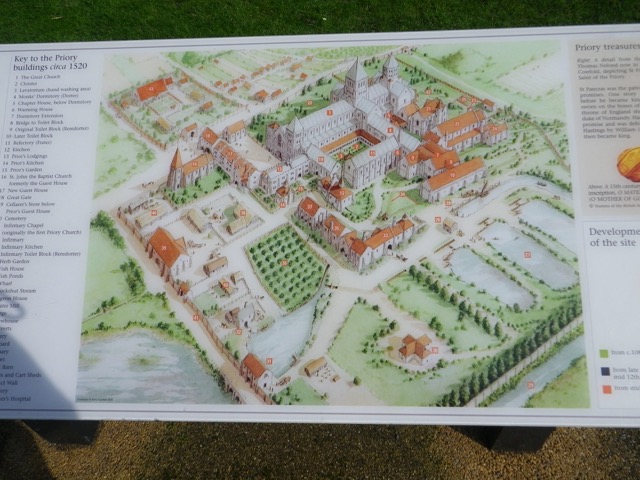
My last stop before a badly needed lunch was Priory Park, which is free to walk through.

From the priory, I had to go past the rail station to get back to the High Street. I passed one of the many “rail replacement” buses since there is a lot of work being done on the railways.

Exterior of Lewes train station.

I had lunch at the Brewers Arms pictured above. I went with the lunch special of sausages and mash with a pint of Harvey’s Best Bitter, a beer brewed right in Lewis. All was yummy. 🙂 I took my time with lunch since I was very tired by this point and wanted a rest before heading onto the South Downs.

After lunch,  I went down the High Street in the other direction towards the South Downs.

The High Street ends with a pedestrianised bit.

I was happy to find (very expensive) ice cream, to which I added a Flake!

Unfortunately, you have to book brewery tours eons in advance.

At the end of the High Street, I started up the very steel Chapel Road.

Not even all the way up, I already had amazing views of Lewes and the valley.

The walk on the South Downs takes you right by cows. That black one on the right had a shifty gaze.

I couldn’t believe how much this part of the South Downs looked like the rolling hills around Haven. And just like at home, the internet up with the cows was much better than down in the valley where the people live. *wry grin*

And the point of this gate is?

I descended into a valley full of sheep.

My walk leaflet mentioned this pond. Little did I know I would spend so much time here that it would be my final destination on the Downs!

It was full of frogs! I spent so much time watching them. I believe it’s mating season.

So cute!

I couldn’t believe the number of them there were, all around the pond.

One on the grass posed for me.

I was supposed to catch a 5PM train back to Hove and it was past 3:30 by this point, so it was time to go back.

But I couldn’t resist capturing one last cutie for posterity.

I headed straight back to the railway station, avoiding the High Street except for the pedestrianised bit.

I passed yet another church.

This was a rather lovely building. I like the rounded corner.

A clearish view of the chalk hills.

Somewhere along the day, I picked up a copy of The Big Issue. It is a very good publication that is sold by homeless people in the UK. They buy the magazines for £1.25 and then resell them for £2.50. So every copy they have is money the invested in their business. Please support a Big Issue seller if you come across one as the program provides gainful employment that contributes to some people getting off the streets .

The train station was a mess. Many trains were cancelled, included my 4:59 home. I was early, so I took the 4:41 into Brighton.

I then just barely made the train to Hove. Exhausted, I looked forward to popping into the Tesco by the station and then only have a short walk home. Well…

No one in my carriage got off at Hove with me and I was unable to get the door to open to let me off! I asked for help and people just laughed and said it was too late as we took off again! Thankfully, the next station wasn’t too far, but I was in a real pickle since UK public transportation in general does not look kindly on folks riding outside of their allotted tickets. I could get on a train back to Hove, but if an inspector requested to see my ticket, I could be in a lot of hot water. They really don’t care about sob stories and I’m pretty sure they make most of their money from fines.

I checked where I was and I was just a block from my road and then two kilometres away. The next train back was in an hour (!) so it made sense to just hoof it. Slightly problem, you have to scan your ticket to get out and I did not have a valid ticket for that station so I couldn’t get out. There was literally no legal way out of this jam since I couldn’t even buy new tickets since the machine was on the wrong side of the gate!

It was getting cold by this point and I was exhausted. Soon as I saw someone come through the wide handicapped gate, I squeezed through by her before they could close. Talk about a ridiculous predicament!

I was so foot sore by this point that I didn’t want to detour to get dinner. I figured I could have a bowl of cereal or maybe a slice of toast. Well, my host invited me to sit in the lounge by a proper fire with a friend of her’s and wine and eventually dinner materialised! Wow! I was inordinately grateful and that really helped make the train stupidity a footnote in my day instead of a spoiler of it.

I’m going to hit post on this as I’m starting to see double. Please pardon the typos. 😉

Walking the Coastline Between Hove and Brighton

I pretty much passed out last night, despite thinking there was no way I’d sleep as the room was bright and loud (I’m on a busy street) and the bed wasn’t great. But next thing I knew, it was bright daylight and I was wondering what the heck time it was. Well, only 6:45. I may have dozed off again. 😀 I eventually went down for breakfast around 9:30 or so and did some online stuff at the kitchen table, then went upstairs to work for a bit.

By one, I was hungry and I also knew I didn’t want to waste inside the gift of a sunny afternoon at +14C! My host was home by the time I was ready to head out, so she let me know about a lunch deal at the best fish and chips shop in town. That sounded good and it was on the way to the water, so I decided to head there and check out the deal.

So I’m in Hove, which used to be a separate city from Brighton, but the two were joined as one city, Brighton-Hove, in 2001. Hove is considered Brighton’s more genteel cousin. While here, I will use both Hove and Brighton. If I’m talking about Hove, I’m referring to this part of the city specifically. But if I use Brighton, it can mean Brighton proper or the city overall, simply because Brighton is better known.

This is my street and you can sort of see the house I’m staying in. It’s another terraced Victorian house, but not as tall, and the staircase is not as steep as the ones in Hebden and Shrewsbury.

What a lovely surprise!

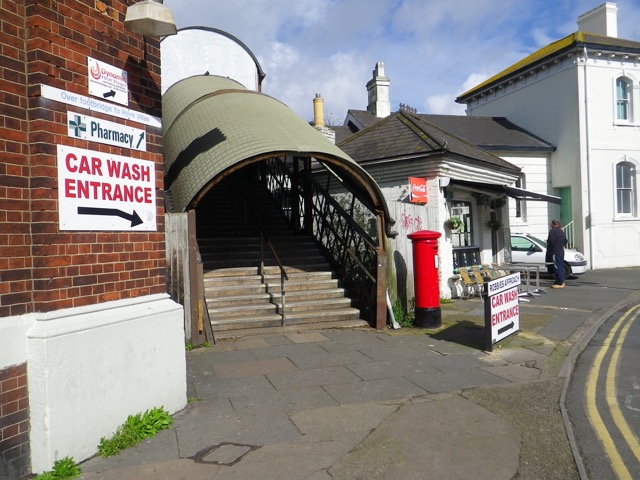
I have to cross this abomination to get to downtown Hove, the pedestrian railway bridge. Trundling through there last night, I was immediately reminded of the ferry building in New Orleans. Just as decaying and smelly. Augh.

Isn’t it nasty? There is talk of it being refurbished or replaced. That would serve the community well as that bridge is a blight.

Here’s the Hove train station. Both Brighton and Hove have direct connections to London in a commute of about one hour, which isn’t too bad.

First Esso I’ve seen in Europe.

Wolfies of Hove had a lunch special of a piece of cod with chips for £3.50. This was a much better deal than I got in Hebden, where I paid over £4 for a portion with half chips that I could finish and I couldn’t finish this portion. It was very good, but the bottom of my fish got mushy and the chips at the bottom stuck to the wrapper. So a good deal and tasty, but not as nice as what I got in Hebden.

I got my lunch as takeaway and ate at a bench by a bus stop to watch the foot traffic.

I continued making my way to the water along this pedestrian street.

I then crossed this busy street to walk the final block or so to the water.

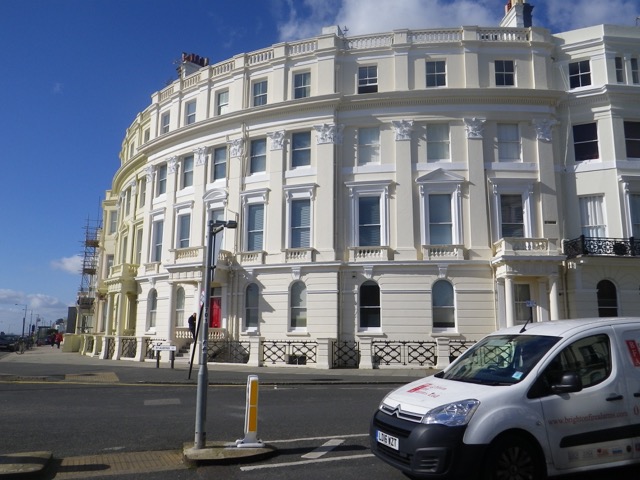
There are some really impressive buildings along the Hove-Brighton Coastline!

Hello, old friend. 🙂

Here are the northern and southernmost places I’ve seen the ocean in the UK. Next time I come, I need to do Cornwall, Wales, and Northern Ireland!

Well, there’s my word of the day. A groyne (pronounced groin) is a wooden or stone structure built to prevent erosion.

Aaaaaah. The famous Hove beach huts! The structures are privately owned and there is a license fee of over £300 a year for the spot. It is very difficult to find one since all the spots are taken so you have to find one available for private sale. One was recently on the market for £14,000. They can only be owned by residents of Brighton-Hove and you have to keep it for at least three years before reselling. Many have been owned by families for generations.

There are very strict rules on the colour of the roof and bottom (notice the light green and red), but the doors can be any solid colour or stripes of several colours.

Each has an address.

Nice French pun (À l’eau — to the water — sounds like allo — hello — and c’est l’heure is “it’s time. So “to the water, it’s time or”or “hello, it’s time.”)

I had a hard time finding images of what the insides look like, but it seems that folks use them mostly as storage sheds with perhaps a table to eat at out of the sun. Many have a gas cooker for making tea and doing basic cooking, I assume. They are meant for day use only.

More magnificent buildings.

More colourful huts.

The British Airways 360, a vertical tram. You ride all the way up in what looks like a giant doughnut.

So that meant I was in Brighton, about 3.5KM from home. I hadn’t meant to walk so far today and I had to get back to work! So I decide to meander my way back home. I passed a street with a Korean, Japanese, and Chinese restaurant right next to each other. Convenient!

I popped into a Sainsbury’s Local to get a salad and some pasta sauce to go with pasta I brought from Shrewsbury, plus a small bottle of wine, so I wouldn’t have to go out again as I’m knackered.

Without going out of my way, I was able to take a different road over the railway so I didn’t have to take the nasty bridge.

Brighton has a reputation for being very grotty and having a lot of homeless people while at the same time being very hip and trendy. That was definitely the impression I got today and I could see a very clear distinction between Hove and Brighton. I hope the weather holds for my future explorations!

A Self-Guided Tour of the Pocket Parks of Shrewsbury

I don’t know if it’s because my time here has come to an end, but getting up this morning was just about impossible. I am absolutely exhausted and looking forward to a very long lie-in my first morning in Brighton. It’s a good thing my last day in Shrewsbury was sunny, otherwise I would have been tempted to not do my final walking tour and instead just spend the afternoon on the couch cuddling Puppy while watching movies!

But it was a beautiful day, so I set off late morning to do the Pocket Parks of Shrewsbury walking tour. We’ve been to most of these stops before and this is the first tour where I wish I’d followed my instincts and done it in my own order since I ended up walking all over town, sometimes for almost nothing, and having to backtrack to get home. The exercise was good, of course, but things were getting rather repetitive. Still, there were a few stops on this tour that were unique and I caught new things even at places where I’ve been.

Here’s a map of the tour (click to embiggen).

“There are several small green havens of peace in Shrewsbury town centre, quiet places to sit, rest, or have a sandwich. … Most are tended by the Town Council gardeners who call them pocket parks.”

So the tour starts at St Alkmund’s Churchyard, where we’ve been countless times. I made it a point to walk around and catch different perspectives.

“St Alkmund’s Church stands on the flattened top of one of the two hills within the river loop, looking as if perched on a pedestal. A Saxon church was once on the site, but the current building dates from the 1790s, except for the tower, which is late 15th century. From Saxon times until 1261, the King’s Market was held here in the space around and between this church and its neighbour, St. Julian’s.”

Note “the unusual 18th century cast iron windows…”

I loved the pretty turquoise front door.

The pub is called The Three Fishes.

Notice a discrepancy between the church and street signs?

Both spellings appear to be used interchangeably.

From St Alkmund’s, I moved to St Julian’s Detached Churchyard, which I was curious about and would be a favourite spot for me to sneak to on a lunch break if I worked in the area.

“This was founded in the early 1800s when John Oakley, a local grocer, sold part of his garden to St Julian’s Church as an extra burial ground. There was a great shortage of burial space in town centre graveyards at this time. He and his wife were buried here; the last burial, in 1881, was of his daughter at age 81. A century later, the Town Council took over the care of this graveyard and it has become a quiet secluded pocket park minutes from the bustle of Wyle Cop. The tombstones seem to form a paved area…”

I occasionally see signs like these in England, making it easier to navigate towns with no street pattern.

Next stop was Old St Chad’s Churchyard, where I spent so much time on the tour of the Shuts that I did not go back in as I did not learn anything new.

The leaflet did make me notice this building across from the chapel. This house “illustrates a fashion that was common in the town in the 18th century. At this time, houses were sometimes modernised by brick skins and plaster to cover the ‘old-fashioned’ Tudor timberwork.”

It was then quite a long stroll to my next destination, about a block from the abbey. On the way there, I discovered that the route to my next destination was blocked.

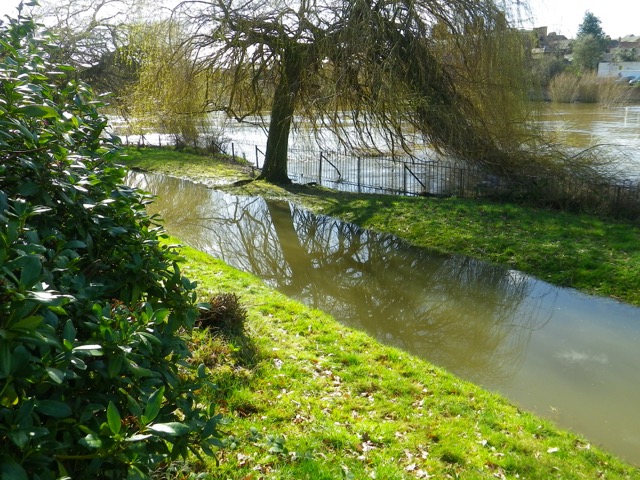
The reason why became apparent very quickly. I didn’t realise it had rained so much in the last few days!

The tow path is fully immersed.

I crossed English Bridge and immediately turned left into the Abbey Gardens.

“These once belonged to the builder John Carline. He and his business partner John Tilley were responsible for building the Welsh Bridge. Carline and his family had a house at the side of the plot away from the river. In his riverside yard, he kept materials, pieces of fallen masonry, and his models of the lions for the base of Lord Hill’s Column; they are still here. At one time, this park was also known as Mr Palin’s Pleasure Gardens; residents came here to walk and admire abandoned pieces of sculpture, which were on display. Many of them are still here. The park is now known for its rhododendrons and azaleas in the spring. From this park, there are excellent views of the 18th century English Bridge, the river itself with its old towing path, and above it a silhouette of the town centre, including the old Royal Salop Infirmary, founded in the 18th century and now converted into flats and shops.”

I love that detailing on the stone columns. Can you see how twisted they are?

I couldn’t get over how lush and bright green everything was!

Daffodils!

A crocus, in early March!

A large part of the garden was under water!

I had to make my own way to my next stop, easily done as I now know my way around the downtown core. I followed the route along the water on the medieval tour, so I didn’t miss anything.

I thought this building had a rather lovely curve.

I was feeling peckish and decided to get a snack to tide me over to lunch. Café on the Cop looked inviting and had a cream tea for just £4 (for which you could have tea or a pot of coffee!). That was exactly what I wanted. I came in and took a seat and was immediately taken in by the unusual slate place mats.

The very sweet proprietor came over right away for my order. I decided on tea rather than coffee as the latter just didn’t feel right with this snack.  I was not offered a choice for the type of tea and whatever it was that came was very lovely. But now, check out my scone!

It was huge! It was equivalent to two scones anywhere else I’ve had a cream team. Needless to say, this became an early lunch! The preserves weren’t the best I’ve had (a jelly rather than a jam), but the scone was the best ever and the clotted cream hit the spot. I did not have the butter. This was definitely my favourite cream tea of the four I’ve enjoyed since discovering this treat at the British Museum.

My next stop was the castle! En route, I got very close to the yellow house we saw on the Tudor tour.

I got a good view of the library across the way.

What an impressive flower arrangement! Can you see the Union Jack?

The castle is now the Regimental Museum, for which you have to pay. But it’s free to walk around the grounds.

“This pocket park is part of the Norman castle built in the narrow neck of the meander by Roger of Montgomery, a relative of William the Conqueror.”  The castle was once connected to the town walls by a sandstone wall.

“Edward I added to the castle, building the great hall in the 1280s, when it was a link in the chain of castles guarding the Welsh border. … In the 18th century, the castle was remodelled by Thomas Telford for Sir William Pulteney, the wealthy owner. He also built, on the old motte, a summerhouse-folly named after Laura, Sir William’s daughter.”

That was my next stop, Laura’s Tower. Up I went!

I love how that stone has been worn from so many centuries of folks treading on it.

Laura’s Tower.

Unfortunately, you can’t go in, but you do get an incredible view of Shrewsbury.

The abbey.

I headed back down to walk the grounds a little.

More daffodils!

The next stop was the library garden and I wasn’t going to bother since there was no new information, but then I saw an interesting tidbit. So off I went to look at the turnable, “which was installed in 1983 to rotate library vans.”

I did pop into the garden to admire the flowers that were blooming. The garden was “planted to give all-year-round foliage colour with minimum maintenance.”

It was another long way to my next park, which we’d been to on my first day out and about in town. Spoiler: both were closed. 🙁 I would have been better off coming straight to the last one from the Abbey Gardens and finishing at the castle. But anyway… I love this shot of Castle Street. It just looks so… old!

Shrewsbury bus station.

St Chad Church in the background.

Welsh Bridge.

I came to find a locked gate the Quantum/Mardol Quay Garden. But I could at least see things from the street.

“This pocket park is located on the site of the Mardol Quay, built in 1607. Some of the original cobbles can be seen and here river boats loaded and unloaded — old accounts show that ‘for every barge load of wood or coal 12d; for a ton of other goods — from a burgess 2d and from a foreigner 4d.” Later, the warehouses were converted into a car repair shop, which eventually was cleared for road widening in 1958/60. A public garden was established on the riverside, which was redesigned in 2009 for the bicentenary of the birth, in Shrewsbury, of Charles Darwin and the 150th anniversary of the publication of the The Origin of Species.”

Remember this odd thing?

“A sculpture, designed by Pearce and Lal and called Quantum Leap, has been likened to a shell, human vertebrae, DNA, and many other things and is locally known as The Slinky because of its similarity to the coiled-wire toy. The garden celebrates Shropshire’s geological history….”

I passed the Rowley House yet again on my way to my last stop, capturing it from a new angle.

Narrow driveway entrance.

Getting closer!

St Chad’s Church “with its adjoining graveyard was built in 1792 to replace the one that fell down. From the churchyard, you can see the unusual circular shape of the church, the largest of its kind in England. In the middle of the 19th century, as a result of the crowded and very unsanitary conditions in town centre graveyards, a Burial Act was passed closing urban burial grounds. As a result, in 1856, the General Cemetery was opened on the outskirts of the town with cooperation from all six parishes. The churchyard is now maintained, as a semi-natural woodland. In the centre, look for Scrooge’s gravestone, placed here for the filming of Dickens’ Christmas Carol in 1984.”

Well, the churchyard was closed. 🙁 A very kind worker came over and said to me, “Sorry, lovie, they’re doing works inside.” Lovie? I love British endearments!

So this is all I saw of the churchyard.

The church itself is large and impressive.

Its vicar is well-named.

Main entrance.

Across the street, balustrade paid for by the Horticultural Society.

Across the street is the unassuming final stop, The Dingle.

I really love this church!

Another vantage point of the hospital.

I headed home after, going all the way back up Pride Hill and down Castle Gates, which I’d done twice before already today. In desperate need of a haircut, I popped into a salon with a sign that said walk-ins welcome. I found that £15 was very expensive for the little work they had to do (I just shear the hair very short), but needs must and I felt much lighter when I got out.

I took the route by the train station to go home from there and it was after I did the turn at Morrison’s Lubricants that I noticed this door for the first time. Very curious.

Well, thus ends my lovely stay in Shrewsbury! I adored this town! Hebden Bridge was cute, not somewhere I would have wanted to be for long. I could certainly see myself in Shrewsbury.

The puppy sitting was restrictive, but it was a blessing in a way in that it forced me to stick close and really get to know the centre of town. There is so much of Shrewsbury that I did not see as I did not venture much on the other side of the river, but I definitely covered the touristy part of town and then some!

I’d consider the puppy minding part of the exercise a success. I know I did a very good job of it and I’m very proud that. It was very challenging, exhausting, and sometimes tedious, but it was also immeasurably rewarding and I can’t remember the last time I laughed so much with such joy on a daily basis.

So I’m heading out tomorrow at about 1PM and as long as I make my super tight connections (not counting on it), I’ll be in Brighton by 6PM. If I do make my connections, I’ll be pulling out of London Bridge in exactly 24 hours and 10 minutes for the final leg of my journey across this country.

My route ahead isn’t nearly this directly, but is well represented here.

Shrewsbury Abbey

I managed to get away for a few hours this afternoon during Puppy’s nap. I decided to head out to Shrewsbury Abbey. First, I thought to grab something quick for lunch, but was lured by the signs for La Lanterna Italian restaurant that took me through twisty medieval streets to the back of St. Mary’s Church.

The restaurant was in the basement of this building, the old church vestry.

The interior was tiny and very cosy, with the theme decidedly Italy.

What had caught my eye was the set menu for £8.50. It came with a glass of wine, bread, a really lovely salad…

…a slice of very garlicky bruschetta, and a generous portion of creamy pasta with greens, tomatoes, olives, and bacon. Wow!

This gourmet meal was a bargain even by Balkan standards! I was really impressed. Service was stellar, too. It wasn’t till I got home that I checked out reviews for the restaurant and they all praise it highly. I really discovered a hidden gem.

Here’s the lobby of the basement entrance with the entrance to the restaurant. Love the stained glass.


I made my way down some stairs to the High Street and turned left to cross the river and get to the abbey.

First glimpse of Shrewsbury Abbey!

Wow!

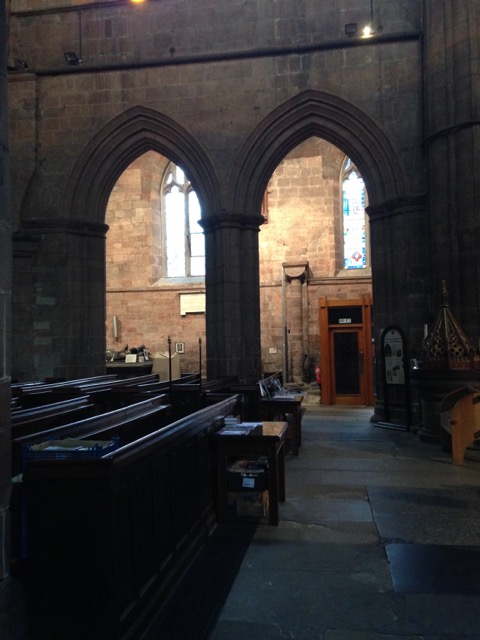
I couldn’t believe that I was there. Of course, I knew that almost nothing remains of the original medieval abbey.  From Wikipedia: “The Abbey was founded in 1083 as a Benedictine monastery by the Norman Earl of ShrewsburyRoger de Montgomery. It grew to be one of the most important and influential abbeys in England and an important centre of pilgrimage. Although much of the Abbey was destroyed in the 16th century, the nave survived as a parish church and today serves as the mother church for the Parish of Holy Cross.”

I walked around the exterior a bit to take in the Victorian parts.

Admission to the abbey is free, but they suggest a donation of “at least £2.” They had guides in many languages and I picked a French one. The translation was decent.

This is the only original stained glass. You can tell that stained glass is really old if it’s wavy and kind of buckling.

This is a very recent stained glass made by a woman named Jane Grey. It is of Saint Winefride, a Welsh woman tied to a number of legends.

I spent about 15 minutes in the abbey reading about its unusual history of partial demolition and reconstruction. It was a grand,  draughty old space. Its guardians are very friendly and welcoming; available for questions, but not intrusive. I’m really glad I had a chance to visit!

It was then time to head back across The English Bridge and head home as Puppy surely needed to be let out.

I passed the front of St. Mary’s Church since I wanted to pop into the Tesco Express near Barclay’s to get coffee.

It was raining steadily when I came out Tesco and, of course, I had forgotten my umbrella. But it wasn’t a hard drizzle so the walk home wasn’t too unpleasant.

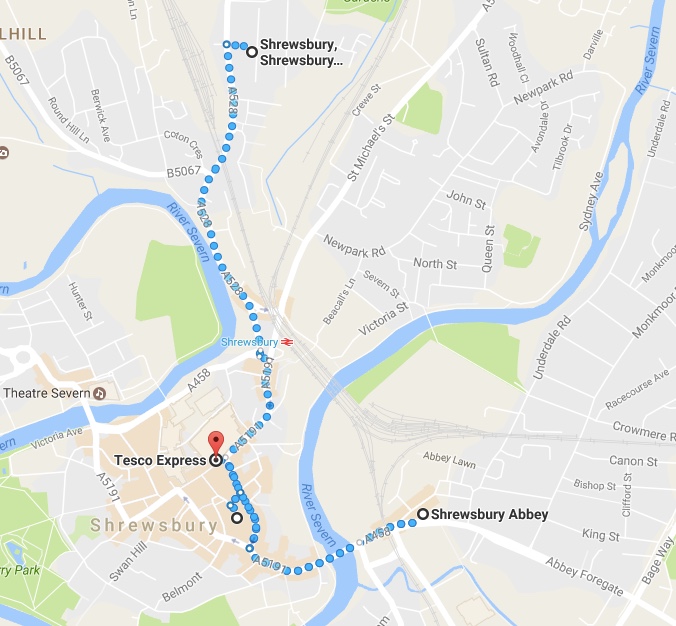
Here’s a rough map of my day, although not of my route.

Riding the Brontë Bus to Haworth in Search of Wuthering Heights

My host is the one who clued me into the fact that I’m right near “Brontë country.” Now, I don’t pretend to be a huge fan of the Brontës as I’ve never been able to get through any of their works, but I’ve always thought that Wuthering Heights had to be one of the most evocative English book titles ever and have a vague general familiarity with the works of Charlotte and Emily. I don’t know much about Anne, however.

It felt wrong to leave the area without going to Haworth, where the Brontë sisters lived from childhood to their deaths, if it was as close by as I’d been told. But with public transportation being so frustrating to sort out in the UK, I kept on putting it off. Well, the other day, as I was walking home from the village, I saw a bus pass in front of my house marked “Brontë bus.” Intrigued, I made a note of the number and the company and headed off to Google.

As it turned out, that bus going in the other direction would take me straight to Haworth in just under a half hour! The stop is literally in front of my house. Talk about convenient!

I thought I’d have the day off, but a small job came in late last night that I could only have if I got the files to my clients by about 8AM their time, which was my late afternoon. So I got up way too early based on the time I went to bed and got it out fast enough to be on “schedule” to grab the 11:15 bus.

Soon we were climbing high up above the valley to give me my first taste of Yorkshire moors. They rather look like a damper version of home…

The road was super narrow and twisty, especially as we meandered through the town of Oxenhope and took super tight turns. The idea of driving in the UK in general, especially something as big as a bus, boggles and frankly intimidates me.  I had a spark of genius last week that was too late to implement here, but that I will investigate it in my next stop, Shrewsbury — I’m going to learn to drive on the left properly, with a driving instructor in a car clearly marked learner. I hope the rates are comparable to here, where I could have have five one-hour lessons for just £55.

At any rate, here’s a rather lovely bus stop in Oxenhope:

I’d bought a day return ticket to Haworth and back (£4.20) and this is where the driver dropped me and told me to get back on to go home.

I understood why when I realised I was at the bottom of the steep Main Street that leads up to the parsonage that was the Brontë home.

I bet Main Street hasn’t really changed that much.

I’m always so happy to see a burst of colour in a rather drab world.

My friend Croft must be a very important man in this country. Every town seems to have a street named after him. 😉

This is the infamous Black Bull pub, right in front of the church, where Branwell Brontë, the only brother, likely drank himself to death.

Here’s the church.

Back of the church, by the cemetery that is between the church and the parsonage.

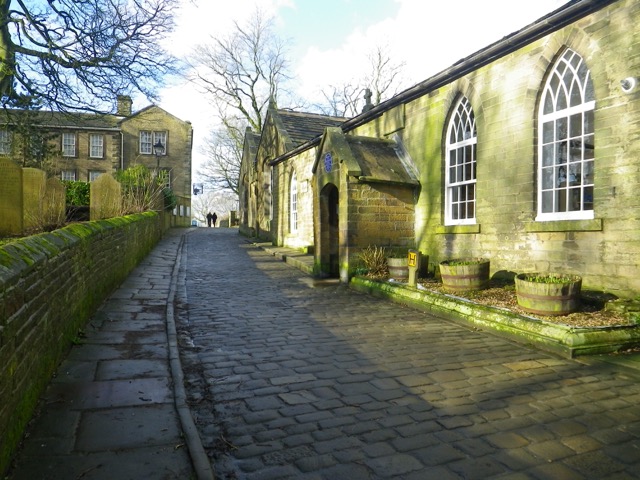
Looking towards the parsonage on the left. To the right is a school built by Patrick Brontë (the father) for the children of Haworth.   Charlotte, Branwell, Emily, and Anne all taught here and Charlotte’s wedding reception was held here in 1854.

Standing by the parsonage looking back to the church.

I decided to have lunch before touring the museum and heading out to “Wuthering Heights,” the place that inspired the locale of the novel. Almost everything in the village was closed today, but I had looked at the menus of places that were open and the Fleece Inn had the most appealing menu as well as reasonable prices. This was going to be a treat meal, out of the “special excursions” rather than “food” budget, so I focused on getting an experience rather than the cheapest meal.

A sign on the wall offering the chance to sample three local craft beers for the price of a pint caught my attention. I selected these beauties, a lager, stout, and bitter. I find it amusing that folks that don’t really know beer would expect the stout and bitter to be super strong tasting, but they were actually smoother than the lager. All three were delicious, but I think I’m really a bitters person!

I ordered the bacon, brie, and cranberry sandwich on ciabatta, which came with a salad. The soup of the day was leek, so I had to try that! The server goofed and brought me a full portion instead of the half that comes with a sandwich, but I knew I’d be working it off. Everything was so yummy! I love that thick-cut British bacon. The meal was only £14 or 23CAD! The soup was a pricy add-on since I had to pay for the full portion at £4 rather than the add-on price of £2, but it wasn’t worth quibbling over. And, of course, you don’t need to tip. I was really surprised by this bill since the beers were only £3.30. Cheapest pint I’ve had yet!

It was almost one when I was done with lunch and I wanted to at least attempt the hike to “Wuthering Heights,” which is about 10KM round trip. With nightfall being around five and the hike expected to take about three hours given the terrain, I had a half hour to get through the museum. I knew that would be plenty and also that the museum is really pricey at £8.50. That’s actually great for locals as you can use the ticket for readmission over the next year, but it sucks for someone who is just travelling through!

Standing in the garden at the front of the parsonage.

The front door of the parsonage is the entrance of the museum. That extension on the right was added after the Brontës.

Throughout the museum, you can see the costumes that were used in the Sally Wainwright production of “To Walk Invisible” about the Brontë siblings. Considering how much a fan I am of her series “Happy Valley” and that one of the stars (Charlie Murphy) and my favourite character of that series is in “To Walk Invisible,” I’m going to hunt down a copy!

So this is “the dining table at which Jane Eyre and Wuthering Heights were written, making it one of the “most significant literary artefacts of the 19th century.” Wow! You can’t see the marks of daily use, like ink stains, from that distance, unfortunately.

Next up is Mr. Brontë’s study, where he carried out parish business and gave his children lessons. Emily and Anne were the main players of the cabinet piano.

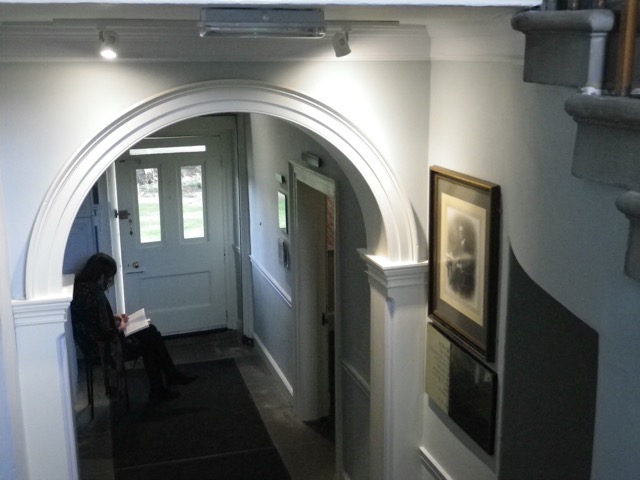
The front hall finally cleared enough for me to photograph its “pretty dove-coloured tint, as per a description of the parsonage by a family friend of the Brontës.

Now on to the kitchen, which was demolished during the renovations to add the extension. It has been restored with period appropriate furnishings, including the range.

After the Brontë sisters’ mother died, their Aunt Branwell took over as the female head of household. After she died, Emily acted as housekeeper and Charlotte and Anne went away to work as governesses. “Baking bread or ironing allowed Emily the mental freedom to focus on her writing and she was always happiest at home.” I can really identify with that. Even when I’m travelling, I need to be able to be “domestic” to feel complete.

The next room I visited on the ground floor was the study of Charlotte’s husband, Arthur Bell Nicholls, who had come in 1844 to help Patrick curate the church. The room was originally a storeroom that was only accessible from outside. Charlotte decorated the room in grey and green, a fashionable colour combination in the 1850s.

The marriage was short, but happy. Charlotte died within a year of marriage when she was pregnant. Now’s a good time to point out that I was disappointed that the museum glossed over the sad facts of their lives and especially that their home, with its non-potable water supply, played a role in the sisters dying so young. I also found that the museum only catered to people who know the Brontë history really well as there is very little context given as to who is who. Several people told me there was an event going on for “Branwell” with the assumption being that I would know who that was, but I had to piece it together for myself.

I then headed upstairs to the bedrooms.

I love the story behind this clock, that Mr. Brontë would lock his front door at 9PM every night and call to his daughters in the dining room not to stay up too late. Then, he would come wind up the clock.

A portrait of Anne, Emily, and Charlotte. They had two older sisters, Maria and Elizabeth, who died when they were 11 and 10 respectively when they died of complications of typhus they contracted while at school.

Looking down to the front hall.

Looking up, we can see the entrance to “Charlotte’s room” (at an angle), flanked by the children’s study on the left and the servant’s room on the right.

The Brontës normally had one servant, who had quite a cosy room.

I used quotation marks above for Charlotte’s room because it was originally that of the parents. When Mrs. Brontë died in 1821, her sister Elizabeth Branwell took over. Charlotte didn’t get this room until she married Arthur Bell Nicholls… and it was here that she died. The room is filled with Charlotte’s effects.

I thought it was odd that this costume was in a box when the others weren’t but now I realise that that’s just because there’s no way to keep it away from curious fingers the way there was downstairs with only a small sliver of the rooms being available to walk through.

I loved her collection of shoes! Some are very dainty and barely worn, showing that they were for special occasions.

She bought these moccasins on a trip to the beach.

Her writing desk, spectacles, and quill cutter, which is what made her impossibly teeny handwriting possible.

Next, I went to Mr. Brontë’s bedroom. He moved here after his wife died. It was furnished from replicas thanks to a drawing by Branwell, who was often kept in this room under his father’s supervision because of his alcoholism. He died here in 1848 at age 31.

With the crowd thinning out, I was able to peek into the children’s study, where Emily may have slept. It is so small because room was taken from it to enlarge Charlotte’s room.

The little red arrows point to faint pencil marks on the walls that were likely made by the sisters.

Branwell’s studio was very messy! I was impressed that it was portrayed so realistically.

From his study, we move into the extension, which has a lot more background information. If you’re really into the Brontës and want to get more information about the parsonage, you can virtually visit the rooms on the Brontë Parsonage Museum website.

I learned about the Clergy Daughters’ School in Cowan Bridge, where Maria, Elizabeth, Charlotte, and Emily went. The school regime was harsh and the two elder girls were sent home in ill health in 1825 and died soon thereafter. “Charlotte’s sense of loss stayed with her for the rest of her life, and she later immortalized Cowan Bridge as the infamous Lowood School in her novel Jane Eyre.”

Charlotte’s writing really was teeny!

That’s a fragment from her “Roe Head journal.” There were a lot of interesting artefacts in that case, including an accounts book for the family where she worked as a governess that showed her final payout before leaving the job.

Here is a trunk that Charlotte bought in Brussels, where she was trying to improve her language skills.

Patrick Branwell outlived all his children and lived to the surprising age of 84, in 1861, five years after Charlotte died. As I wrote above, Branwell died in 1848, aged 31. Emily and Anne became ill soon thereafter. Emily died three months after her brother from tuberculosis, aged 30. Anne tried a sea cure and went to Scarborough with Charlotte and a family friend, only to die there on 28th May, 1849, age 29. “To spare her father the anguish of another family funeral, Charlotte had her sister buried in Scarborough, then she returned to Haworth alone.” In 1854, Charlotte accepted Nicholls’ proposal and they married, but she died on 31st March 1855 in the early stages of pregnancy. Nicholls took care of his father-in-law for six years at the parsonage.

Here is Branwell’s drawing of death visiting him in his father’s room. He called it “A Parody.”

It was then time to head off to “Wuthering Heights.” It was 1:30, sunset was at five, and I was told to allow 3.5 hours, which meant three hours for me. That only gave me 30 minutes of wiggle room. So I was hyper aware of distances and times as I walked and hiked as I did not want to be out on the moor in the dark!

The walk starts behind the parsonage. I got so lucky with the weather!

A look back at the parsonage and the gift shop.

I immediately felt at ease with the landscape. It was really not that different from my experience hiking in the Highlands, which I remember in vivid detail thanks to my journal. Most of this is private land and there are rights of way for walkers. Follow the path and close any gate you open.

Sheep here instead of “hairy coos.”

Remember that structure out on the lake. It’ll be worth an exclamation point later.

Status report on my boots about a mile in.

The sky looked ominous, but I didn’t get so much as a spatter of rain. The path was very mucky, though.

This man overtook me just before the waterfall. I was jealous of his trekking poles, seriously overdressed, but surefooted.

Charlotte wrote this about the waterfall on 29th November, 1854

“We set off, not intending to go far; but though wild and cloudy it was fine in the morning; when we got about half-a-mile on the moors, Arthur suggested the idea of the waterfall; after the melted snow, he said it would be fine. I had often wished to see it in its winter power, so we walked on. It was fine indeed; a perfect torrent racing over the rocks, white and beautiful!”

There obviously hasn’t been much rain this winter!

I then headed over this bridge, knowing that I would soon need to check the time.

I’d just come down so of course I had to go up.

Looking back down to the bridge.

Left towards “Wuthering Heights,” right back to the parsonage. The sky worried me. I was adding two miles to my trek if I went left. According to my clock, I had time. It takes me about 20 minutes to walk a mile in rough terrain, so if I wasn’t at the end of the trail in that time, I would turn back.

This lovely stone path did not last.

On the other side of this wall was was… muck.

This is a “stile.” I was bemused by the “please close the gate” sign seeing as there is no obvious “closed” position.

Oh, this was going to be fun.

I soon was hiking in what was more like a very shallow river.

I stepped into one puddle and ended up in water up past my ankles. Incredibly enough, while my jeans got soaked through, my boots didn’t. They earned their keep!

There’s the end of the trail at the distance. Can you see the building on top of the hill?

Now?

It had taken 20 minutes to get to this point, so it was time to turn around. I’m glad that I know my limits and speeds so well when hiking that I can make smart decisions. I wasn’t that disappointed since I knew that I’d just get more of this and this was more than I ever imagined seeing!

So I headed back in the muck.

In case there’s any doubt that I was doing some serious hiking. 😉

So much GREEN! This is where I wasn’t sure which direction to go as there was no obvious path. I felt like I was in a video game looking for the exit and trying to avoid obstacles. I spent way too much time and energy in this pasture trying to figure out how to keep moving towards Haworth. The hike is meant to be a loop and I didn’t want to go back the way I’d come.

Ah, the exit.

Which had a swimming pool at the bottom. Total real life video game. 😀

I made it around!

I have rarely in my life been so happy to see a proper road!

The sheep here are dyed, presumably to identify their owners.

Had a nice chat with this handsome fellow.

Remember that structure in the lake from earlier?! I was a bit shocked to find myself so far from it on the opposite side.

I ended up in a place called Stanbury. Huh. A nice lady confirmed that I just had to keep going straight to get to Haworth but that “it’s really far.” I knew I had about two miles to go so while I was definitely off the trail, I wasn’t out of my way.

Everything was going swimmingly to about a mile from Haworth as I’d been going downhill for ages, then I had to climb back up much of that distance. This staircase was fun. I particularly liked the barbed wire handrail.

I was shocked when I got to this intersection because on the way out, I’d had a brief section off the moor and on the road along the fork at the top. I really had done a perfect circle!

I was at the end of my strength so I just made my way straight to the bus stop. I had just enough time to check the time on my phone (40 minutes to the bus, gah) when my phone died. I thought on the way in to get a cream tea if I had such a long bus wait, but I hadn’t seen any tea shops or cafés open and I was way too foot sore to go exploring. So I sat on a bench across the street to wait.

This bus from another company went by. The Quebec ambulance yellow colour caught my eye.

I spent my time just watching the traffic (trying to “normalise” the driving on the left traffic patterns) and shivering as the temperature went from comfortable to frigid as the sun set. A lovely police community support officer who looked just like my favourite character on “Happy Valley” passed me and stopped to ask if I was okay. Nothing that a warm bus and a hot shower at home wouldn’t cure. And maybe a view ibuprofen tablets…

Final status report on my boots. The need a good cleaning once they dry and a coating or two of wax!

The bus finally arrived and it was crowded. Thankfully, I got one of the last seats and no more older people came on so I didn’t have to give it up. It was super dark and I knew there was no way I would recognise when to ask to get off. What I normally do in such circumstances is track my route on my phone. I finally found out what’s wrong with the stupid thing, its battery is on the point of failing, and I’ve discovered that I can sometimes revive it after its shut down. After we got through Oxenhope, across the moor, and started to head down, I tried to turn it on and it came to life. It conked out again promptly, but lasted just long enough to make up for a lot of its recent idiocy by doing so just as my stop was coming up. I was going to go tell the driver my stop when a lady signalled to get off. Based on what I’d seen on the map, she would either be the stop before mine, if there was one, or my stop. As it turned out, it was my stop!

I was so glad to have nothing more to do to get home than to cross the street and go down the stairs. I promptly hopped into a hot shower and fresh clothes.

It was an incredible day in Brontë country. I had perfect weather for it, learned a lot, and got some fresh air and exercise. I now feel that I’ve done all the touristy stuff I needed to do here and am ready to move on to my next location.