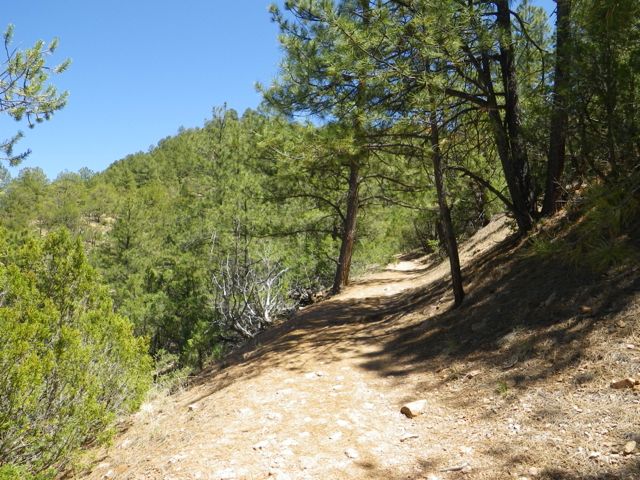
Pecos National Historic Park

John pointed out to me yet another national monument/park just a short distance from Santa Fe, the Pecos National Historic Park. Yesterday promised to be, and was, a gorgeous day, so I decided to go check it out. I got a late start because I was working on the project from hell (most projects of that type would have taken me three hours and it took seven), so I only arrived around 12:45.

The website made it seem like there was a lot to do, with two trails and two tours, but they were still on their winter hours and their Civil War trail was closed. There was a tour at 1:30 of a ranch house owned by Academy Award winner Greer Garson, a benefactor of the park, but that didn’t interest me. Despite that, even if I had had to pay the $3 admission fee, I would have come out of there feeling that I got my money’s worth. If you like history and are interested in ruins, Pecos is a must-do for Santa Fe!

The drive there felt longer than it was because there was a bike marathon thingamabob along a good part of my route to I-25 and instead of being able to drive 50MPH, I had to drive 25MPH. But I eventually got there!

Made it!

Made it!

Look at what I found in the parking lot, a car with a license plate from ARGENTINA!

A license plate from *Argentina*!!!

A license plate from *Argentina*!!!

I’ve heard that Argentinian Spanish is very different from European and Mexican, but this was too interesting to ignore, so I went up to the couple and said in Spanish, “Wow, big journey! How long have you been traveling?”

This is Spanish speaking territory, so they weren’t shocked by the Spanish and replied, “Two years!”

We then had a bit of a chat about their trip. They are arriving in Alaska this summer. I gave them some suggestions (do not miss Dawson City!) and answered their questions about the Alaska Highway. We could understand each other just fine! And just as I was leaving some time later, they came to grab me to act as an interpreter because they were having trouble with a Ranger’s accent. I’m really starting to feel like I speak Spanish now that I’ve communicated with folks from four different Spanish speaking countries (Spain, Mexico, Chile, and Argentina) and been understood. So cool!

But enough about that, you want to hear about Pecos!

Pecos is one of the most important Native pueblos of the area, home to some 2,000 people.  Archeologist Kidder found here perfectly preserved layers of history that enabled him to sort out timelines, tribes, and categorize pottery with methods that are still used today. He considered Pecos the place that helped to make sense of the until then scattered and conflicted information about the peoples of the region and work out a plausible chronology.

A 16th century report of the pueblo describes it as the “greatest and best” of the Indian pueblos, and is, “most thickly settled.”

You learn all of this in the visitors’ centre little museum, which does a good job of setting you into the context of Pecos. Then, you head outside to see the ruins.

From the visitors’ centre, there is a trail (accessible) that takes you around the ruins of the pueblo all the way to the ruins of 17th century and 18th century churches built by the Spaniards determined to bring Christianity to these ignorant savages.

I was surprised by how much there was to see. The pueblo had been like a large fortress, made of 700 rooms, four to five stories high, around a central courtyard, with the upper stories linked by balconies and walkways. It must have been quite a sight!

The pueblo would have had a wall all around it.

The pueblo would have had a wall all around it.

IMGP1730

The church in the distance.

The church in the distance.

The trail is a bit of a treasure hunt if you are loaned the trail brochure, several sheets of laminated paper with tons more information than you find on the sparse placards scattered throughout the site. I had fun looking for all the numbered markers.

I was loaned this trail guide.

I was loaned this trail guide.

Snow in the distance.

Snow in the distance.

Wheelchair accessible path.

Wheelchair accessible path.

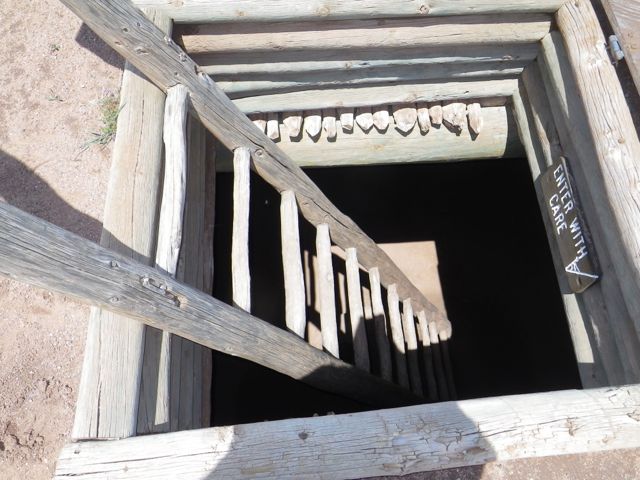
Kivas were circular holes in the ground accessible via ladders. The entrance led to a ceremonial chamber where much of daily living, including weaving, was done. There are two kivas on the tour that you can actually enter!

Entrance to a kiva.

Entrance to a kiva.

Hey, you can really go down!

Hey, you can really go down!

I can never resist stuff like this.

I can never resist stuff like this.

Surprisingly light down there.

Surprisingly light down there.

Ceiling.

Ceiling.

This hole represents the journey of the Pecos people to this world.

This hole represents the journey of the Pecos people to this world.

Masonry of the kiva walls.

Masonry of the kiva walls.

Foundations are all that remain of what were four or five story buildings.

Foundations are all that remain of what were four or five story buildings.

Kivas.

Kivas.

There was a trash heap here.

There was a trash heap here, a goldmine for archaeologists.

So much open country.

So much open country.

You could have seen all around from up here.

You could have seen all around from up here.

More snow in the distance.

More snow in the distance.

This sign made me laugh.

This sign made me laugh. See how uneven the word uneven is?

Up a few stairs for a view!

Up a few stairs for a view!

Looking from the top of the stairs across another kiva.

Looking from the top of the stairs across another kiva.

Contemporary descriptions make it sound like a medieval castle, both in its construction and occupation, with all manner of trades, such as weaving and pottery, being practiced, and there being music.

What the pueblo might have looked like.

What the pueblo might have looked like.

Then, you get to the churches. What we see are the foundations of the 1625 church and the ruins of the 1717 church walls. The first church was destroyed in a 1680 revolt by the Natives, but they didn’t keep their independence for long.

Approaching the church.

Approaching the church.

What remain are bits of the newer church.

What remain are bits of the newer church.

It would have been white washed.

It would have been white washed.

Foundation of the older church.
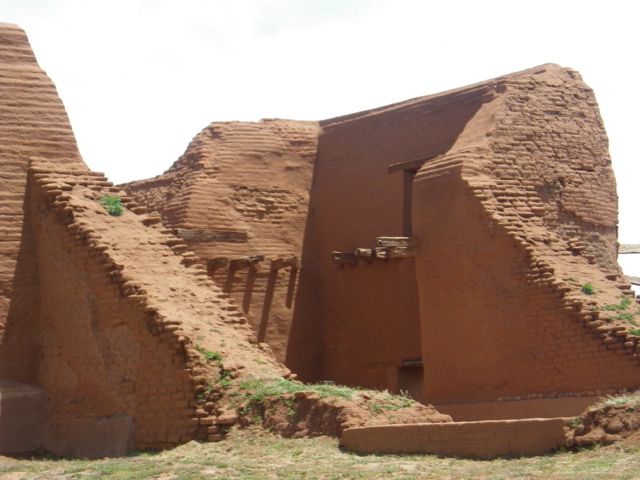
Foundation of the older church.

You can see a lot of details of the construction.
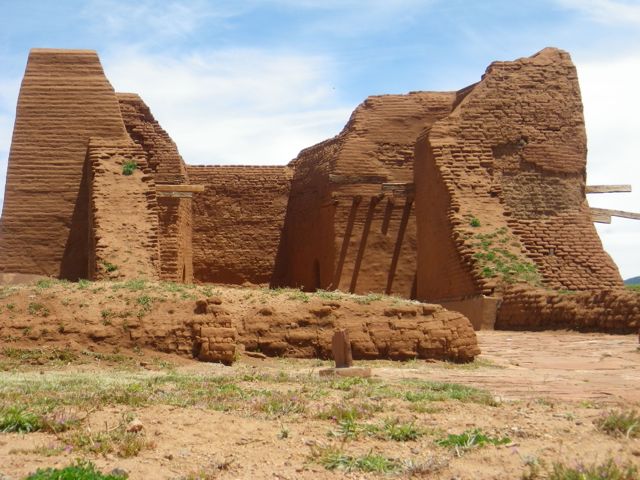
You can see a lot of details of the construction.

The grass is trying to reclaim it.

The grass is trying to reclaim it.

The Pecos leaders gave each pueblo a knotted rope. Each knot represented a day. When there were no more knots, it was time to attack the Spaniards.

The Pecos leaders gave each pueblo a knotted rope. Each knot represented a day. When there were no more knots, it was time to attack the Spaniards.

I was shocked that we could enter the ruin and walk around! This is where I spent most of my visit, admiring the architecture.

I couldn't believe I could go in!

I couldn’t believe I could go in!

More foundations of the old church.

More foundations of the old church.

Entering the newer church.

Entering the newer church.

Narrow passageway...

Narrow passageway…

...into a courtyard.

…into a courtyard.

Another doorway to explore.

Another doorway to explore.

And another.

And another.

Look at the two angles of the masonry joining together.

Look at the two angles of the masonry joining together.

This buttress is perfectly preserved.

This buttress is perfectly preserved.

I like how the park uses these wooden fences to gently corral guests.

I like how the park uses these wooden fences to gently corral guests.

I should have asked if the flagstone is original or at least a replica of what would have been used.

I should have asked if the flagstone is original or at least a replica of what would have been used.

Also curious about the stairs.

Also curious about the stairs.

You can really see the detail of the masonry work here.

You can really see the detail of the masonry work here.

Vigas (wooden ceiling beams).

Vigas (wooden ceiling beams).

The construction is just like that of a medieval keep, with a flared base to distribute the weight of the building (and I thought my medieval history degree was never going to be useful in the real world!).

The construction is just like that of a medieval keep, with a flared base to distribute the weight of the building (and I thought my medieval history degree was never going to be useful in the real world!).

Two-toned masonry.

Two-toned masonry.

This drain is original! The holes in it are perfectly round!
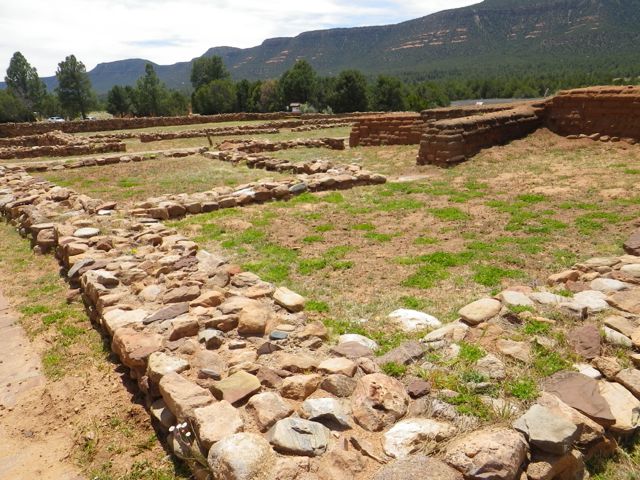
This drain is original! The holes in it are perfectly round!

Oodles of foundations.

Oodles of foundations.

Another kiva.
Another kiva.

What is it with me and pokey places?

What is it with me and pokey places?

Oh, just like the other one.

Oh, just like the other one.

This would have been a turkey coop, with a cobblestone floor for easy cleaning.

This would have been a turkey coop, with a cobblestone floor for easy cleaning.

The directional signs made me laugh.

The directional signs made me laugh.

This would have been a 16th or 17th century residence or part of a farm.

This would have been a 16th or 17th century residence or part of a farm.

One last glimpse of the church.

One last glimpse of the church.

Pecos’ last inhabitants left the pueblo in 1838 and joined up with related tribes nearby in Jemez, where their descendents live to this day.

This boardwalk goes over the Santa Fe trail.

This boardwalk goes over the Santa Fe trail.

The visitors' centre had lovely architecture.

The visitors’ centre had lovely architecture.

Pecos pueblo taught me a lot about the geography of the region, the local peoples, the influence of the Spaniards on the development of the region, and more. I am leaving Santa Fe with a much better understanding of the history of this region and how it ties in to the history of my part of the continent. Thanks for another great recommendation, John!

Now, it’s time to move on. Work kept me up very late, two hours past my bedtime, last night, so I am up very late this morning and nowhere near ready to hit the road yet, but I am going! Next stop is Bandelier National Monument and then I’m pointing Moya towards South Dakota. I doubt I will get out of New Mexico today, but tomorrow will be a driving day.

Randall Davey Audubon Center and Sanctuary

John suggested I drive up Upper Canyon Road one day and check out the Randall Davey Audubon Center and Sanctuary. I Googled it and it seemed like the perfect thing for an afternoon where I only had a couple of free hours as it’s super close by and there is only a couple of miles of hiking trails to do there, unless you can get into the house, which I couldn’t today.

The directions on their site made me laugh, acknowledging that you’ll feel lost and in the middle of nowhere by the time you arrive!

The welcome sign in the parking lot.

The welcome sign in the parking lot.

I went into the Nature Store to get information. Access to the property is free and donation boxes abound. I slipped a few dollars into the box, signed the guest registry, and accepted a map. The lady at the desk asked if the altitude is an issue and I was able to proudly say no. Yes, I’m feeling it, but my Mexico winter whipped me back into shape and I’m breathing only a little bit harder. I refuse to concede any speed, preferring to get a little winded, as that means I’m getting a better workout.

I love how their signs are hand drawn with coloured pencils.

I love how their signs are hand drawn with coloured pencils.

I went around the trail network, enjoying the scenery. The only animals I saw were a bird and a man, but there was scat on the trail that looked like it might be from a cougar, of which there are lots in the hills here according to the signage.

IMGP1561

Interesting bench/table.

Interesting bench/table.

Such beautiful scenery.

Such beautiful scenery.

Another hand drawn sign.

Another hand drawn sign.

So much for the eye to take in.

So much for the eye to take in.

I did the bear canyon trail; it wasn't much of a distance!

I did the bear canyon trail; it wasn’t much of a distance!

View from a bench.

View from a bench.

Val-deri,Val-dera, Val-deri, Val-dera-ha-ha-ha-ha-ha Val-deri,Val-dera.

Val-deri,Val-dera,
Val-deri,
Val-dera-ha-ha-ha-ha-ha
Val-deri,Val-dera.

I kept going.

I kept going.

The only wildlife I saw.

The only wildlife I saw.

I was told I could keep going beyond this point.

I was told I could keep going beyond this point, so I did.

Just had to get over this.

Just had to get over this.

Nice pile of rocks.

Nice pile of rocks.

Yeah, that's the end of the road...

Yeah, that’s the end of the road…

Love the bright green.

Love the bright green.

Lots of orthoclase feldspar (a reddish/pinkish quartz) abounded).

Lots of orthoclase feldspar (a reddish/pinkish quartz) abounded).

What a lovely hour and a bit this was! It was a change from hiking the arroyo and it didn’t take up my entire day. I would hike there a lot if I lived in the area.

A Very Full Afternoon in Santa Fe

This afternoon, I drove to downtown Santa Fe to see what was what. John gave me a few street names about a mile from downtown as possible free parking spots. On the way, my ‘you need gas’ light came on and then came a nearly hour-long search for fuel. I am throwing my GPS into the Santa Fe River! It kept directing me to gas stations that haven’t existed in years or to turn the wrong way down one ways, all the while directing me through super narrow European-style streets. Not the introduction to Santa Fe I wanted. 🙁 I finally found fuel and put in 17 gallons. HOLY MOLY. The tank holds 19.5 and I’ve never put in more than 16 gallons or so. I was running on fumes! But I’m glad I found gas early in the day because my afternoon was going to take on an unexpected twist.

But first, I parked where John told me to park and hoofed it down the Old Santa Fe Trail, a busy thoroughfare that takes you to downtown. I passed the visitors’ centre and popped in for a walking map.

Courtyard of the visitor's' centre.

Courtyard of the visitors’ centre.

Front of the visitors' centre.

Front of the visitors’ centre.

Since it was getting late in the day, I decided to go straight to the history museum. But I still passed some interesting stuff on the way.

The oldest church structure in the United States (early 17th century).

The oldest church structure in the United States (early 17th century).

IMGP1529

Another beautiful church.

Another beautiful church.

Loretto Chapel, home of the miraculous staircase.

Loretto Chapel, home of the miraculous staircase.

Remember that miraculous staircase…

Yet another gorgeous church, and very ornate inside.

Yet another gorgeous church, and very ornate inside.

The history museum.

The history museum.

As it turned out, my pass for the New Mexico History Museum was good not only for that museum, but also for the Palace of the Governors! I’ve already gotten more than my money’s worth out of the CulturePass!

The history museum was smaller than I expected, but that’s just a statement of fact, not a valuation. It was really good and had a lot of interesting exhibits. The main exhibit is the history of New Mexico from prehistory to now. It’s a part of North American history I’m not familiar with, but it’s really no different from the history in my part of Quebec, only with different actors.

I enjoyed an exhibit about a top secret facility related to the Manhattan project, one about the Civil War, and one about what was probably the first chain of dining and hotel establishments in the west, Harvey House. I was going through this exhibit when I got a text from John asking me to call when I could, and another saying that there was no emergency. We are on the same wavelength! 😀

I called when I could and as it turned out, he had some free time and was wondering if he could join me. We had made tentative plans to hang out on Tuesday, but he wasn’t going to be free and the weather is promising to be miserable. I told him where I was and he said he’d text when he was closer.

I then went upstairs to the temporary exhibits and saw one on camera obscuras and pinprick photography, as well as one about the Virgin Mary.

Then, I went into the courtyard to check out the printing presses and go across to the Palace of the Governors.

Courtyard between the history museum and the Palace of the Governors.

Courtyard between the history museum and the Palace of the Governors.

Courtyard between the history museum and the Palace of the Governors.

Courtyard between the history museum and the Palace of the Governors.

Nothing says May more to me than lilacs. I will be planting a lilac tree at Haven!

Nothing says May more to me than lilacs. I will be planting a lilac tree at Haven!

This building was originally constructed in the early 17th century to be Spain’s seat of government, and then was adapted and remodeled to suit other needs as the years went by. There was an interesting exhibit that showed different stages of development on plexiglass that you could layer to see the changing floor plan.

This was an expansive building taking up a full block and full of white plaster walls and dark ceiling beams. I’m really digging that decorating scheme. 🙂

There were lots of interesting exhibits about settlement and governance in New Mexico, religion, and, my favourite, hide paintings, that is scenes of New Mexico life painted on animal skins.

John still hadn’t arrived when I was through at the Palace of the Governors, so I headed out to explore the immediate area.

Across from the Palace of the Governors.

Across from the Palace of the Governors.

The area really reminded me of Plazuela Machado, only much more touristy (which will make my Maz friends laugh). John says that Santa Fe used to have a ‘real’ downtown, but now, it’s all for the tourists and full of expensive shops and restaurants.

Plaza.

Plaza.

Front of the Palace of the Governors.

Front of the Palace of the Governors.

IMGP1541

John texted me just as I finished my tour of the plaza to let me know he was at the entrance to the history museum. We met up and headed across the street to the Museum of Art, which was once the ‘fine arts’ museum. We just did a quick tour since it was getting very late and I’ll actually be able to go back if I want.

The art museum.

The art museum.

Egyptian obelisk in the courtyard of the art museum.

Egyptian obelisk in the courtyard of the art museum.

I really liked what I saw on our dash through it. The museums in Santa Fe are all very small, but they pack in a lot! There was a photograph exhibit that we both liked that featured the subject at a young age, then as an adult.

When we came out, John asked if I was thinking about food, which I was. I hadn’t had lunch and planned on having linner after doing the museums. He suggested we go to a burger joint owned by friends of his called Santa Fe Bite. The restaurant used to be a 10-seater located outside the city limits, but now it’s a proper downtown restaurant. I wouldn’t have thought to go in since I figured it was just a basic diner attached to a hotel. It pays to play tourist with a local guide!

I ordered just a basic burger with lettuce, tomato, pickles, and onions. It was really good! The meat was lightly seasoned and juicy while the homemade bun was buttery and chewy. I had the whole bun, but I left most of the delicious kettle chips. John had a spicy-looking chili with cornbread. Best of all, his friend was working and they were able to have a quick catchup. Serendipity!

From the diner, it was decided that we would walk to John’s car and that he would take me back to my truck.

We stopped at the Loretto Chapel on the way and since it was past closing, we were allowed to very quickly go into the chapel and get a picture of the miraculous staircase without paying the museum admission fee.

The miraculous staircase. Can you see why?

The miraculous staircase. Can you see why?

I love spiral staircases and knew about this one, but didn’t realise it was in Santa Fe. It is an engineering marvel! Can you see why?

The chapel is lovely, too.

Another beautiful chapel.

Another beautiful chapel.

We went into another church, the third one I saw on the way to downtown, and then made it to his car. Before going to my truck, we drove to Fort Marcy Park. It’s a sinuous uphill walk to a viewing platform on the site of an old fort, with plaques all the way up detailing the history of New Mexico.

A place I wouldn't have found on my own.

A place I wouldn’t have found on my own.

Breathtaking views of Santa Fe.

Breathtaking views of Santa Fe.

Breathtaking views of Santa Fe.

Breathtaking views of Santa Fe.

Quite a climb, but worth the effort.

Quite a climb, but worth the effort.

Breathtaking views of Santa Fe.

Breathtaking views of Santa Fe.

We then got back to my truck and I followed him most of the way home, where he detoured to show me the site of an old pueblo that was excavated in the 1970s. It felt like a place of immense power. What amazed me the most was all the potsherds just lying around on the ground. I had to take a picture of an incredible find, but, of course, left it behind!

Black on white potsherd. What a find!

Black on white potsherd. What a find!

The day didn’t start off too well, but definitely improved! It was a wonderful afternoon and I was once again grateful for a local guide.

Now, I have TONS of work to do in the next couple of days, so I will probably hunker down at home for a bit. But John’s not ready to kick me out (I think…), so I may extend my stay a bit to go on a field field trips in the environs.

Driving Through Saguaro National Park and Visiting the Arizona-Sonora Desert Museum

For this afternoon, I wanted an activity that would get me out of the truck (so not too far from Coolidge in the direction of Tucson), but which would still be outdoorsy. I found the Arizona-Sonora Desert Museum, which sounded like the perfect way to wile away an afternoon. To get there, my GPS routed me through Saguaro National Park, a route I would have avoided had I not had my parks pass as it costs $10 to enter this park for a week. I pulled over a few times to enjoy the view of all those hills covered in one saguaro cactus after another. It looked positively like an alien landscape!

Later, at the museum, I asked someone there all my questions about the saguaros. First of all, the g has the Spanish pronunciation, so it is more like sa-wah-ro  than sa-gwa-ro. Next, the root system really interested me. The saguaros have a lot of roots, most of which are just below the surface and the radius of the roots equals the height of the cactus. So if you have a 10′ cactus, the roots extend 10′ all around it. The older the root, the more woody it is. The saguaros are firmly rooted, but sway in the wind. They get their first spear (arm) when they are about 75 to 100 years old and they live a long time!

The desert museum admission is just shy of $20 and you need at least two hours to see everything. I stayed 2.5 hours and that was just enough to view everything except hike the desert loop to the coyotes because it was just too dang out.  Anyway, I see coyotes all the time back home, so I decided to see the (indoor) snake exhibit a second time instead. 🙂

This museum is really a zoo and botanical garden. You get to see all the animals of the Sonoran desert as well as the plants, insects, and geology. It is beautifully laid out.

I arrived around 1:40 and was told to hoof it down to the rear of the site to catch the raptor show at 2:00. This was an incredible experience! Several types of trained raptors, including peregrine falcons, Harris’ hawks, and barn owls fly over and near the crowd. One hawk swooped so close to me that I had to duck! The show lasted a half hour and we learned about how these birds thrive in a desert environment.

After that, I just wandered the site with my map, looking at what was interesting, from the aviary to the big cat canyon, the mineral dump where I was able to find a treasure to take home to the hummingbird garden, the bee and butterfly habitats to the cactus garden, and more. There was lots and lots to see and plenty of cool buildings to duck into when I had enough of the unrelenting sun. There was also a conveniently located café selling ice cream at a reasonable price. 🙂

The museum takes good care of its guests by not only providing a lot of sources of good drinking water for refilling bottles, but also sunscreen in every bathroom!

My camera ran out after the black bear. I got some more pics with my iPhone, but I forgot to bring the transfer cable into the bunk with me. All you’re missing is pictures of prairie dogs, several rattlesnakes, and every more saguaro-covered hills. In other words, not much. 🙂

I learned so much today about this desert that extends as far north as B.C.’s Okanagan region. The saguaro-savvy staff member and I talked about about that and she explained that prickly pear-type cacti do well in colder climates, hence why we have them in Canada. She was surprised that we have them as far east as southern SK, though.

From the museum, I took a twisty road to Tucson, stopping along the way to soak in the view. It’s been another full rich day!

Driving the Kolob Canyons Scenic Drive

Today is last full day in the area of Zion National Park. I have a little work to do, so the quick excursion to the Kolob Canyons section of the park was the perfect activity, taking up the afternoon.

It was just a short drive up I-15 to the visitors’ centre for that section of the park. Here, you can see a series of slot canyons. I really want to come back and hike in this part of the park, but the prospect was too daunting for my current drive-through the area, requiring permits and equipment for overnight stays. I especially want to do the hike to the Kolob Arch, considered to be the second largest natural arch in the world. It’s doable as strenuous 12-hour day trip, but I would have had to plan for a permit in advance for that, so it was still not a reasonable to-do item for this trip.

Besides long hikes, the only activity in this part of the park is the 5-mile scenic drive to a lookout point and 1-mile trail to a further lookout point. So the road ends with a giant turn around that has toilets, a nice view, and the trail head. I met a nice couple with two beautiful older dogs who gave sweet kisses and liked to be petted. Yup, definitely a dog person now. 🙂 BTW, Zion, like most national parks in the US, is NOT dog friendly.

When I came back from the hike, a man asked me what part of SK I’m from and I explained to him that I’m about 2.5 hours south of Regina, 45 minutes north of the Montana border. He confidently informed me that Saskatchewan does not have a border with Montana, only North Dakota, and that I am mistaken… But he did correct a German or Dutch lady who asked me how to pronounce the name of my state, informing her that it’s a province, so he gets points for that. 🙂 The lady got the name correct after only two tries and sadly informed me that she would forget in minutes how to say it.

Thus ends this current visit to Zion National Park. It’s really not that far from Haven (two long days or three short ones) and there are so many more parks I want to experience in Utah that I would like to make the state a destination at some point and do a lot more hikes! I’m pretty sure now that I want a class B camper van type thing, like a small RoadTrek, rather than a bumper pull trailer, btw, enough that I’m going to start window shopping this winter!

Hurricane was a fantastic base to explore the park, much less expensive than Springdale and with more services. I think it would be nice to spend a week in Springdale and be pretty much right on site, but the drive from Hurricane is so short that it’s not a huge compromise.

Tonight, I’m going to finish my work project and continue packing. I got the tote back into the truck today, so that’s progress. I’ve also discovered that the tailgate handle I installed in 2012 is not working and I don’t have the screwdriver I need to pull open the cover and see if the handle is broken or just came loose. It’s a weird screw driver and I don’t really feel like buying one, but US Customs opened the tailgate and I want it openable in case Mexican Customs wants access, too. I can still get stuff in through the topper cover, myself included, but it’s not very convenient. I am not pleased. Oh, well, if that’s the worse thing that happens to the truck on this trip… 🙂