Bulgarian Yoghurt

I don’t think it’s a secret that I love yoghurt. I will buy the flavoured stuff as a treat, but am very happy with plain as a savoury topping in lieu of sour cream or mixed with berries or other fruit to turn it into a creamy dessert.

So I was quite excited when I learned that Bulgarian yoghurt is considered among the best in the world. When I went shopping with Max my first day here, I asked about yoghurt and he pointed to this stuff:

bulgarian yoghurt

In Canada, I buy Dannone Oikos “Greek style” yoghurt with 2% milk fat. It’s the best plain yoghurt I’ve found. I used to make my own, but lost the habit (very sadly). The Dannone stuff is okay, but getting through a tub is work. It’s not very smooth on the tongue and leaves me wishing for sour cream — or whipped cream!

This “kiselo myalko” — literally sour milk is so different from the commercial yoghurt I get back home that it might as well be from another planet. It is tangy, but not sour, very creamy (my homemade stuff was always lumpy), and is delicious right out of the jar. Oh, I’ve been having it the odd time with fruit or even, as a huge treat, a bit of strawberry jam, but it’s not a yoghurt whose flavour needs to be tamed. This is what milk wants to be when it grows up (okay, that or a really strong English cheddar). It’s available with 2% or 4% milk fat and I go with the former.

I brought two large containers back from Sofia since you can only get smaller containers in Yablanitsa. They survived the trip home!

My only complaint about this yoghurt is that it has a non-resealable aluminium foil top, like the single serving containers do, but there are many servings in the container. So I’ve been using a piece of clingfilm to keep it air tight.

I’m Really Liking Market Day

Market day in Yablanitsa is “something to do” that is much appreciated in my little quiet corner of Bulgaria!

The project that I have been expecting since I returned in Mérida (yes, the beginning of March!) has finally dropped and work is about to get insane. So I wanted to make sure I was well stocked up on groceries and made room in my schedule this morning to go to the market to get some fresh veg.

I set off around 8:45 with the hope of being home by no later than 1:00, and, of course, much earlier if I lucked out and got a ride. It was mercifully cool at that hour and I enjoyed my walk to just past the village limits, about a kilometre.

The sheep were bleating loudly.

IMGP5004

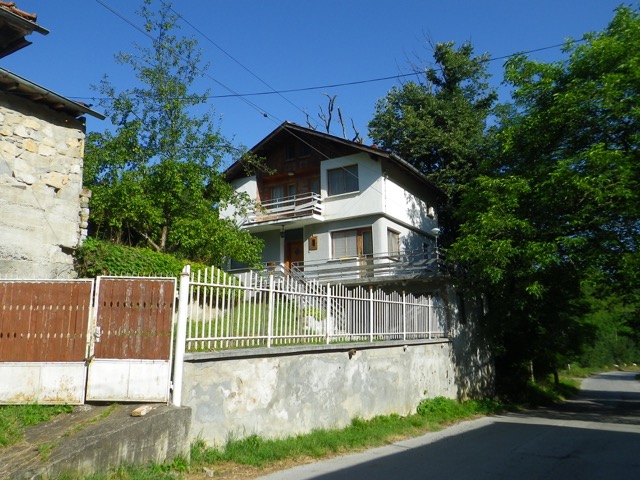
Notice something different with this house?

IMGP5005

Soon after, I encountered the “goat man.”

IMGP5009

It’s quite a sight when he takes his herd through the village! The noise from the bells is something I got used to once I understood what I was hearing!

A lovely elderly gentleman pulled over right after the goats. He asked if I was going to the market in Yablanitsa. Yep… He then said something from which I understood that he was going to Pravets, but he could let me off at the square in Yablanitsa (not a detour for him). Great! I hopped in and as we got to the town limits where one access road is closed off before the market, he did the universal hand motions for “I’m going around” and again mentioned the central square (ploshtad) to make sure I knew he wasn’t taking me for a ride. Soon as we got to a corner I recognised, I said, “tuk dobre” (here’s fine) and thanked him profusely.

I passed the infamous taxi on my way to the market and made a note of the very reasonable rates.

IMGP5011

In order to ensure I get a modicum of exercise while living here, my rule is if I get a ride into town, I can’t take a taxi back (being picked up is okay). So the taxi would have to wait for another day.

I also completely photographed the bus schedule (here’s a bit of it):

IMGP5012

I got my veggies, going to the vendors I know as their stuff has been top notch. I had a lot of change and small bills today, which was great because it enabled me to realise something important when someone is rattling off a price — it doesn’t matter if I don’t understand how much change (stotinki) they want if I understand how many leva. For example, my potato/courgette/hot pepper/carrot vendor said 2BGN something. I handed over 3. The tomato vendor’s number was huge, which meant it was only stotinki, so I handed over a 1BGN coin. Much easier than trying to wrangle a notebook and pen for them to write prices and it’s harder for someone to short change me (not necessarily intentionally) than if I give them a big bill.

One thing I find annoying when I go to market is that being with a backpack, my change purse and phone are not easily handy. My skirts don’t have pockets and so I tend to find myself juggling bags and personal belongings. I thought it would be nice to have a very small cross body bag into which I could stuff my change purse, phone, change, tickets, etc. when I’m using my backpack and don’t have my purse. This wasn’t quite what I wanted, but for a mere 5BGN, I was very happy to pick it up today!

IMGP5025

It just fits my phone, but my notebook is too big for it. I could put the change purse in another zippered compartment and put the notebook in here, leaving the compartment unzipped. Again, for 5BGN, it’ll be great until I find something better. This one didn’t have a price tag and was a little different from others marked at 5BGN so it felt like another small victory to say, “Pet?” (Five) and get an answer in the affirmative.

IMGP5026

I then went to get groceries. Like in Mazatlán, I find myself referring to things differently than do the expat locals who have been here a while. They call this the “green store.” I call it the “food store” because that’s  what the sign says (well, actually the word that starts with the X translates to English as “grocery,” but I recognised the first part of the word as being “food,” so food store stuck). This is more of a deli-type store where you have to order things at the counter.

IMGP5019

I like this building. Imagine what a little love could do to it!

IMGP5020

This is a pharmacy (aptekа).

IMGP5021

This is a bookstore (knidzarnitsa — the k is not silent!).

IMGP5022

The Yablanitsa church.

IMGP5023

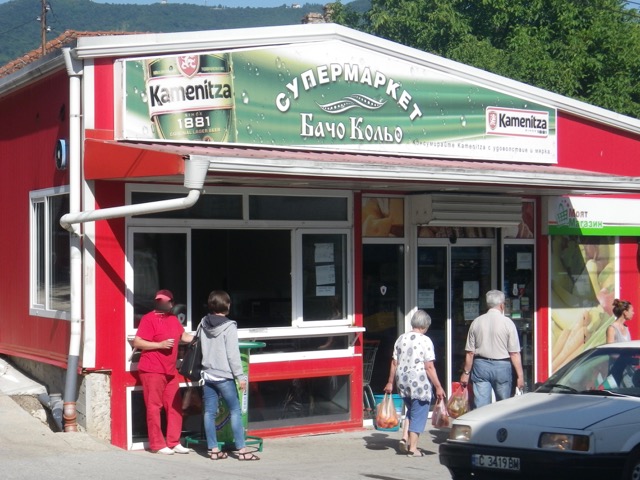
And this is what the other expats call the “red store,” and I call the supermarket, because that’s what the sign says.

IMGP5024

I showed immense restraint in not buying this even though I got super excited at the word bacon. 😀

IMG_1286 (1)

Had another little linguistic victory when I got to the deli counter to buy butter and they now had two sizes… and I knew how to say big! I didn’t know where the adjective goes in the phrase so I stuck it before butter as I would in English or French (so “I would like one big butter, please.”) and the smile the attendant gave me made up for so much of the rudeness I got when I was in Sofia! “Little” is easy to remember because it’s in the name of the town where I live, malak/maluk!

I was famished by the time I got my shopping done and decided to try some Bulgarian street food at a little stand in the market that smelled like heaven (which I apparently imagine smells like cooking meat and spices…). I wasn’t too sure how to order and so watched a few people until I felt confident enough to get in line. Well, I didn’t have to do that because the cook motioned for a guy to wait while she served me! What a lovely lady. 🙂 I ordered the first thing on the menu, which I thought would be something along the lines of “kebab” since it was kebapche (кебапче). She asked me for 1BGN and then cut a huge piece off a baguette, cut a slit into the piece, smeared it with Bulgarian ketchup (similar to Mexican ketchup — very thin), and then held up what looked like a meat patty and said, “Okay?” I said yes. My snack was mostly bread (which is soooo much better in Europe) with the incredibly savoury and delicious meat thing the middle:

IMG_1289 (1)

I approve of kebapche. 🙂 Next week, I will try it with ljutenica, a spicy Bulgarian relish. I saw it at the stand, but didn’t investigate since I had the ketchup already.

It was then time to make tracks. I walked about 2KM when people who recognised me as staying at Max’s picked me up. They dropped me off at the guesthouse since the road up was blocked by a giant cement mixer!

I got in at 11:00, not even remotely exhausted, and happy with my morning. Now, work!

How to Navigate Sofia’s Centralna Avotogarа/Central Bus Station Website (Централна Автогара)

Sofia is proud of it’s new Centralna Avtogara/Central Bus Station (Централна Автогара), claiming that it is a modern facility that has cut down on chaos. But it is actually a nightmare to navigate, even if you speak Bulgarian! I suspect that it’s easier to get to a major destination than a small town, of course, so the following instructions are likely more applicable to the latter.

While trying to get home the other day, I discovered that the Centralna Avtogara website is where you need to go to get information. It’s really not very user friendly, but the salient information is there. You really don’t need much more than two screens and also how to spell the name of your destination in Cyrillic.

This is the homepage for the website. Don’t worry about anything I haven’t highlighted.

home page

This home page gives you the next few departures, but they only list the termination points. If you want to go somewhere like Teteven that isn’t usually a termination point, you have to go deeper into the website, as per my note at the bottom.

You get to this screen:

next screen

There are two ways you can navigate it. The slowest is to just scroll down and scan the destination names until you see your destination. The better way if you have the Bulgarian Cyrillic keyboard on your device (easy to add to iOS and OS X), do a search on the page for your city name.

In the example above, I was looking for a departure for Teteven. What I highlighted in the left column is the name Ribaritsa. That’s the destination I’m looking for. Next, I highlighted the time the bus leaves, the gate, and the cost. I only paid 7BGN for my trip, so that is the maximum amount you can expect to pay and it may be less if you’re not going the whole way.

If I kept scrolling and looking for Teteven, I would have found one more at a different time, gate, and price.

So now, you have a departure time and gate, but still don’t know where to buy a ticket. All I can say at this point is do what I did. Go to each wicket and scan the list for your termination point and destination. If you don’t see either, just go to the gate and hope that you can buy a ticket from the driver!

Monday morning, I brought up this screen and was able to determine that there would be two Teteven-bound buses that day. Well, what if I was looking for another day? The little green squares represent the days that route operates.  In the above example, all have seven green squares. So that means that there’s a 12:30 bus to Ribaritsa every day. If a day (usually Sunday) is greyed out, then the route doesn’t run that day.

I was warned that buses are delayed and canceled without notice, but hopefully this information will be enough to get you to your destination at some point, if not the exact time you wanted!

First Weekend in Sofia, Buying Groceries, the Bus Station from Hell, and the Nicest Man in Bulgaria

I knew there aren’t many buses to Teteven so I decided on Monday to aim for the second to last bus of the day, to play it safe. I had to do some serious digging on the bus station website to determine that my options were 12:30 or nearly 5PM. I didn’t want to take the chance of being stranded, so I planned my day to be on the 12:30 bus. My only real priority was going grocery shopping. This meant that when I woke up around 7:30AM desperate to go back to sleep, I didn’t. 🙂

I debated whether to take my suitcase with me or come back to the hotel to check out later and then realised that it was a no brainer. I’d brought the suitcase for the sole purpose of holding my groceries. Moreover, a quick check of the map the hotel provided showed me that there was a road just a block from the hotel that would go straight to the bus station and the grocery stores were at the halfway point. Talk about convenient!

One of my two tour guides had told me where to go for groceries downtown, Billa, and Lidl, so it had just been a matter of figuring out the closest ones, something that is not easy to do with Google Maps since the app is stupid and won’t show you the nearest results, but rather random ones. But I thankfully found the correct locations. The plan was to walk up to them to make sure they would be suitable, then head to Makis on Vitosha Boulevard for breakfast, stopping at the Central Post Office to mail Bast a post card.

The post office stop was… interesting. I walked into a cavernous room with wickets all around it, kind of like at a bank. I was ignored, of course, so I translated the signage at each wicket, trying to find one that would sell stamps. I also Googled how to say stamp in Bulgarian and came up with “marka” as being the most likely candidate. Finally, as I circled the room for the third or fourth time trying to decide who to approach to be told to get lost, a lady directly opposite the entrance motioned for me to come to her. I held up the post card I’d bought the day before and said, “I would like a stamp, please.” She sighed and reached into a desk drawer, pulling out a binder from which she extracted a sheet of stamps. After much sighing and muttering she tore some off, passed them to me, took them back, and then repeated the exercise with another binder. The stamps totaled, I believe, 1.70BGN. I only had a 20BGN note and I got the now common, “OMG, don’t you have change?!” eye roll. She didn’t have a till system, but instead reached into her own purse, pulled out her wallet, and came up with change for me! Wow. I thanked her, went out to the hall, licked the stamps, affixed them to my post card (one being upside down by accident), and dropped the card in the mail box outside. Now, to see if it gets to Virginia!

Needless to say, I was ravenous by this point and was very glad to get to Makis. The English speaking gentleman wasn’t there, but I earned a “Dobre” (the Spanish equivalent of claro, okay or got it) when I said “Bik iskal edno kaputcino c edno sandvich klasiko.” I am making progress! 😀 I didn’t like my Monday sandwich as much as my Sunday one (needed some sauce), but it was still very good!

I then headed to Billa. It’s about as close to a “proper” grocery store as you’ll get in Bulgaria, but very tiny. Like the stores in Yablanitsa and Teteven, it felt very haphazard in its layout. I circled twice before committing to purchases. I wanted to buy things like spices, sauces, and salad dressing to jazz up boring rice or veggies and also cheese and yoghurt since the store in Yablanitsa has been out of them. It wasn’t a very hot day so I wasn’t worried about my dairy going bad on the trip home. I also found some of that thick bacon at Billa! I spent about 66BGN (50CAD) on what amounted to mostly staples and things like shower gel and lotion. I even found (Greek) peanut butter! I was pretty happy with my haul, but decided that since I still had room in my suitcase, I would go check out Lidle, especially since I hadn’t found almond milk.

Lidle felt more like a North American supermarket in terms of the products available, including a lot of Tex-Mex stuff! I didn’t pick up much there, but I did snag some tortellini and what appeared to be pimento cream cheese, something I love but have a hard time finding these (spoiler: it was pimento cream cheese… but spicy!). They didn’t have almond milk either. I only spent about 20BGN there.

Grocery shopping in Bulgaria is delightful since there is food from all over Europe and labels are in a kazillion different languages. The tortellini, for example, were in Italian on the front, but the cooking instructions and ingredients on the back were in Bulgarian, Hungarian, Czech, and Romanian. Romanian is rather mutually intelligible with French, Italian, Portuguese, and Spanish, so I was glad to see it. 😀 Just before the till at Billa, I saw cookies with an English label clearly identifying them as being the Central and Eastern European version of McVitie’s Jaffa Cakes from the UK, but the ingredients on the back of the package were in German, Bulgarian, Czech, Hungarian, and more, with no English. I was glad for the English front since I hadn’t picked up any “treats” and I adore Jaffa Cakes. These were half the cost as the McVitie’s version, so I grabbed two packages (spoiler: they are just as good!).

It’s also interesting to see what other palates like and how they interpret various cuisines. The irony of “Mexican-style cheddar” had me chortling in the aisle. Many foods that are considered luxury imports in North America, like some premium jarred Italian sauces, are just normal goods over here and a fraction of the cost.

Grocery shopping in Sofia was a positive experience, but I’m not sure it would be worth planning a day trip there to do it again since the buses are rather erratic. I would be better off making an effort to go to Teteven.

It was 11AM when I came out of Lidl and I decided to head straight to the bus station. I knew it had good bathrooms, several restaurants, and a waiting area, so it would be worth getting there with lots of time to kill in case I had trouble finding my bus. I must be psychic…

I hailed a cab and the driver appeared put upon with taking me the couple of klicks to the bus station (really, I could have walked, but I knew I had to lug my suitcase that far once I got home so no point getting fatigued to save about 4.50CAD). We got to the station and my total was just under 6GBN. I handed the driver two 1BGN coins and a 5BGN note. When he realised I was giving him a tip, the driver’s demeanour completely changed! He had popped the truck for me to get my suitcase and now hurried to get out of his seat to pull the suitcase out for me!

I got into the station and went to the electronics departure board (very small). It listed the departures until about 1PM and there was no Teteven on it.

There are about 28 wickets for the various bus companies, each listing the towns serviced and the departure times. I went through them repeatedly and… no Teteven.

I went to the information desk and asked, “Bus to Teteven?” The woman sighed and replied in perfect English, “Figure it out yourself.” Really! And she had been equally rude to the Bulgarian ahead of me as he literally left her counter in tears! Now that I think about it, that makes me feel better…

I went to the one window where I had seen Yablanitsa listed, thinking that might be it. The woman told me, in perfect English, to go to information!

It was almost noon by this point. I pulled up the bus station website on my phone and managed to get back to the screen that had suggested to me there might be a Teteven-bound bus at 12:30. I’m telling you, if I wasn’t as comfortable as I am now reading Cyrillic, I would have been at a dead end because I only had the stress of copy and pasting to Google Translate anything I wasn’t sure about, not the stress of staring at a language that might as well have been hieroglyphs. When I got to that screen, I saw that there was another name after Teteven, Ribaritsa. I looked up at the departure board and there was Ribaritsa, at the very bottom, leaving from “sector” 32 at 12:30. I had a departure gate, but still no idea where to buy a ticket.

I went to all the windows again and did not see Ribaritsa. I decided to take a chance that I could buy a ticket from the driver and to just go to the departure spot. En route, I picked up a cheese croissant to eat on the bus (spoiler: yum!).

I got to sector 32 at 12:20, just as a bus marked Ribaritsa pulled up. Soon as the driver was available, I asked him, “To Teteven?” He said yes. So far so good! He then wanted to put my suitcase under the bus. That wouldn’t do because I wanted to get dropped off at the turnoff to the village and was sure it would be hard enough to get him to do that, never mind get out and pull out my suitcase. His helper was pretty insistent so I said, “Not Teteven, Malak Izvor.” That stopped them dead. I mimed, “Here’s Yablanitsa, here’s Teteven, here’s Malak Izvor,” and got some confused looks. The driver then become my first hero of the day when he very patiently waited for me to pull up a map on Google. By the way, Google is as slow on blazing fast Bulgarian Internet as it is on slow poke Canadian internet!

Once the map was up, I pointed to Yablantisa and said, “Bus,” then showed the bus route to Teteven. That got me a “Da.” I then showed the turn off for Malak Izvor and then said “I” and then “walked” my fingers from the turnoff to the village. He went, “Oh!” and then “Two kilometres.” I replied in the affirmative to which I earned a “Dobre!” He then tried to take my suitcase again and I let him. When he came back, I asked, “Ticket?” (which, mercifully is “bilet,” so close to the French “billet”) and he motioned for me to go in and said what sounded like conductor. I went in, got comfortable, and just before we took off, his helper handed me two tickets totally 7BGN (1BGN more than the trip to Sofia) and had change for my 20!

Knowing that I would be let off at the turnoff meant that I could sit back and enjoy my trip without worrying about getting stranded in Teteven. I read for a bit, then enjoyed the scenery. We detoured to the town of Pravets before going through Yablanitsa. No one got off there. Next stop was me!

The nicest man in Bulgaria got off the bus with me (at least, I think he did, because I have no idea where else he could have materialised from). He earns his title in that he… lugged my suitcase all the way to the village!!!!!!!!!!! He wanted to take it straight to my place, but I made him hand it over at the guest house, before the final slog, because I didn’t want to take advantage of him! He babbled to me the whole way and I just shook my head apologetically. I don’t know who was more pleased when he said, “Ulitsa?” (street) and I had an answer for him! But even better, he had no idea where my street was and with my saying, “Store, hotel, [my street name],” miming the location of each, he understood!

Just the little slog at the end was exhausting so I can imagine what shape I would have been in if I’d had to drag the suitcase the whole way (although I suspect I would have gotten a lift if I’d been on my own). The bus driver and this man both made up for a lot on Monday.

The dogs were very happy to see me when I got in and the feeling was mutual! Max had left me a list of things to add to my chore list and a note that he’d be back on Friday.

So that was my great big Sofia adventure! It broke the ice on a lot. The next thing I want to try is to take a bus to Teteven and back, but that might be very tricky and could require me to leave at the crack of dawn and not come back till early evening. I might be better off finding out how much a taxi would cost. But I’m glad I figured out the buses, ate at restaurants, and was forced to use some of the Bulgarian I’ve been stowing away in my brain.

I will be taking about a week off at the end of August (when Max will be here with his daughter), renting a car, and going on a grand tour of Bulgaria. In the meantime, I will try to get out into the environs a bit and possibly return to Sofia one more time. I can’t believe we’re already three weeks into July! I knew my time here would fly by!

First Weekend in Sofia, the Communist Tour (by The 365)

There is no way I can do justice to Daniel’s nearly four-hour long tour about Communism in Bulgaria, but I suppose sharing a bit is better than sharing nothing…

Daniel was born in the late ’80s, as Communism collapsed. So his personal story is what his parents told him and more about the period of reconstruction than actually remembering what it was like to live under the regime.

To start, it’s a misnomer to call Communist countries Communist. Communism was a utopia that was aspired to, but the countries we think of as being Communist (like Russia) were instead hard core socialist states aiming to be Communist. This period in Bulgarian history started after the Second World War, during which Bulgaria was half-heartedly aligned with the Axis powers.

By the way, both Nikola and Daniel shared the darkly funny story of how Russia was pressuring Bulgaria to be more aggressive during WWII, so they decided to declare war on the country the farthest from them, figuring they wouldn’t be found on the map: the United States. Well, they were found and the US bombed the hell out of them…

Another thing about Bulgaria during this time that I should have mentioned in my last post is what happened to the Bulgarian Jews during the Holocaust. There was immense pressure from Hitler to deport them to the death camps. Bulgaria’s leaders stalled, claiming that they needed their Jews for reconstruction work. They stalled so much that the entire Jewish population in Bulgaria was spared, something that Bulgaria, deservedly, is very proud of!
The Communist tour started at the court house, but our first stop was the old Princess Korek building. There is no consensus on where the name came from and it is incredible the sign is still up. This building used to be a department store where certain people could buy luxury goods, which were anything not made in Bulgaria, from a Tic Tac to a Rolls Royce. You could only shop in there if you had US dollars and only a small group could have US dollars. Daniel’s parents said that shopping there was a matter of knowing someone who knew someone.

IMGP4972

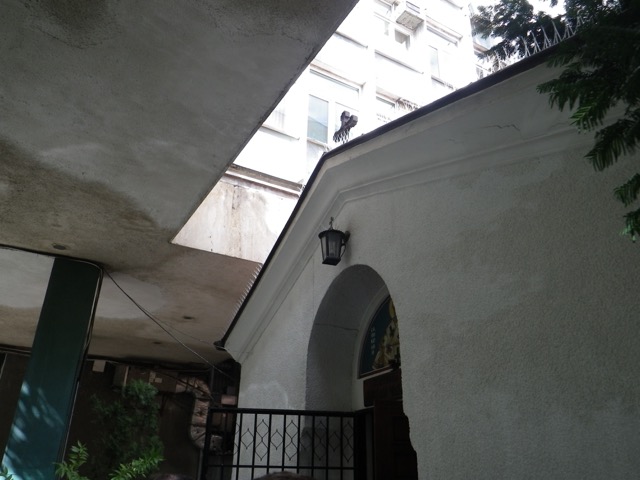
The building hides this small church. Expressions of religion were frowned upon during the Communist era, but not outwardly banned as that would have turned religion into something of a forbidden fruit. It was still something very private that you did not discuss with neighbours. Another guide was baptised in this church and it was done at night with a very small group of people. The Princess Korec building was built in such a way as to hide the cross from the street.

IMGP4973

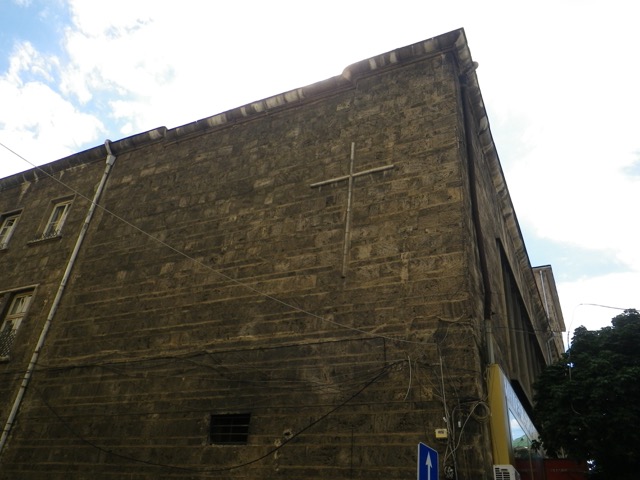
The Church of St. George is another example of a church that was hidden in plain sight. This is the only view of it not obstructed by other buildings.

IMGP4974

And here’s another sneaky church.

IMGP4975

We turned into this alley and the atmosphere was suddenly sinister. The picture does not do justice to how oppressive this alley felt.

IMGP4976

As it turned out, my gut feeling was correct. This building that is now a night club is where agents would “interrogate” (read, torture) dissidents of the state.

IMGP4977

IMGP4978

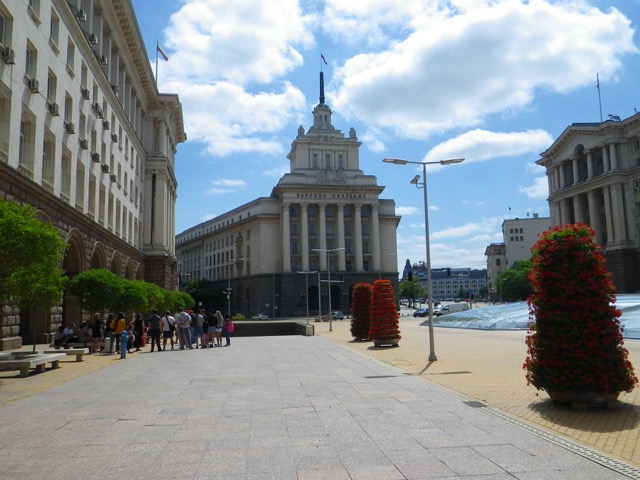
This is the Bulgarian parliament, a few blocks from the Communist headquarters.

IMGP4979

The Communist headquarters were built in the solid “Communist style,” with three types of Greek columns marking the evolution of Communism. Daniels showed us pictures of the complex being built and then of the red star being removed. It is apparently on display in a museum in Sofia. There was a fourth building planned, but they ran out of money so, instead, there was a statue of Lenin.

This is the Monument to the Tsar Liberator, for Russian Emperor Alexander II who liberated Bulgaria from Ottoman rule during the Russo-Turkish War of 1877-1878. It is in front of the Parliament building.

IMGP4980

We paused here to discuss some positive benefits of life under Bulgarian Communist rule:

  • There was financial security under Communism. Daniel’s parents lost everything after Bulgaria became a democracy and the currency was devalued. Things they had taken for granted, like food, suddenly became scarce.
  • Education was free, even if there was a lot of propaganda.
  • There was gender equality, so much so that Bulgaria has one of the smallest wage gender gaps in the world, maybe even smaller than that of the Scandinavian countries.
  • Many social programs, like a generous maternity leave, still exist today.

At another stop , we discussed some of the negative aspects of living under Communism, like limited freedom of expression, but, to be honest, I don’t remember any extensive discussion of the cons like the pros. It was more something that we gleaned as the tour progressed.

One thing I found interesting was how housing was attributed by the government and you could wait for years to get an apartment. Daniel’s parents waited for years for their own place and raised Daniel and his brother in the same small apartment where one of his parents had grown up, sharing it with his grandparents; three generations living under one roof.

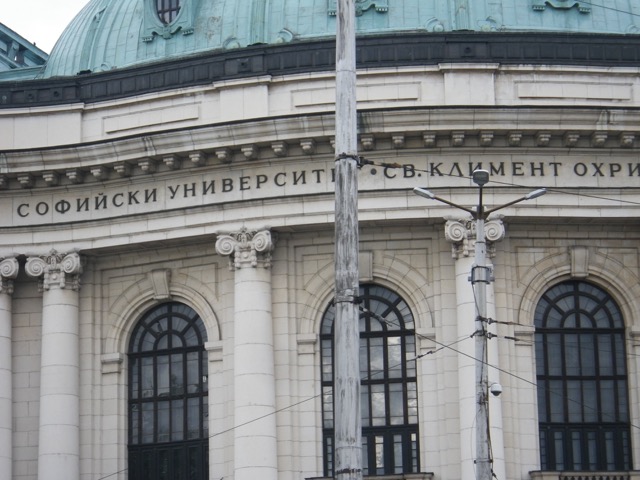
From our spot in front of the Parliament building, we could see Sofia University.

IMGP4982

IMGP4983

IMGP4984

We moved on to the controversial “monument to Communism,” showing a peasant, worker, and soldier.

IMGP4987

Notice that there is more brasswork to the bottom right. Hold that thought.

IMGP4988

The monument is in front of a skatepark. Kids tried to run up the sides, but failed.

IMGP4989

This guy didn’t. Wow!

The statues below the monument to Communism have been the subject of vandalism. This happened in 2011. Notice Ronald McDonald!

IMGP4991

Here it is today, cleaned up, but you can still see traces of the pink paint from another assault on it. The monument is now guarded by a video camera monitored by the “Friends of Russia.” I don’t dare look that up. 😀

IMGP4992

I didn’t take any more pictures of the National Palace of Culture, but we did talk about it a bit. It’s a convention centre and folks are polarised over its utility, or lack thereof. Daniel also talked about the monument to 13 centuries of Bulgaria and how it was built over a monument to WWI veterans. The monument was poorly constructed and fell apart quickly. Currently, the plan is to raze it to… build a monument to WWI veterans.

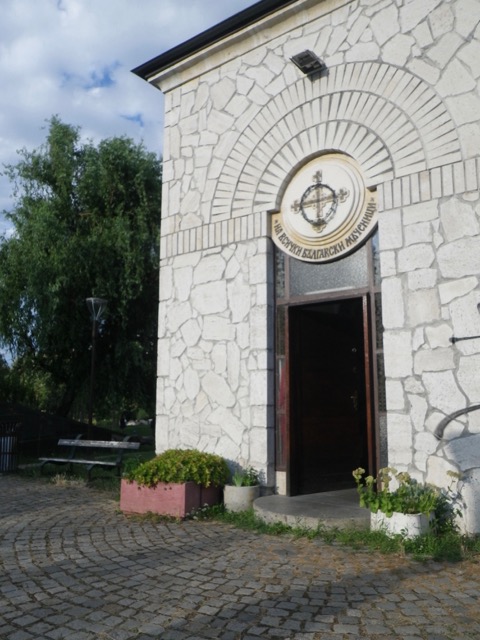
We continued to this little church…

IMGP4994

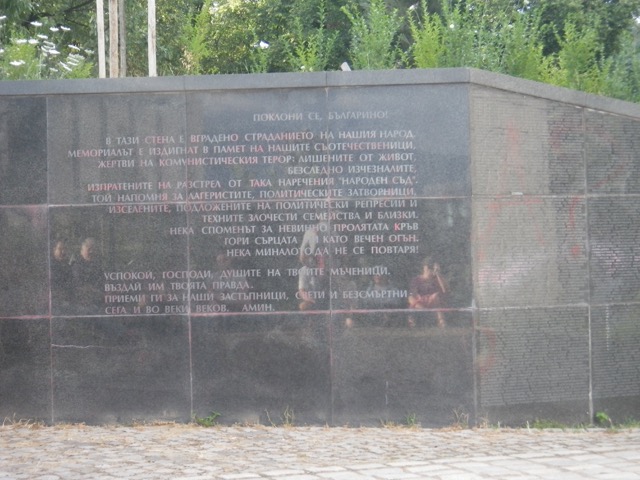
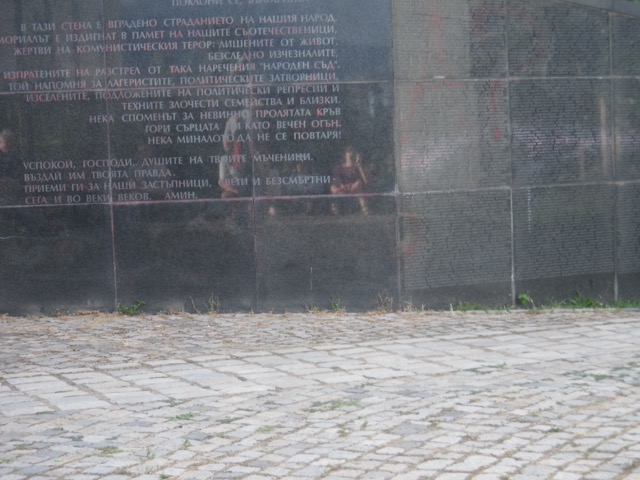
In front of which is the monument to all those who died during the Communist era. Thousands of names etched in stone…

IMGP4995

IMGP4996

IMGP4997

Our final stop was this piece of the Berlin Wall…

IMGP4998

At the end, Daniel gave us all a little pin to remember our tour by. Pins were apparently very popular at one time and he had quite a collection. We picked ours at random. He wasn’t sure what mine symbolises. мая is May, as in the month. I just popped the tiny letters into Google Translate and got “Patriotic War.” Nice little souvenir!

IMGP5003

This post does not even remotely do justice to Daniel’s tour. We learned about leaders of Bulgaria, assassination plots, conspiracy theories, and more. The tour had a fairly neutral point of view and ended with a brief description of how and why Bulgaria has managed to move into the West, with it being a member of the EU, while other nearby countries, like Serbia, have not and are aligned with Russia. It made me realise that I cannot leave this region without visiting other Balkan states.

I have to add something I should have mentioned on the free tour post. The Cyrillic alphabet is linked with Russia but guess what? It started in Bulgaria and Russia later adopted it! I was really surprised to learn that.

Well, if you’ve done the math, I started my day around 9AM and it was now almost 8PM and I had walked who knows how many kilometres. As you can imagine, I was very glad that the tour ended just a few blocks from the hotel. I thought we’d be much further away and had planned on taking a cab home. I was not even remotely hungry so I went straight back to the hotel and crashed. It wasn’t a matter of being too tired to look for food since there was a convenience store right by the hotel where I could have picked up munchies, but I was just beat and still digesting all that pizza and cake!

Sunday was a ridiculously full day, but a really good use of my time in Sofia. I really hope it won’t be my only chance to visit Sofia, but if it is, I hit all the main points.