I can’t believe I haven’t been out for almost a full week! Well, I have been going for daily walks with Puppy around the neighbourhood, but that’s been it. I had an unexpected burst of work that kept me very busy indeed! It wasn’t an unmanageable amount, but between that and Puppy and house duties, there wasn’t much time left except for an hour or two of Netflix in the evenings. I had the day off today, so I was able to head out to the Shrewsbury Museum, the only thing left on my to-do list for Shrewsbury proper.
Puppy and I had lunch, then I took her for a walk before settling her in her crate for her afternoon nap that meant that she’d barely know I was gone.
Spring is springing in my part of England. These are from the garden here.

I headed downtown by way of the route to the train station. Not sure if it’s a short cut, but it lets me do a loop. I like this row of cottages along a walk and bike path. They all have different coloured doors.

The museum is off High Street. It’s so strange to see here a bank I use in Mexico.

Market Square.

The Shrewsbury Museum & Art Gallery is in the old Music Hall.

Admission to the museum is £4.50 and well worth it! This museum is a trove of treasures! There is absolutely no way I can do justice to it as that would involve recounting 2,000 years worth of British history, for which I have an unfair advantage over most of you. So I’ll just share a few things that caught my eye.
You start in a very thorough exhibit about Roman Shrewsbury, starting in the Late Bronze Age and into the Iron Age to set some context. There was an exhibit inside a miniature “roundhouse” that explained how those people lived.
The ceiling:

Here’s what a roundhouse would have looked like.

The roof:

I learned in this exhibit that there are 70 hill forts in Shropshire, more than anywhere else in Britain, and that they had purposes beyond defence.
The Roman invasion was “a terrifying and shocking experience for the local people.” For some, life went on as before. Others took advantage of the situation and provided the soldiers with goods and services. New materials and technologies appeared. Think of what would happen in North America some four or five centuries later.
An interesting fact I learned is that the Romans introduced tombstones to Britain. Here are some Roman tombstones:

Here’s what a farming settlement might have looked like at the time. This was not a primitive society.

I saw some wonderful mosaics that reminded me of those I saw in Bulgaria.

One of the innovations the Romans brought was writing. “There is no evidence of the written word in Shropshire before the Romans arrived.” The soldiers who conquered the region would have been literate.
Wealthy Romans had all the comforts most of the developed world enjoys today, included glazed windows, painted walls, central heating, and running water. The underfloor heating was particularly ingenious. “Hot air from a furnace circulated under the floors and was sent up pipes built within the thickness of the wall and roof, something like a modern central heating radiator.”
Of course, the Roman period moved into the so-called Dark or Middle Ages. By 650 AD, the nearby Roman city of Wroxeter was abandoned. “What is certain is that bit by bit, the grand buildings of this once-fine city rotted and collapsed.” I hope to get a chance to visit the ruins of Wroxeter before leaving here.
Here is the most incredible artifact I saw today, a silver mirror that would have been held by a slave. It is “the finest Roman mirror found in Britain”!


The Shrewsbury Hoard:

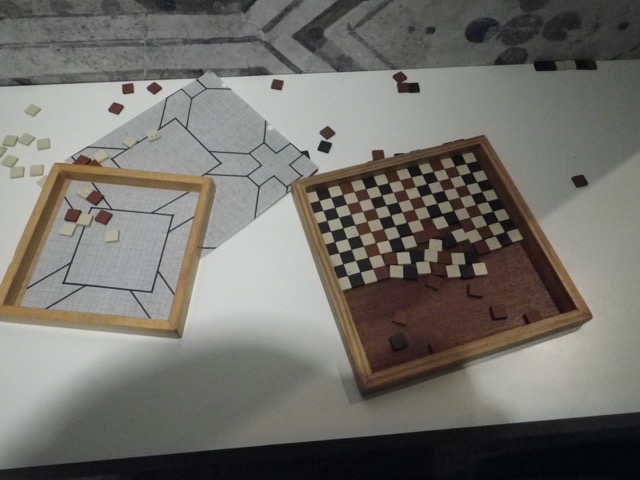
I had fun playing with mosaic tiles.

Just a tiny bit of some of the Roman artifacts I saw. These are all jewellery or pieces used to tie togas and tunics.

I headed upstairs and found this signage rather confusing!

Into the medieval section.

I recognised this straight away, having spent quite some time poring over it when I was in university! It is the Great Domesday Book of 1086, a great survey undertaken by Willian the Conqueror after the Norman Conquest of 1066 to learn who owned what and its worth, all for taxation purposes. This segment is about Shrewsbury, whose townsfolk felt they were being overtaxed.

The medieval section has a timber frame ceiling.

Shrewsbury as it would have been in the 16th century.


This shows what the English Bridge would have looked like during the Middle Ages. It originally had two sections, with an island in the middle.

This was a fun game. There are magnets that you need to place in the correct spots to create a medieval town. I got to work!

Ta-dah.


Medieval tiles.

This did not go well.

I actually have real quill pens that I purchased when I went to Washington DC in 1997.

This screen by Shrewsbury Abbey played an episode of Cadfael.


There he is.

Medieval armour.

Next, I went into the exhibit about Tudor Shrewsbury, starting around the end of the 16th century. By this point the town’s economy was stagnant, the population was dropping, and buildings were in disrepair. The reformation of the church had left the abbey and friary buildings in ruins. But by the 1560s, there was a revival of the woollen cloth trade and the town began to prosper once more.
A bed owned by the Corbet family of the area.

The embroidery was exquisite and all done by volunteers according to traditional patterns.

Looking back to the medieval section. There were so many children running around that I wasn’t able to spend as much time as I would have liked. 🙁

Daniel Defoe, in his A Tour through the whole of the island of Great Britain, 1724-26, described Shrewsbury as “A town of mirth and gallantry.”
Then came a hodgepodge of exhibits where I learned a very surprising fact that I’m shocked I didn’t know: Shrewsbury is the birthplace of… Charles Darwin!


There was a very interesting bit about the natural history of the area and I got to hold a mammoth tooth!
I learned about the ceramics and porcelain trades here, made possible thanks to the good Shropshire clay.


Near the end of the regular exhibits, I saw a panel that said something I’d never been explicitly told, but knew implicitly, that “teenagers” are a very modern concept dating to the mid to late 20th century.
I also learned that the Victorians were mad about ferns and that led to some species becoming locally extinct!


“Trying to Find my Ancestors in a Cross Cultural Word,” is a portrait that “parodies passport photo-booth images and combines the artist’s own face and those of Victorian ethnic stereotypes.”

They combine to form this famous face. Amazing!

Finally, there was a special exhibit about British nursery rhymes.

I had never heard the “go to Spain” line of this classic nursery rhyme.

I love this!

There was another room upstairs, but I’m not sure what for. It did give me a great overview of the “miscellaneous room”and its ceiling:


And the exterior of the music hall.


There’s loads more to see at the Shrewsbury Museum, but that’s what I’ve got to share with y’all. Then, I was off to take a self-guided walking tour.
Back of Market Place (museum behind me).

The museum has a bunch of self-guided walking tour guides. I picked the top three that interested me the most. If I get through these, I’ll go back for more! They are really well done and detailed, so the £1 cost is very fair. I have maps at the bottom of the post to orient you once the walk recap is done.

The Medieval Centre brochure had this to say as an introduction: “Shrewsbury was an important town in medieval times. William the Conqueror put a strong baron, Roger de Montgomery, in charge of this lawless border region and the settlement was fortified as a strategic town to defend England against the Welsh. The Normans also reorganised the church and the importance of religion in daily life can be deduced from the remains of the Abbey, three friaries, and four parish churches in the town centre. Shrewsbury became an important market town and trade centre, attracting merchants who built substantial stone mansions in the 13th and 14th centuries and timber-framed buildings in the 15th century.”
The tour starts at the Music Hall, which incorporates Shrewsbury’s most intact 13th century stone house, Vaughan’s Mansion, owned by a leading fleece exporter.
From there, I walked back towards High Street, crossed it, and found myself in Grope Lane, which was referred to as long ago as 1324. It is one of the rare Grope Lanes that retained its name through the centuries. Its name came about for exactly the reason you think.

This is a good spot to see some of the old timber framing up close.
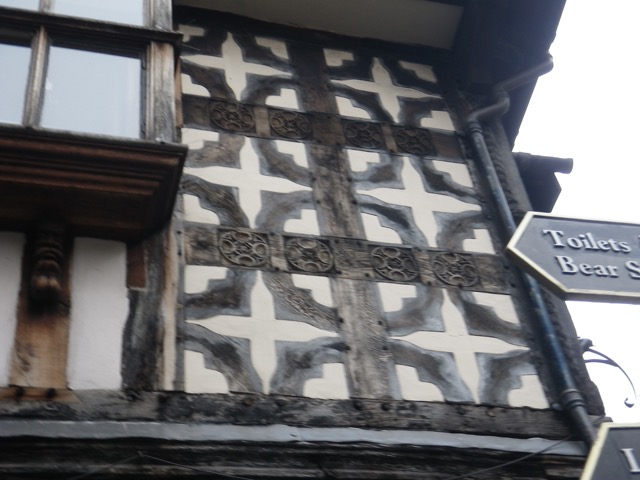

Grope Lane leads to Fish Street, from which you can climb the Bear Steps.


“The complex of buildings at the top form the core of medieval Shrewsbury. It was built and altered over many years and dendrochronology shows that the earliest timbers date from 1358.” So that answered a question, how they date the buildings.


This is the area where the medieval market would have been held.


I then headed to St. Mary’s Church, “the only great medieval church in Shrewsbury to have survived intact.” Its core dates to 1150.

I can relate (pun not intended) to this sign I passed on the way to my next stop.

What I’ve been calling the main pedestrian street is actually Pride Hill. In the Middle Ages it would have been lined with shops, just like today.

Next stop on my medieval Shrewsbury tour was the McDonald’s. Really.

Check out its basement! It would have been the cellar of a business on Pride Hill.


I circled back to the High Street, passed Grope Lane, and found myself at the Golden Cross Passage, which is typical of Shrewsbury’s shuts, or short cuts between two streets. The Golden Cross Pub has been dated to the late 15th century!


I emerged on the other side to take Milk Street and then turned on Wyle Cop to stop just after the Lion Hotel.

There, I could see two medieval timber-framed buildings, one of which was built in 1406.

The tour then took me through Barrack’s Passage.

These well-preserved buildings are 2 of the 32 surviving 15th century timber buildings in Shrewsbury.


From Barracks Passage, I descended Belmont Banks to get to the Town Wall.


Here’s a bit of the town wall.

There was no good vantage point, so it’s hard to show how high up the wall is. The wall was “terraced into the river bluff at the edge of the river flood plain. The whole wall was 3.2km long and was built between 1220 and 1250, on royal orders, following the successful attack on the town by Welsh forces. … The major part of the wall encircled the high ground and ran down to the river, where there were gatehouses on the two bridges. Much was destroyed in the 18th century and this is the best remaining section.”

I then retraced my steps and went down Beeches Lane to turn onto St. Julian’s Friars.


Instead of crossing this foot bridge, I went under it to the tow path.


These cottages are all that remain of the perimeter buildings of the Franciscan Friary founded in 1245.


I continued along the tow path to English Bridge.


Having been to Shrewsbury Abbey, the next stop, already, I didn’t go back since I’d been gone quite a while and needed to get home to Puppy. Instead, I continued to walk along the river.


These arches are part of the remains of a Dominican Friary.

It was then time to head back to the centre of town along St Mary’s Water Lane. It was a pretty steep climb.


The last stop of the tour is the castle. I’m undecided if I will go there because I’m not that interested in the military museum it houses.


“The castle was built within three or four years of the Norman Conquest [1066]. Its primary purpose was to dominate the town, to monitor and intimidate the population, and suppress rebellion. From here, the garrison could survey the whole town, including the approach through the neck of the meander, any movements on the river fords and hostile gatherings in the market place. Today, the inner bailey has stone curtain walls built in the 12th century on top of the original Norman ramparts. The crenulated parapets were originally medieval, though they have been repaired or replaced several times. The hall, with flanking circular towers, is mid-13th century.”
From this final stop, it was an easy one-mile walk home along the river.
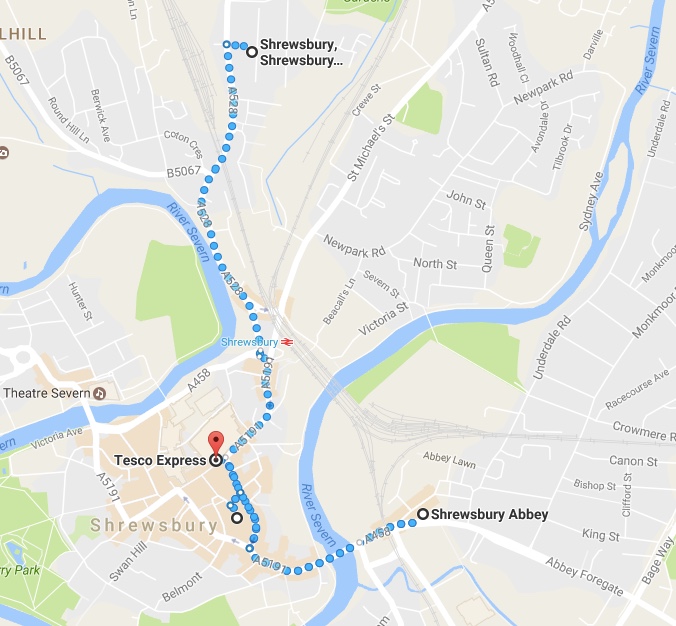
Here’s a general overview of my afternoon:

And a more detailed map of some of the highlights of the walking tour.