Driving Through Saguaro National Park and Visiting the Arizona-Sonora Desert Museum

For this afternoon, I wanted an activity that would get me out of the truck (so not too far from Coolidge in the direction of Tucson), but which would still be outdoorsy. I found the Arizona-Sonora Desert Museum, which sounded like the perfect way to wile away an afternoon. To get there, my GPS routed me through Saguaro National Park, a route I would have avoided had I not had my parks pass as it costs $10 to enter this park for a week. I pulled over a few times to enjoy the view of all those hills covered in one saguaro cactus after another. It looked positively like an alien landscape!

Later, at the museum, I asked someone there all my questions about the saguaros. First of all, the g has the Spanish pronunciation, so it is more like sa-wah-roΒ  than sa-gwa-ro. Next, the root system really interested me. The saguaros have a lot of roots, most of which are just below the surface and the radius of the roots equals the height of the cactus. So if you have a 10′ cactus, the roots extend 10′ all around it. The older the root, the more woody it is. The saguaros are firmly rooted, but sway in the wind. They get their first spear (arm) when they are about 75 to 100 years old and they live a long time!

The desert museum admission is just shy of $20 and you need at least two hours to see everything. I stayed 2.5 hours and that was just enough to view everything except hike the desert loop to the coyotes because it was just too dang out.Β  Anyway, I see coyotes all the time back home, so I decided to see the (indoor) snake exhibit a second time instead. πŸ™‚

This museum is really a zoo and botanical garden. You get to see all the animals of the Sonoran desert as well as the plants, insects, and geology. It is beautifully laid out.

I arrived around 1:40 and was told to hoof it down to the rear of the site to catch the raptor show at 2:00. This was an incredible experience! Several types of trained raptors, including peregrine falcons, Harris’ hawks, and barn owls fly over and near the crowd. One hawk swooped so close to me that I had to duck! The show lasted a half hour and we learned about how these birds thrive in a desert environment.

After that, I just wandered the site with my map, looking at what was interesting, from the aviary to the big cat canyon, the mineral dump where I was able to find a treasure to take home to the hummingbird garden, the bee and butterfly habitats to the cactus garden, and more. There was lots and lots to see and plenty of cool buildings to duck into when I had enough of the unrelenting sun. There was also a conveniently located cafΓ© selling ice cream at a reasonable price. πŸ™‚

The museum takes good care of its guests by not only providing a lot of sources of good drinking water for refilling bottles, but also sunscreen in every bathroom!

My camera ran out after the black bear. I got some more pics with my iPhone, but I forgot to bring the transfer cable into the bunk with me. All you’re missing is pictures of prairie dogs, several rattlesnakes, and every more saguaro-covered hills. In other words, not much. πŸ™‚

I learned so much today about this desert that extends as far north as B.C.’s Okanagan region. The saguaro-savvy staff member and I talked about about that and she explained that prickly pear-type cacti do well in colder climates, hence why we have them in Canada. She was surprised that we have them as far east as southern SK, though.

From the museum, I took a twisty road to Tucson, stopping along the way to soak in the view. It’s been another full rich day!

Casa Grande Ruins National Monument

In 1998, I was fascinated (okay, obsessed) with Scottish medieval history and took a month to backpack around Scotland. In my world, the oldest ruins I could visit dated from the early 17th century. In Glasgow, I stepped into a cathedral that dated back to the 12th century. Weeks later, I walked through Cawdor Castle, built in the 14th century, and continually inhabited since.

I had absolutely no idea until today that sometime between the building of these structures, the ancient peoples of North America’s Sonoran desert were constructing equally impressive structures that would endure through the centuries. One of the most impressive remains of this civilization are the Casa Grande structure and surrounding village site, preserved as the Casa Grande Ruins National Monument.

In one of the harshest environments in the world, these ancient people built the kind of civilization that existed all over the world at this time. Why am I so surprised to find such evidence in North America? The well-constructed buildings, impressive system of irrigation ditches, and beautiful artwork, in the form of jewellery, pottery, and weaving, point to a civilization that had evolve well beyond basic subsistence levels.

It is not known exactly what the Casa Grande structure was used for, perhaps as an administrative centre or food storage facility. It is so well constructed that no repairs or maintenance have needed to be done on the structure since it was deemed a protected site in the late 19th century!

This morning’s excursion to the Casa Grande ruins was a revelation. I’m thrilled that I took the detour!

Cartoon Cacti!

Cacti in general are not an exotic plant to me, certainly not in the way palm trees still are. I mean, I can hike the hills around my property and see some. But the iconic, cartoony saguaro cactus? Now, that’s something as exotic to me as the palm tree!

IMGP9463

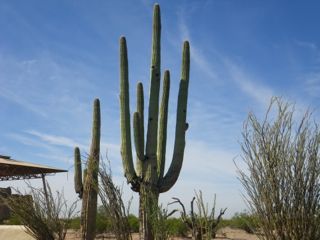
On the way into Phoenix yesterday, I saw ‘forests’ of them dotting the hillsides. I couldn’t believe how big they are. It wasn’t until I reached this morning’s destination that I finally had an opportunity to properly observe and photograph this amazing plant. The one in this picture most closely matches my mental image of the cactus, but I saw some that had no spears (‘branches’) at all and others that had dozens, if not hundreds, of them and were absolutely massive, bigger than a two-story house!

Montezuma Castle National Monument

On the way to Phoenix tonight from Sedona, I stopped at the Montezuma Castle National Monument. Name for the Aztec ruler, even though there is no connection, this is an apartment-type complex carved out of the hills. It was built 1,000 years ago by people now called the Sinagua (for the Sierra Sin Agua mountains), who farmed the valley below, and eventually abandoned the site. To put this place into an historical context, it was built sometime in the middle to the end of Europe’s Middle Ages.

Until the 1950s, you could actually climb up and explore the ruins, but today you have to stand below and gaze up in awe while walking a short loop. Admission is $5 unless you have an interagency pass. πŸ™‚

Of all the information panels, the one that struck me the most said that while the structure was made solidly and there were obvious signs of maintenance and repair, it was ultimately designed to be returned to the Earth when it was no longer needed. How many more of these structures existed, but have left no trace?

There was a nice diorama showing a cross-section of the complex. It really is built like a castle, complete with a fortified keep.

This site was amazing and I wish I had more time to write about it, but the Starbucks is about to close. I invite you to follow the link at the beginning of the post to get more information.


Fun in Sedona, AZ

Driving around Flagstaff last night gave me the impression that it’s not an easy city to drive in. I kept on missing my turns and had to do long detours to get turned around because of the railroad that divides the city. This morning, in the light of day, it wasn’t any better.

There wasn’t anything I particularly wanted to see in Flagstaff, so at reader Sandra’s suggestion, I decided to go spend part of the day in Sedona, a short distance away. Well, it took longer to get out of Flagstaff than to actually get to Sedona!

GPS directions and the paper map told me to take Beulah Blvd, or route 89, to Sedona. So far so good. Until I hit construction and a sign that said, ‘Road ahead closed, take I-17 and exit 337.’ I was at a dead end and had to reverse until I could find a place to turn around. Had I been in the rig, I would have had to unhook and reverse a giant motorhome for about a quarter of a mile!

I finally got turned around and looked for detour signs. There were none. I could see I-17, but no on ramps. My GPS was of no use. The paper map wasn’t detailed enough. Siri had no idea what I wanted. I finally pulled into a parking lot and saw a police officer standing by his patrol car sipping a coffee. I asked him how to get to I-17 and he told me that the gas station over there could sell me a map. Gee, thanks! *rolls eyes*

On the way to the gas station, I passed a lady walking and asked her. She had no idea how to direct me. I made it to the gas station and asked the attendant. He said the on ramp was near Walmart. So I drove around Walmart a bit and finally found the on ramp.

I drove down I-17 until I got to exit 337. Guess what was there? A sign that said, ‘Sedona detour, exit here.’ Seriously, Flagstaff?!

Had I been in the motorhome today, I really doubt I would have made it to Sedona as I would have been caught in dead ends several times and would have been fed up with having to unhook and get myself turned around. For a tourist destination, Flagstaff has a lot to learn about road signage.

When I finally got on the way to Sedona, I enjoyed the drive down a very steep twisty road (the kind that I hated in the RV). We dropped several thousand feet in elevation quite quickly.

I was surprised upon entering Sedona to find tons of signs announcing free three-hour parking all around the main tourist strip. Quite unexpected! I parked and then walked up and down the main street looking into shops, checking out restaurants, and eventually came to the visitor info centre. The city itself is quite unremarkable, but the surrounding landscape is very beautiful! Sedona had a good vibe to it. I felt very relaxed there.

A very helpful lady at the visitor centre gave me some info on hiking trails to check out in the afternoon, telling me that I needed to stay longer to explore Sedona’s 300 miles of trails! She also told me that there is $5 per day fee to hike in the area, but that a number of other passes are accepted, including my interagency pass! She gave me a hang tag for it, something I could have used at Craters of the Moon.

I then headed across the street to the Life is Good store, hoping to replace my now much too big ‘All who wander are lost’ tee-shirt. I found several shirts with the phrase on it, but the only one that had a colour and cartoon on it that I liked was a lady’s size L. The sizing is ample, so I needed at most a medium and didn’t feel like paying $32 for a tent I wouldn’t want to wear in public. Oh, well. I pass Life is Good stores every so often and will keep trying.

It was only just past 11:00 by this time, but I was ravenous, so I decided to hunt down lunch. When I found a well rated restaurant serving rattlesnake, my decision on where to dine was quickly made. That’s all I have to say about that in this post with respect to those of you with sensitive constitutions. For the curious, here’s a review of my lunch.

After lunch, I wanted ice cream seeing as the temperature was now infernal. Most places wanted $5 or more for a small scoop, but I finally found a place that wanted a more reasonable $3.75. I got a scoop of espresso and it tasted exactly like a Tim Horton’s iced cap!

I was then ready to walk off my lunch, so I headed off for a trail head. I wasn’t really dressed for the climate (denim capris and a cotton tee-shirt) and only equipped to carry half a gallon of water, so I didn’t have any ambitious goals except to explore the hillside. I found myself in a warren of hiking trails, all poorly marked, and eventually turned back, certain that I would get lost. I mean, after a few turns, one cactus and pile of red rocks looks pretty much like another! πŸ˜€ I still managed to spend about an hour before making my way back to the trail head.

There, a man came up to me and asked if I was visiting from out of town. I cautiously said yes. He said that if I didn’t mind going all the way back up the road to the first round about and coming back down the other side of the divided highway, I just had to do the short Yavapai hike up to a scenic viewpoint. Thank you!

I did exactly that and found a short, but still a bit technical, hike up to a fantastic viewpoint of Sedona’s red hills. I am so grateful to that lovely man and his beautiful and sweet German shepherd! And thank you, Sandra, for making sure I didn’t miss out on this lovely town!

Sedona really charmed me and was much more affordable than expected. I could have easily found a hotel under $50 a night in the area. But unfortunately, border day is coming up fast and I had to make tracks. Yet, there was more magic to be found a short distance down the road.