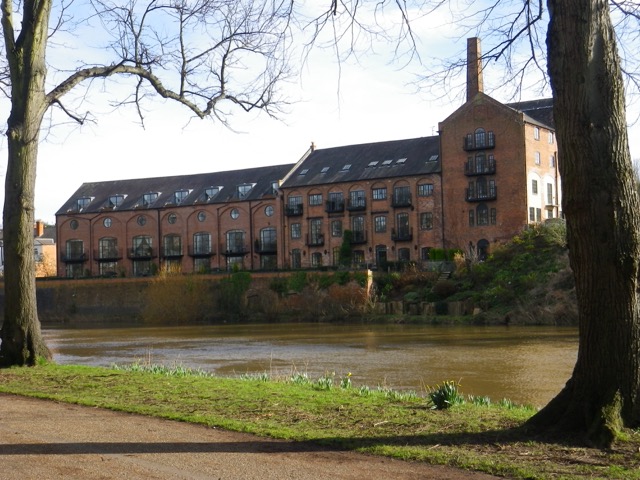
The Victorians in Shrewsbury, a Self-Guided Walking Tour

Having completed the Tudor tour of Shrewsbury, I headed back to the Music Hall to commence the Victorians in Shrewsbury self-guided walking tour.

“Queen Victoria reigned from 1837 to 1901. These were years of peace, prosperity, population growth, invention, and expansion. Shrewsbury was not one of the boom towns and, although some working class estates and substantial middle class villas were erected in the suburbs,” the tour was limited to the town centre and its then new public and commercial buildings. “Many were built of high quality materials and were very varied in style because, of course, architectural styles did not change with the new monarch. Queen Victoria’s reign was also a time of greater regulation, moral certainty, growth of religious non-conformity, and considerable philanthropy.”

So the first stop was the Music Hall itself, where we finally get some information about it. It was “built in 1838-40. It looks classical and Greek and was known at first as Shrewsbury Public Rooms. It was built around a shut that led to a yard where engines of the Salop Fire Office were kept; this is now the entrance to the museum. The Music hall, with a choir and orchestra gallery, was to the left. The hall could seat nearly 800 and was also used for balls, banquets, lectures, meetings, and bazaars. … To the right of the shut, now the Visitor Information Centre, was the rebuilt Salop Fire Office; while a News Room occupied the elegant room on the first floor overlooking The Square, and a billiard room the floor above.”

It was this tour that finally gave me information on the unmarked statute at the front of The Square. Sorry for the wonky angle; there was a display in front of it.

So that’s Clive of India. “The Victorians decided to commemorate him, although his influence had been 100 years earlier in Georgian times. The sum of 2,000 guineas was raised by public subscription and Carlo Marochetti sculpted the figure, copying the likeness from a painting by Nathaniel Dance. In addition to his exploits in India, Clive was mayor in 1762 and M.P. for Shrewsbury three times. The statue dates from 1860.”

Across from Clive is a building in what I’ve learned is the Flemish style and which was built in 1892 from high quality materials for the Alliance Assurance Company, which is now the Halifax Building Society. “The carvings commemorate the companies that were incorporated into the Alliance at its creation.”

Next stop was the Victorian post box in front of Gullet Passage. It is late Victorian, hexagonal, and made of cast iron. It is called a Penfold box, after the designer. It would have originally been green since the boxes were only painted red starting in 1874. “Pre-charged mail, based on weight, was introduced at the very beginning of Queen Victoria’s reign and the volume grew dramatically from 76 million letters in 1839 to 350 million in 1850!”

On the way to the next stop, I was told to look at Claremont News, which has a typical Victorian small shop façade.

Next up is the Baptist Church, “which has recently been repaired and cleaned.” It “is very classical and less ornate than was usual for its date. The hard red bricks came from Ruabon in North Wales and were very popular at this time. … Here, they are paired with Grinshill stone, a local grey sandstone, to pick out the round-headed windows and Corinthian pilasters. This church cost £2,500 to build in 1878.

There is a lot of walking between stops on this store, so I had time to notice other things.

I have one of those…

These steps look very precarious.

Next up was The Quarry and the entrance to Wonderland…

AKA The Dingle.

St Chad’s Church

Entrance to Wonderland/the Dingle. As you can imagine, my expectations were low.

First glimpses of this faery tale world before the bla bla bla.

Looking back to the entrance from which I came.

“This is the Dingle, created from a quarry, which produced building stone for the early town. Long abandoned, a pool had formed in the lowest part and was used for watering cattle; one old photo shows children skating here during a cold spell. The quarry was landscaped in 1879, with a path and shrubs around the lake and a more formal area of flower beds that are replanted seasonally.”

The Dingle is the last stop on my next tour, so here is more information from that guide: “Although the rest of the Quarry was laid out as a park with an avenue of lime trees by the Corporation in 1719, an early photograph shows the Dingle as a ‘wild’ area, with a natural-looking pool; Charles Darwin is said to have fished there for newts. … The fountain in the centre of the formal flower beds was given to the town in 1889 by the Independent Order of Oddfellows. The gardens are a Percy Thrower legacy … He was park superintendent from 1946 to 1974 and became known nationally as the TV gardener. The Dingle is the jewel in the crown of the Parks Department, … each year it is brought to perfection for the Flower Show in August. Trees in the Dingle include Maidenhair Tree, Sweet Gum, Ginko, Tulip Tree, Swamp Cyprus, and an enormous mature Beech.”

Back to the Victorian guide, “At the far end of the lake is the statue of Sabrina, Goddess of the River Severn, now reclining in her own grotto…. The Earl of Bradford presented her to the town in 1879.”

I had fun watching the ducks for a bit.

Interesting artwork in a tree.

What an amazing spot, like a miniature Buchart Gardens.

I reluctantly left The Dingle and found the cast iron bandstand that dates from 1879 and which in recent years has been revived every odd Sunday afternoon

Across the river is the Pengwern Boathouse, with its typical Victorian architectural style.

“The Boat Club was founded in 1871 when rowing was very popular and it had racing boats as well as a number of pleasure boats. It moved to these premises in 1881 and still flourishes, holding a popular regatta in May.”
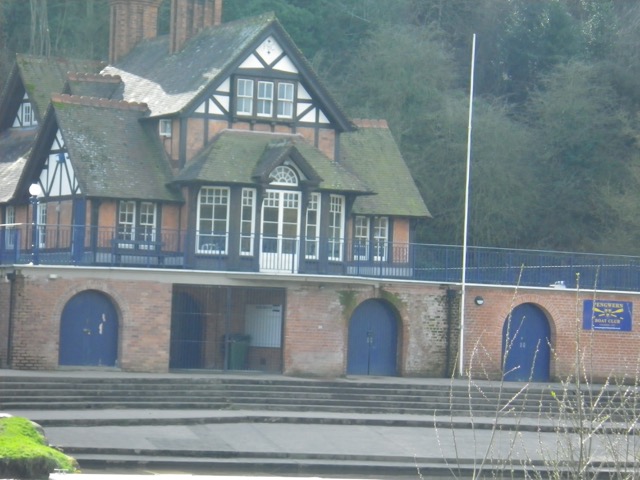
Very near the stop where I took the boathouse pictures, I came across this stout post just before the Kingsland Bridge, which you can see in blue in this picture. “This is an old ferry post, the windlass can be seen set back above some steps on the other bank. There were several of these pedestrian ferries in central Shrewsbury, which saved people a long walk to either the Welsh or English Bridge. This one was superseded by the Kingsland Bridge in 1882, which gave access to the fine Victorian suburb of Kingsland and the new Shrewsbury School. … The bridge, known locally as The Penny Bridge, as it charges tolls, has always been privately owned and operated. The ferry remained for some years and the boys from Shrewsbury School used it to avoid paying the toll to cross the river.

I now had a very long stroll ahead along the water, so I took the time to enjoy the surroundings.

Back of a structure we will see from the front…

Kingsland Bridge.

Looking to the centre of town. Notice the cathedral. That’s my second to next stop!

The Greyfriars pedestrian bridge, where I turned left to begin a surprisingly gentle climb back to town.

But first, this obelisk, “in memory of Dr W J Clement, a skilled and innovative surgeon, philanthropist, a long-serving local councillor, mayor, and for a while M.P. for Shrewsbury. He demanded reform of rotten boroughs, thus antagonising the Tories who dominated the Corporation. In return, they refused him a post at the hospital. … The memorial was erected in 1873 and was originally outside the railway station, but has been moved several times.”

Off I want to the cathedral, marvelling that I was all the way down there just moments before.

“The steep-gabled, neo-Gothic church is, in fact, the Roman Catholic Cathedral. It was started in 1853, only 20 years after the Catholic Emancipation Act and soon after the restoration of the Catholic hierarchy in Britain. … The limitations of the site led to some alterations to the original plan; the tall spire was replaced by a bell-cote and the chancel is very shallow.”

Looking back along Town Walls. If you keep going, you can turn left to take Wyle Cop to go back to the centre.

Looking ahead. I found it interesting how the sidewalk was so far up the road as to need a railing.

This is a water pump. There are several in Shrewsbury and they are all listed by English heritage. “They day from 1870 and the inscription encourages the careful use of water; the basin at the base catches any waste, which can be used for animals.”

Door to the watchtower. There is no information about this building on this tour, just its name.

The watchtower.

Looking towards my next two stops.
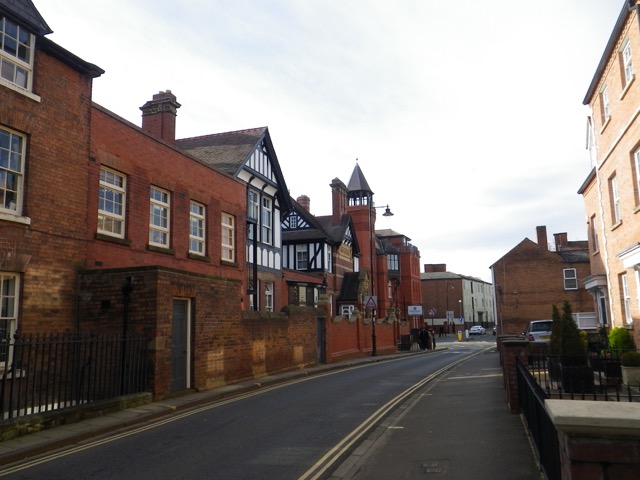
First is the girls’ high school.

Can you read the sign?

The high school was built in 1897-98. “This independent school is part of the Girls’ Day School Trust set up in 1864 following a National Enquiry, which concluded that there was ‘a general deficiency’ in the provision of secondary education for girls. The aim was to provide a high standard of academic, moral, and religious education for all social classes.”

Next is the magnificent neo-Gothic building we saw the back of down by the river, the former Eye, Ear, and Throat Hospital, opened in 1881, and now converted into flats.” I know where I’m moving to… 😀

“Its construction was a great example of Victorian philanthropy, ‘upwards of £12,,000 being raised largely through public subscriptions. … The cantilevered operating theatre windows on the second floor were originally glazed with single sheets of plate glass to provide maximum northern light for operations.”

I then turned up Swan Hill to get to my last destination.

This wasn’t on the tour, but was pretty.

The final stop is the Italianate former Police Station/Weights and Measures Office, built in 1893 “to house two important new services that were to be carried out by the local authority. The provision of a police service was made compulsory in 1856, though Shrewsbury was ahead of the game, having appointed 13 constables 20 years earlier.”

“In relation to the weights and measures, there were many attempts throughout the Victorian period to standardise weights and improve the standards of retail transactions. Between 1878 and 1893, new mechanisms for inspection and enforcement were established.

Thus ended the delightful Victorian tour. I think this was my favourite!

Heading home up Pride Hill, I was shocked to find that the McDonald’s had closed permanently. Am I glad I was able to visit its basement before that happened! I hope that Shrewsbury will not permanently lose that important landmark.

Sushi at Umai and then the Self-Guided Tudor Town of Shrewsbury Tour

I had to finish up a super tedious file today with a very late deadline, so I decided to do half the work this morning, go and have some fun, and then come home to finish. I wanted to be gone all afternoon to have lunch and do two walking tours, so that would mean an outing of 3.5 to 4 hours, the longest I’ve been away from Puppy. Needless to say, I planned my outing with military precision!

I worked steadily to noon with a mid-morning break to give Puppy a walk. Noonish, I gave her lunch, then had a play session to wear her out. Once she’d had a bowel movement and pee, she was very happy to go into her crate for a nap. Knowing that she’d had plenty of exercise and was being left with a fully tummy and empty bladder, I felt comfortable leaving her. She didn’t even whine as I prepared to head out, which was gratifying.

So first stop was Umai Japanese restaurant. I haven’t had a proper sushi meal since Málaga (and even that was stretching it a bit) and was very overdue, especially since I’ve been having the truly mediocre Tesco stuff to soothe the itch. We’ve been by the restaurant a few times as it’s in the Cross Keys Passage. I doubt I’ll have time to come here for dinner before I leave, but I realised this afternoon that I really should go see Shrewsbury after dark and whether these shuts are as spooky then as I think they would be!

I thought the restaurant was just this tiny bit on the shut, but, nope. There’s a large dining room at the rear towards Princess Street.

I went with the £12.50 mixed sushi special as that would give me the most bang for my buck. Such specials tend to be at the chef’s discretion, but I really wanted octopus. So I asked if a couple of my five nigiri could be octopus. The server said she could ask, but normally there are no substitutions for the lunch special and octopus is never included. So I was delighted when this beautiful plate came very quickly!

Everything was so fresh and this was the first time I’ve been able to describe the maguro (tuna — dark pink) as “buttery.” Whenever I’ve read that description of the fish, I’ve thought people were off their rockers or there was something wrong with my tastebuds! My only quibble is small, that I got three pieces of salmon sashimi plus a salmon nigiri and salmon isn’t my favourite (I’d rather maguro, but I know that’s much more expensive!). The maki (roll) had crabstick in it, so it wasn’t special, but I loved the masago (the orange stuff round it) as I haven’t had it in a while. The octopus was absolutely perfect and exactly what I hoped it would be.

I was enjoying my last piece of it when the server went to take away my plate and I had to quickly swallow and tell her that I wasn’t done as I still had my ginger left! I always save it for the end so that I don’t walk out with a fishy taste in my mouth. That’s one thing I haven’t missed about Canada, the US, and the UK, how I feel rushed to get out of a restaurant. Anyway, my lunch was YUM and very filling. I couldn’t believe the quality and quantity for the price.

I then walked a short distance to the Shrewsbury Museum, where I bought two more self-guided tour pamphlets, a second one for today and one to save for perhaps Monday. Then, it was time to start my tour of the Tudor Town of Shrewsbury. This was the least value tour as it is very light on stops. It said to plan for two hours, but I think I got it done in 30 minutes!

Here’s their map of the tour (click to embiggen to legible size):

The introduction to the tour from the brochure: “Following a disastrous trade depression in the previous century, Shrewsbury’s fortunes revived in the later Tudor period. The population grew and merchants thrived, especially drapers, the middle-men dealing in woollen cloth. It was a period of great re-building. Shrewsbury is one of the best-preserved Tudor towns in England, with many listed 16th century buildings. In this walk, we will draw your attention to just a few, but hope that you enjoy the Tudor townscapes. All of this is, of course, against a background of medieval buildings, many of which still remain — not just the parish churches, but also many of the commercial buildings.”

So chronologically speaking, this tour comes after the medieval one. The first stop is the Tudor exhibit in the museum, where we’ve already been.

Next up, I got all my questions, and then some, answered about the Old Market Hall I have passed a kazillion times. It’s right in front of the museum/music hall.

The Old Market Hall “was built in 1596 by the powerful Guild of Drapers who chose to use stone, which is slightly unusual since most market halls of this era were timber-framed. Tuscan columns support the first floor, where there was a chamber for Welsh cloth dealers and Shrewsbury drapers to meet and negotiate prices.

“The covered area beneath was for the sale of corn. In the far left corner, note the tally stone used to record or document quantities or prices.

“The Square had been the market place since the 13th century, long before the Market Hall was built, and milk and vegetables continued to be sold here until 1868 when the general market was built.”

There are many decorations around the hall.

“On the west side, the large coat of arms with the Tudor dragon and the English lion belongs to Elizabeth I, who was reigning when the building was erected.”

The hall was restored in 2001-2 and is now a café and cinema. You can go upstairs to see the roof.

Directly across from the Old Market Hall, on High Street, is “Owen’s Mansion, built in 1592. Richard Owen was a prominent woollen cloth merchant and this was his prestigious house, in the centre of the commercial area.

“This is a good place to note the curved braces, a shallow S, used to strengthen the frame and the quatrefoils, 4-pointed designs. These and the carving of timbers to form cable mouldings are typical of the Shrewsbury school of carpentry. … the finials depict a warrior and his lady.”

Across the street is Ireland’s Mansion. “This was described by Sir Nikolaus Pevner, the 20th century writer on art and architecture, as the ‘Grandest timber framed house in Shrewsbury.’ This massive building, tall, broad, and symmetrical, was constructed in 1575 for commercial purposes by Robert Ireland, another wealthy wool merchant. It was three different houses, with shops on the ground floor, offices above, and accommodation in the attics. Locals are said to have called it ‘Ireland’s Folly’ because of its immense size. It has four projecting full height bays and four large gabled dormers.”

“This is a good place to see cable carving at close quarters.”

Next stop was my favourite building on Pride Hill.

“Space on major commercial streets was at a premium and often shops were very narrow, but the owners made up for it by building several storeys and also by adding jetties jutting out into the street at both first and second floor levels. This very narrow timber-framed house is Thornton’s. “This probably was a medieval shop with a single chamber above.

“The decoration on this building is interesting: under the first floor window is a design of cusped concave lozenges and the bargeboards are original, with damask work decoration. For some reason, the gable has been placed asymmetrically.”

Then, I was off to the library. By this point, one of the reasons the tours were taking less time is that I knew my way around!

The library used to the Grammar School, which “was founded in the reign of Edward VI in 1552, partly financed with money gained from the dissolution of the collegiate churches of St Chad and St Mary. The building is an amalgam of dates from 1450 to 1630 (main façade).”

I went into the library’s courtyard.

Across from the library is a big yellow house I’ve been curious about.

This is “a fine example of a late Tudor house.” It was moved from its original location around 1700.

I then headed to Windsor Place to see a long, curved building. It “is a side wing of John Perche’s house built in 1581. Its front is hidden behind the shops on Castle Street. This more natural brown and cream was the norm in Tudor times rather than the Victorian ‘renovations’ in black and white. … John Perche was another rich wool merchant and he served as bailiff four times.”

I then headed around the back of St Mary’s Church to find my next location almost at the corner of St Mary’ Street.

It is Drapers’ Hall, now a restaurant. “The trade in wool and cloth manufacture brought great prosperity to Shrewsbury in Tudor times and the Guild of Cloth Merchants or Drapers dominated other tradesmen like shearmen (finishers) and the mercers (retailers). The built this hall as a meeting place in 1577-78and added a second story in 1580. … The Drapers were a reliouss as well as a trade guild — The Brethren of the Holy Trinity.”

On my way to my next  destination, I saw something that drives me nuts and which I admire Amsterdam for not doing, changing the name of a long street partway.

My next stop was the original site of the Bradford House we saw above.

Heading back to The Square, I learned some interesting things about this Costa at the corner of Grope Lane. It was once the Cross Keys Inn. “It was restored in about 1990 and the beams were stripped of their black Victorian paint to reveal the original brown colour. The first floor [upstairs in the UK] is much the same as it was, but the restorers added a number of contemporary allusions in the carvings on the replacement bargeboards.”

I can’t see it, but one of those tiny figures is supposed to be Margaret Thatcher.

I went back through Gullet Passage to get to my next destination.

Right at the end of this passage is an unnumbered stop. This building is timbered on one side, but has a brick front, a good example of a Tudor building that was modernized in the 18th century.

The last stop is another place we’ve been. This is where I thought I would have done well to read the pamphlets ahead of time to save myself steps, but, hey, the exercise is good! Anyway, we’re back at Rowley’s House. “Today it stands in solitary splendour, surrounded by car parks, but originally it stood amongst a jumble of yards and passages, which may account for the unusual shape and positioning of the building. It was built in about 1590 and, since it has no chimneys, it is believed to have been business premises. It probably was used by William Rowley, a draper, brewer, and malster, as a warehouse. A little later, early in the 17th century, Rowley built himself a fine brick mansion attached to the timber-framed building. This is believed to be the first brick building in Shrewsbury.”

I was underwhelmed by the Tudor tour, but grateful to have that knowledge about some of the buildings I’ve noticed many times. But I found myself wondering if the next tour would be worth my time since I felt like I was just basically walking in circles around Shrewsbury’s core repeatedly (to the point that a couple of panhandlers felt a need to ask me if I was lost and needed help!). But I’d paid for the guide, so I figured I might as well go ahead.

Little did I know, I was minutes away from falling down the rabbit hole into Wonderland.

To be continued…

Off to Tesco

I’m on the tail end of another large burst of work. I’ll have made for one of my clients in the last week what I normally invoice them for in three weeks! So I’ve only had time for work and puppy stuff the last few days. But today, I really had to get some groceries. I debated doing one final order with Tesco delivery since there are no full size grocery stores I can walk to and it’s a mile to a Tesco Express, but decided that I didn’t want to end up like in Hebden with too much food I need to use up and just get my groceries locally. Since I’m hoping to get to town tomorrow to do another self-guided walk (no time for that today), I didn’t particularly want to walk in to get my groceries. So I did some research and found another Tesco Express in the opposite direction and still only a mile from me.

So off I went around 10:30 this morning. Part of my route was through a park I go to daily with Puppy. She’s not a very good walker yet, so I didn’t want to take her all the way to the shop, plus I didn’t want to have to leave her outside. So she stayed home.

Considering the poor road signage for cars, there is decent pedestrian signage on footpaths. This is the first one I saw coming into the park. My destination is on the side you can’t see very well.

This is a park straight out of my childhood. It has a proper playground.

There’s big wide open field for playing with your dog or kicking a ball.

I used to love biking on tracks like these when I was a kid! You can also see a basketball court where some local girls like to rehearse their cheerleading routines.

I went under this railroad bridge.

I walked below the Shrewsbury Flaxmill, which is undergoing a major regeneration.

It’s a very interesting building. I can imagine those bits projecting out as flats with wonderful views of the park, not that that’s what they’re doing with them.

I came around the front and was impressed by all the scaffolding.

There’s an art installation in front of the building site to keep people from having to look at the grey walls for two years. So there are a bunch of paintings, like this “Monet.”

Unfortunately, the paintings are all on chip board and deteriorating quickly. Here’s another one that’s aging well, though:

One side of the street in this Shrewsbury suburb had buildings that made me think of apartment buildings I’d find back home, except maybe for the bay windows.

But the other side was definitely “English.”

OH?

It’s a “gold bead,” but not the kind of bead I was expecting.

As expected, the Tesco Express was small, but adequate except for lacking in unsweetened almond milk and having slightly higher prices than online. I was able to put together a decent shop for £20 and am pretty sure that I’ll only need to do a slight top up at the shop around the corner from the house as I only have a week to ten days left here (depending on if I take the owner up on her offer to stay a few days to go explore locally).

I came in and spent some time exhausting Puppy so I could then get back to work. Thankfully, I learned very quickly in my stay here that when she’s in one her manic moods, I just need to give her my undivided attention for 10 to 20 minutes and wear her out with some ball throwing before she’ll flop down for a two-hour nap and let me work. I was really concerned the first couple of days I was here that I wouldn’t be able to work with her being so insane sometimes and I’m glad that we’ve settled into a schedule that works perfectly for us both. I mean, by the time she’s done with her two-hour nap, I’m as ready for a break as she is for playtime! Minding Puppy has been exhausting, but so rewarding and I know I’ve done a very good job of it.

Back to work I go… I should be able to go have some fun tomorrow as long as the weather holds. If I do, there will definitely be sushi. 🙂