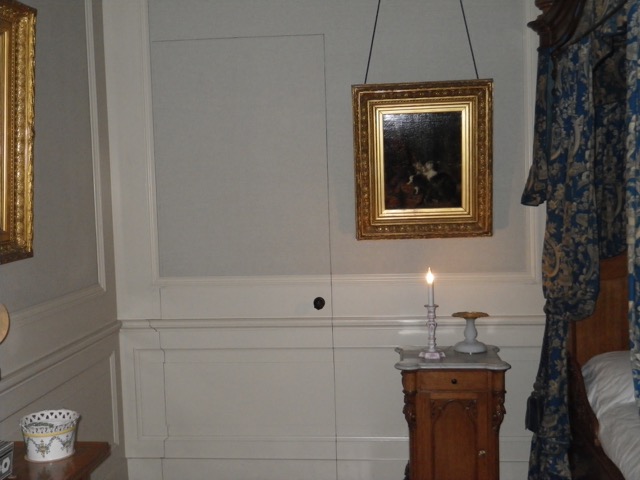
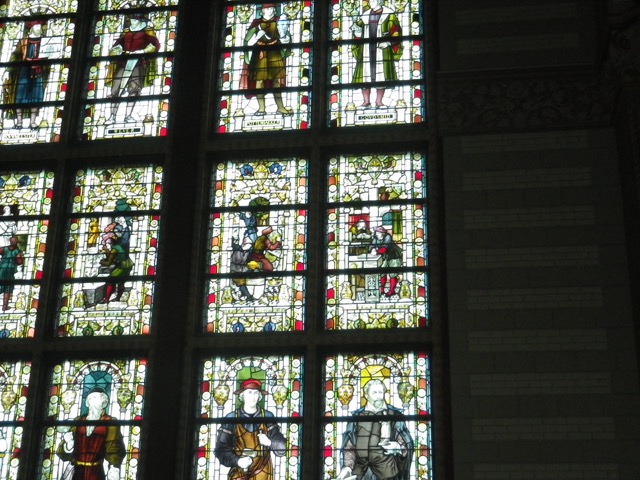
The Amsterdam Museum

I worked for several hours this morning and headed out around one for a late lunch and a visit of the Amsterdam Museum, which is all about the history of the city.

I made sure to pack everything I needed for my excursion, including my pretty (but obviously very cheap) new Museumkaart bag that I’ve been using to bring home my supermarket purchases. I regretted not packing such a bag when I left home all those months ago and am impressed with how much use I’ve had out of it so far.

It folds up into a little pouch.

I went across the street to throw out the trash and found that someone did some serious clean up. Yes, that’s a bag of VHS tapes.

I’m slowly starting to orientate myself and could get most of the way to the museum without needing a map. This meant I could notice things I’d missed on previous trips, like my life motto on the wall of this canal: “Memories are souvenirs too.”

I made a withdrawal and was pleased to pay only 145CAD for 100euros. A few months ago in Montenegro, I paid 155CAD. My money is going further!

Google Maps once again failed me, which is no surprise, but I managed to find the museum on my own with a minimal amount of wrong turns. Then, I wandered around the Dam for a bit and found a restaurant that had a good burger deal, so I went in. I ended up waiting 20 minutes to be served a beer and be told that they were out of burgers and only had omelettes left! I felt like telling them to just keep the beer, but it was a small one so I decided to treat it as my appetiser. This enormous waste of time was almost worth it for an exchange I had with a little girl at the table next to mine. She was reading the menu and asked her father about four times, “Papa, c’est quoi un ‘Italian roll’?” (Daddy, what’s an ‘Italian roll’?) I took pity on her, leaned over, and said, “Un Italian roll, c’est un pain italien!” (An Italian roll is an Italian bread!”) She looked at me wide-eyed as a grin took over her features and gave me a very grateful, “Merci!”

By the time I was able to pay and leave, it was two and most restaurants were done serving lunch. Yes, I appreciate the irony. So thank goodness for finding falafel, and some of the best I’ve had outside of the Montreal-Ottawa corridor at that! And since lunch was fairly inexpensive by Western European standards, even with the beer, I had an ice cream after. Let me tell you, Ben and Jerry’s is very disappointing after months of gelato! It’s very popular here, but having had it twice now, I think that’s it for the rest of my life.

So back I went to the museum. Its entrance is very crooked!

The main part of the museum is about the history of Amsterdam. It was a lot of talking from the audio guide and reading from the signage. I’m just going to make a few general notes of what I learned, but, really, I cannot do justice to a whole museum devoted to the topic.

One of the questions I didn’t realise I had about Amsterdam, but which is obvious in retrospect now that I have the answer, is how the heck did the city come to be?!

Let me share two illustrations to make my point. Here are some major cities of the world. The dotted line is sea level.

Now, here is Amsterdam. Notice that most of it, including the airport, is well below the dotted line.

Well, Amsterdam started like many cities do, as a village in the mud at a strategic location. Buildings were on piles and, over time, more land was drained, canals were built, the dams were constructed, etc. I saw lots of period maps showing how the city grew over the years and much of the development and plans for expansion were carefully calculated.

Amsterdam is built on mud and it’s its millions of piles that keep the city from sinking into that mud. Excavations into the mud often reveal interesting artifacts, like this perfectly preserved shoe from the late 13th century!

It was after two major fires that the city was finally rebuilt in brick and stone. Can you imagine how much weight that is on piles?!

Amsterdam was once a Catholic city, but broke away from that faith and moved to Protestantism. Catholicism then had to be practiced in secret and Catholic nuns and priests were driven away. But as long as Jews stayed away from Christian women, they were welcome because of their positive impact on the economy.

I still dream of a home with a dark panelled library and such a wonderful old globe. 🙂

Amsterdam was the home of the Dutch East India Company and claims to have been the centre of the world for at time. The company went bankrupt in 1799.

The city was governed by a group of men called burghers. I love how contemporary this picture of a group of burghers feels. Take away their period clothing and I could see them talking about the latest gadget.

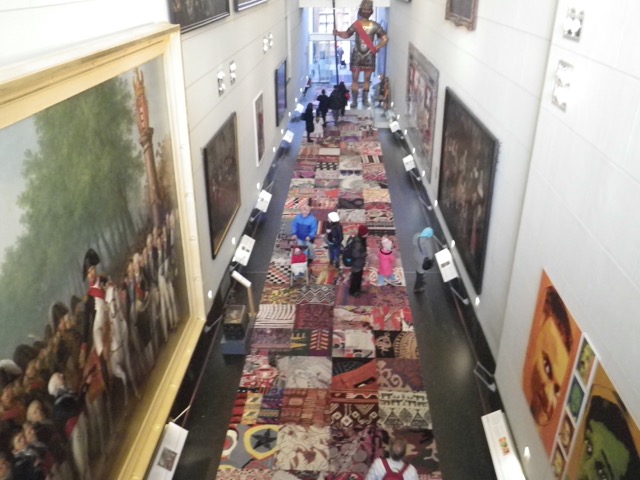
Looking down to the psychedelic carpet I photographed on my walking tour.

I learned that Napoleon’s forces invaded Amsterdam and that the city was under French control for a time, which is when the town hall became the Royal Palace.

Bust of Napoleon.

One of the most interesting facts I learned in this early part of the museum is only just how recently Amsterdam has been easily linked to the rest of the world, considering it was the home of an international trading company. First, a North Sea Canal in 1876. Then, the Central Station for trains, built on three artificial islands in 1889. The first cars appeared in 1900 and, get this, 1916 is when the original Schiphol Airport opened! Yes, 100 years ago! It was originally a mud field for military aircraft, but in 1920, regular service began with an Amsterdam-London route that was flown by 440 passengers. More on Schiphol in a bit.

There was not much about why Amsterdam is such a bicycle friendly city, as though they take that mode of transportation for granted. But I can gather that much of modern Amsterdam grew at the same time as the bicycle came into fashion and it was just the most logical way for folks to get around.

You could ride this bicycle in front of a screen playing a scene from 100 years ago and one from today.

Anne Frank is the face given to the thousands of Amsterdam Jews killed in the Shoah. Amsterdam claims to be the only city that held a protest against the treatment of its Jews. The city ultimately “lost” 66,000 of its 80,000 Jews.

Anne Frank

There was a whole section about how tolerant Amsterdam is and that it was the site, in 2001, of the first same-sex weddings in the world. This section also described how ethnically diverse the city is. I have to say that I couldn’t help but notice upon landing at Schiphol and going to the attached train station that almost all the employees were black. I saw a lot of black people in southern Spain, which makes a lot of sense with Africa being as close as it was, but I didn’t see a lot of non-white people in the Balkans. I’ve also seen a lot of Asian people here. It’s refreshing. I’m still not used to living in Canada in an area where everyone looks like me, having grown up in a part of the country that is truly a great big tossed salad of human diversity.

Here is the very first map ever drawn of Amsterdam. If I recall correctly, it dates back to the 1500s, before the rings of canals were built. North is down, to highlight the harbour. That harbour is now the area of Central Station.

There was an exhibit about Dutch cruelty at its Suriname plantations. Looks like Americans and the Brits don’t have an exclusive monopoly on that sort of thing.

Waterland Plantation in Suriname.

Bunch of armour.

From the main part of the museum, I moved to exhibits about the 100 years of Schipol Airport’s history. The original site was expanded until it was completely destroyed during World War II. It was rebuilt a few kilometres away and has been expanding ever since. The airport is almost a city as it has restaurants, stores, a museum, and many services. It is so much below sea level because it was built on a drained lake.

Modern Schipol Airport came into being in 1967, with four runways facing different directions so that planes can land and take off  in whichever direction the wind is blowing. The new terminal had travelators, tax free shopping, and is more functional in design.

Did you know that one of the biggest robberies in Dutch history, a diamond heist, happened at Schiphol?

Today, Schiphol is connected to the entire world. Compare those original 440 flights to the 58 million in 2015, of which 23 million were connections.

There was a fun booth where I got to play the role of a passport control officer. 🙂

2003 saw the opening of a sixth runway, Polder, which is the airport’s longest. It exacerbated noise problems in the area, so the debate about environmental norms is ongoing.

There was a series of panels about the future of travel and how we will stay safe. I was struck by this phrase, “The sky is not the limit.”

The Amsterdam Museum is a bit of a maze and exhibits overlap. I found some interesting information about the city’s coat of arms. The three crosses are actually of St. Andrew’s, supposedly because the apostle was tortured to death on such a cross. The origins of the rest of the design are unknown.

There was a brief exhibit about how Amsterdam is dealing with the influx of Syrian refugees: by welcoming them with open arms.

The exhibit about the squatters’ riots of the early ’80s had a lot of dramatic photographs. These riots led to the creation of a lot of affordable housing in the city.

This tram hit an oil patch from a truck accident and derailed.

You can read more about the squatters’ riots:

There was an in-progress exhibit about the creation of a city and a home that made me think of all the homes I’ve lived in and viewed over the years. It doesn’t matter whether you live in a hut with a dirt floor and no power or a luxury mansion with all the modern conveniences, you will have a place to cook, a place to wash and t0 use the toilet, a place to sleep, and a place to live. Sometimes, it all occurs in one room, sometimes there’s very little furniture involved, but, ultimately, human needs for a home are the same the world over.

This is a kitchen from the Jordaan part of Amsterdam in the early 1900s. The toilet bucket was right in the kitchen.

Around 1275, Amsterdam had a single neighbourhood, one line of houses along the Amstel River, which gave the city its name. More neighbours emerged as the population grew. The first canal rings were built in the 17th century.

There was an exhibit about Amsterdam’s policy of turning a blind eye when it comes to the use of soft drugs while being tough on the hard drugs. This has led to the number of junkies in the city staying around the same level as in the ’70s and the junkie population is getting older since young people don’t have access to the hard drugs. The current estimated population of junkies in Amsterdam is 5,000. There are about 850,000 residents in the city.

There are lots of rules regarding Amsterdam’s coffee shops, which are a place to smoke marijuana.

The Netherlands, in 1988, was the first European country to launch an open Internet connection. Compare that to a certain country that shall remain nameless that just decided to meet within the next many years norms that are already obsolete in most of the rest of the world.

I learned more about the Dam, which is the most famous square in the Netherlands. Since the ’50s, it has increasingly been the scene of protests and demonstrations.

There was an0ther exhibit near the end about the occupation and subsequent liberation of the city during WWII. I saw some great archival videos of Canadian troops marching in. No matter how much my country embarrasses me today, I recognise that much of Europe still sees us as the badass warriors we once were. Canada and the Netherlands are particularly close, not just because we liberated the country, but also because we sheltered the Dutch royal family during World War II and Princess Margriet was born at the Ottawa Civic Hospital. All of this is the reason why Ottawa has its wonderful Tulip Festival every spring.

It was only upon exiting the museum that I learned that its building was once an orphanage. Children played in this courtyard.

The building was the Civic Orphanage, one of the oldest and best known children’s homes in the Netherlands. Tens of thousands of children grew up here between 1580 and 1960 (WOW).

The courtyard is now a seating area for the museum café.

In the 17th century, 1,000 children might have lived there at one time, with four children sharing one bowl. They drank “small beer” every day. That is, a beer with a low alcohol content, which was safer than drinking water.

In 1960, the orphanage moved to a modern complex and after a massive renovation project, the museum opened in 1975.

This was an interesting set of exhibits. The bottom windows are about the orphanage and the upper windows are about other museums in the city.

I liked the contrast of the worn stone step with the worn wooden floor planks.

It was almost time for the museum to close by this point and I still had work to do, so I headed home, pleased that I could get there without any help. I’m really learning my way around my parts of this compact city. By the way, I’m really liking Amsterdam. It would be lovely to live here one day for a bit longer and I can actually see a way that that could happen — if I ever get to a point where I could afford the cost of living here, of course!

The only negative thing I can say about the city is that it’s really crowded now that the holidays are done! So getting around isn’t as much fun as my first couple of days, I’m afraid, and I’m getting tired and cranky a lot more quickly. 🙁

I passed an English language bookstore with a sign that made me laugh.

I went in since I had something on my list I’d been meaning to look for.

The title of this book reminds me of one my favourite sayings: “Every time I make ends meet, someone moves the ends.”

I wanted a 2017 diary and found exactly the perfect thing (pink one on the right). It looks rather nice next to the Moleskine notebook that I bought at Harrods in London! You’d never guess from how it still looks so pristine, but that notebook has gotten a lot of use!

I headed back out into the throng and found the Le Creuset store. I really want one of their Dutch ovens! Maybe once I settle in Mexico…

This is the halfway point of my stay here. I have exactly eight days left. My work for the next couple of days is pretty heavy, so I will probably just explore by immediate neighbourhood. There are still a couple of museums I’d like to see and I really want to go back to the Rijksmeum, but I’m really pleased with how much I’ve been able to do within walking distance of my flat. Some of the museums left on my list may require the use of the tram, if only to save me some time.

I hope you enjoyed learning about the history of Amsterdam. I find it a fascinating city!

Tassenmuseum Hendrikje (Bags and Purses), Museum Willet-Holthuysen, and Rembrandt House Museum

I slept in a tad this morning and took it easy since I’ve been getting up early since I got here. I did a bit of my work for the day and set off late morning for the third museum in Amsterdam that I might have visited had I had to pay piecemeal for each entry: the Tassen Museum of Bags and Purses, the largest such museum in the world.

The sky was a strange colour as I stepped out of my flat.

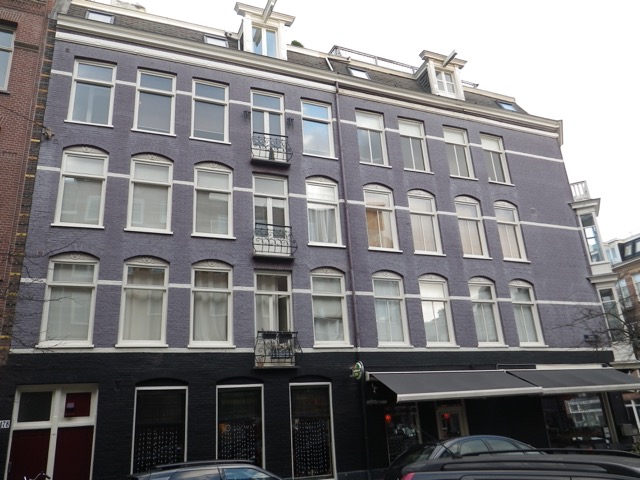
I love this purple building at the end of my block, a good example of how a building can be colourful, but not garish.

Moped parking spaces.

What is that blinding thing in the sky?!

A museum devoted to cat stuff. Sadly closed today.

The Museum of Bags and Purses is in a canal building and the exhibits cover the history of bags from the 16th century to present day. The building housing the museum was built in 1664 for a former mayor of Amsterdam, Cornelis de Graeff, and restored as the museum in 2007.

I took about 50 billion pictures in this museum, but since everything was behind glass and I couldn’t use a flash, not many came out well. So I will show restraint. 🙂 I went through twice, so the pictures are going to be out of order. You enter the museum into a ground floor bag shop and then go up to the third floor to then work your way down.

Gaming purses.

Beaded bags were quite a luxury. They were first knit, then woven. Some have as many as 50,000 beads.

The need for sturdier bags made leather popular as the train travel age started.

Tortoiseshell was popular, but expensive and finicky. Advances in plastics made it possible to create replicas.

Snake skin with ivory clasp.

Prickly pear fibres and lace, dating back to 1789!

Chatelaines, which hung from a belt and then things like a thimble, watch, keys, sewing kit, etc. would hang from them.

Bags with silver frames were passed down from mother to daughter. The frame would be reused with a new bag.

Men’s leather bag. Bags for men fell out of favour as their clothing got pockets.

Very similar to chainmail.

Until recently, it was mandatory for Dutch schoolchildren to have a leather bag like these. Now, many use backpacks.

These were used before the leather bags. They held a tablet and stylus and served as a lap desk.

Novelty bags.

I like the stegosaurus look with the turquoise knobby bits.

All sorts of travelling cases.

These were popular as plastic became a common material.

Tulip bag.

I had to pay a 1.50 euro surcharge as they have a special exhibit about royal bags. I breezed through this on my first pass as it was crowded.

These belonged to Queen Elizabeth II.

I had kind of sort of thought to treat myself to a cream tea in their café, but it was closed today. I was told to help myself to free coffee or tea and cookies, though! Wow! Am I glad I didn’t get a coffee before going in and, of course, this rather makes up for the supplement I had to pay. 🙂

The café setting is extraordinary.

The crowd had gone through, so I went back to the top and started all over.

This 16th century bag had secret compartments. Intriguing.

Very pretty. Kind of looks like Mount Fuji?

Closeup of chatelaines with “stuff” on them.

Yup, Charlie Chaplin.

Very heavy cut steel bags.

See the teeny pencil?

Art Deco bags.

The SHOES!

Peacock feather bags.

Lobster bag, LOL

Margaret Thatcher’s “Weapon.” Google it!

Gateau (cake) bag.

“Socks” bags after the Clintons’ cat. To the left of it is a picture of Hillary Clinton holding it.

Versace bag used by Madonna at the premiere of “Evita.”

Sunflower bag.

Love the budgies.

*Swoons* Love that snake head clasp!

This bag was held by a member of the Dutch royal family and we got to see how it was selected and dyed to match the dress.

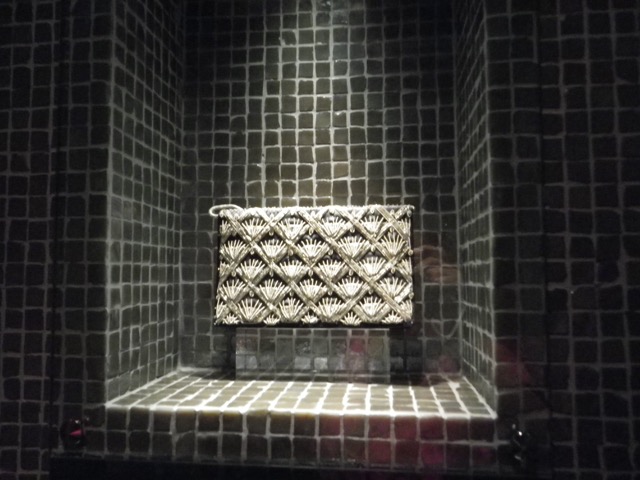
This jewel was in a toilet stall!

And this one in another stall!

Wall hanging.

Amusing donations box.

I’m always attracted to bags with such bright colours (we’re in the shop now!).

The Tassen Museum of Bags and Purses was incredible. I am a real bag nut, but not in the sense of wanting expensive designer bags that I’m afraid to use. I love finding unique bags at thrift shops, especially well worn leather ones. I have little patience now for bags made of PVC that will age quickly. There were so many bags in the shop that I would have loved and not all were at terrifying prices. I would definitely consider this museum a place to shop for a nice bag and I think it would be lovely to have high tea in their café, although if you factor in the price of admission, it’s extremely pricey. Definitely something I’d consider if I was a Museumkaart owner living here full-time, as that would reduce the total cost immensely.

I didn’t get anywhere near the next museum on my list when I passed one that was right up my alley, but hadn’t been on the list of Museumkaart member museums I’d consulted. I’d figured out that that list was outdated since none of the admission prices were right. So I went in and asked if I could get in free. Yes! It is the Museum Willet-Holthuysen, which gives you the opportunity to wander all through a canal house that was willed to the city of Amsterdam for public use in the 19th century. I’m a bit of a voyeur in that I like to go through houses and see how they’re decorated, so I could not miss this!

You know straightaway that the family was rich because they had one one set of stairs but two leading up to the front door. But you enter the building through the basement door.

Looking down the basement hallways to the kitchen and the back of the house.

All of these items were crocheted, LOL!

Some of the kitchen wall tiles had interesting details.

Even the clock was crocheted!

The secondary kitchen, for messy chores.

The garden at the rear of the house.

Look towards the front of the house.

You then go up this magnificent staircase to the first floor of the house, with the public rooms.

The front door.

The house had a doorbell.

The women’s salon, where the owner, Louisa Holthuysen, received her guests.

The ballroom, where they had parties.

The stunning blue “club room,” where the husband, Abraham Willet, received his male friends.

Love that painting at the top.

The ceiling.

Love this painting too.

The dining room had a low ceiling because there is a pantry above, halfway between this floor and the next. The brochure said the pantry was not open to the public, but it was. Signage throughout the property indicates that they are constantly renovating it, so I guess the brochure is a tad outdated.

Now into the conservatory at the rear of the house.

Signage says this room needs a lot of work to return it to its former vibrancy.

Heading upstairs to the private rooms, I found the entrance to the pantry. This room would have held a lot of valuable items, so only the mistress of the house would have had a key and the room would have been regularly inventoried.

Heading up from the pantry.

Skylight.

This staircase would have led to the garret, which had the laundry facilities. To the left is Abraham’s library.

Can you see the door in the corner? It led to one of Louisa’s rooms. This way, they could go see each other without having to pass any servants.

My flat has a seat like this. Really like it. 🙂

Can you imagine sitting at that desk looking down to the garden?

There is another “secret” door in the library, but there was no mention of where it leads.

Stained glass in the hall.

Garish carpet in the “collection room.” Louise and Abraham were very well to do and did not have children. They spent their time collecting art and socializing.

The incredible wallpaper in the collection room.

The rest of the house was “modernised” by Louise and Abraham when they married, but this room kept the traditional dark wood Dutch furnishings from a hundred years prior.

Then, the bedroom.

The bed was actually two twin beds pushed together.

The wash area. Hot water had to be brought up from the basement.

Another secret door.

Chest in the hallway.

Abraham and Louisa. She inherited the house from her father. They married in their late thirties.

The final spaces exhibit some of Louisa and Abraham’s things.

Hat and umbrella stand (I think) by the visitor entrance.

The two entrances.

What an extraordinary treasure this museum was!

I headed towards my next destination and kept my eye out for food along the way. I’m really not into the whole holiday thing, but there are some decorations that I really enjoy. These are so pretty.

WHAT IS THAT???!!!

Drawbridge over a canal.

Chipotle-style burrito shop.

Back of the house, with the garden again.

Approaching Rembrandt Square. I went the opposite way of my next destination, but this area was my best bet for lunch.

Statue of Rembrandt with The Night Watch.

Lunch!

NOT New York style pizza, but it hit the spot!

This is a cinema.

I prefer the real kind, thank you very much (yes, this is candy sushi!).

There are so many wonderful cheese shops in Amsterdam.

I found a second-hand store where you pay by the weight. A tee-shirt is about 5 euros and a kilogram costs about 35 euros. They had really lovely stuff.

My final destination of the day was the Rembrandt House, which he owned before foreclosing and going bankrupt and in which he painted many of his masterpieces. Again, I’m not a fan of Rembrandt, so I wouldn’t have paid to do this, but I thought it would be interesting to see his studio and, of course, I like house tours.

Well… I was about to start in the museum when a staff member told me I had to check my purse. That was not going to happen! I’ve never been asked to check it before as it is not huge. I told her that I had all my valuables in it and would take care to not have it hit walls or anything. She sarcastically retorted that I don’t care about my stuff since the zipper was open! What business is it of hers if I choose to have my bag open somewhere that there is nobody around?! So that set a sour tone for the tour.

Then, employees hovered around me during my entire time in the museum. I thought I was imagining things, but one guy followed me almost all the way through and whenever I’d look up, I found him staring at me. Finally, I got told off for trying to take pictures (no flash) when literally every other customer was taking pictures and not being told to desist! All I can think is that because I didn’t pay for admission, I wasn’t considered a real guest?

So needless to say, I didn’t get much out of my visit because I was so distracted and I rather regret expending the energy of getting to the Rembrandt House. It is crazy expensive (12.50 euros) and quick to tour, so I don’t recommend anyone go unless they have a Museumkaart and/or are huge fans of Rembrandt.

At any rate, the audio guide was really good. The most interesting thing I learned is that people at the time slept in a sort of cabinet and that they reclined rather than laid flat.

When Rembrandt declared bankruptcy, an inventory of all his possessions was made. That combined with sketches he made of his home made it possible to furnish the restored space very realistically. It was interesting to see his collections room with things like seashells, exotic stuffed animals, and books. A few of his works are exhibited in the house, including those of four of the five senses, the first of his works that I actually rather like.

But, of course, the pièce de résistance was his studio. What struck me when I came into it was the light. It was a good reminder that I should place my own studio where it faces north to get that soft consistent light that is so perfect for a painting studio. There was someone there demonstrating how Rembrandt would have made his own paints and I got to smell that wonderful scent of linseed oil I love so much.

Upstairs from the main studio was another studio where Rembrandt’s students studied. It must have been cold up there in winter as there was no obvious source of heat the way there were two stoves in Rembrandt’s space.

Finally, there was a series of rooms with drawings and etchings made by some of Rembrandt’s students. I was tired by this point and ready to leave, so I rather breezed through this and didn’t even catch the artist’s name. I just wasn’t keen on his style.

It was mid-afternoon by this point and I was done. I asked Google Maps to get me home and decided I couldn’t justify a tram, so off I went.

Amsterdam is very damp so you see mossy footpaths all over the place.

I was afraid to ask the price of that cute Batman purse in case it was affordable!

While I knew that Maps was sending me in the right direction when I set off, I found myself walking longer than expected without having to turn. I realised that Maps had stopped navigating and that I was farther from home than when I’d started! This would happen three times before I figured out that because I was asking Maps to navigate to a landmark that was closed, it figured I was an idiot and didn’t mean to go there. Google’s idiocy never fails to astound me! And I was using the landmark because Maps doesn’t recognise my address. *sighs*

I put the app away in disgust and decided that even though I was really getting too close to home to make it worth taking a tram, I would. I passed the blumenmarkt on the way, a floating market selling all manner of flowers and bulbs.

There was a bit of a wait for a tram when I got to a stop, so I popped into the supermarket right there to get some dinner stuff (been shopping daily) and when I got out, the tram was just pulling up. It felt absolutely ridiculous to pay 4CAD to go about four stops or just shy of 2KM, but I was footsore (still breaking in my new boots) and really tired as I hadn’t sat down since I left except for the few minutes when I had my coffee. My tram driver was really sweet!

I got in and went straight work, then made a curry for dinner. The Patak sauces that I like that are such a luxury in Canada are super cheap here (but of course), so I’m working my way through all the flavours I haven’t tried yet. Why not? 🙂

This will be my last really full day out for a bit as I have larger quantities of work to do every day. But I should still be able to go out to do a museum every afternoon.

My Museumkaart has already paid for itself and I am 22 euros or 32CAD ahead!

A Visit to the Anne Frank House

Diarist Anne Frank should require no introduction. Visiting the house where she and six other people hid for more than two years during World War II was the number one thing I wanted to do in Amsterdam. Yes, the Van Gogh Museum was second.

Entry into the Anne Frank House can be a bit difficult. You can book a time slot until about 3:30PM most days, or else show up before then and queue for up to several hours in the hope of getting in without an appointment. All time slots for my entire time in Amsterdam have been booked for weeks, so I thought I was going to have to queue and hope for the best.

Well,  today, Christmas Day, access was only with booked time slots and because I kept checking back on the site, I managed to snag a last minute cancelation for the first time slot! Talk about something being meant to happen.

It was a dark, cold, and bleak morning when I left home around 8:15 and I seemingly had Amsterdam all to myself. While I had purposely avoided passing the Anne Frank house in the the past few days, I had travelled other parts of Prinsengracht Straat, on which it is located, a few times and so I knew where to go.

I’ve seen these cute cars all over Amsterdam.

Seeing the Westerkerk, which she so often references in her diary, was the moment of realisation that I had arrived.

And here’s the house. You can see the museum entrance space well lit up. To the left of it is a house with a pale foundation and stairs. To the left of that is a house with black doors. That was the location of Otto Frank’s business, with the offices above and the Secret Annexe behind.

I walked on the opposite side of the canal (to get a better view of the house) and had to double back. So here is a view looking the other direction to the Westerkerk.

And here is the view across the canal that Margot and Anne would sneak peeks of on their bathing day in the front office.

Here is the church tower that they could see from the Secret Annexe.

Daylight shot up close.

Here, I’m around the block in front of the Westerkerk, trying to get a glimpse of the Secret Annexe. This is when I understood just how they managed to be so well hidden. You cannot see the extension from the street and with all the buildings being stuck together, even if you can see it from another building, it’s not clear to which building it belongs.

The Westerkerk in daylight, from the other side.

I arrived around 8:50 and there was already a queue forming for those with tickets for nine. Anyone with a ticket for a later time, even 9:30, was told to leave and come back no earlier than five minutes before their turn. I had to queue for almost 10 minutes in needling rain. That felt exactly right.

I had no trouble gaining entrance once the line started moving, although I had to increase the contrast on my phone so that the scanner could read the bar code.

From the entrance, guests move towards the actual house, with pauses to watch videos and read informational placards. I did not feel rushed or crowded. The first space recognisable from Anne’s diary is the office where Miep Gies and other helpers would work and where Anne and her sister Margot would bathe on Saturdays. We then proceeded from there up a very steep staircase to the Secret Annexe.

I think the museum does a very good job of leading guests through the spaces in a fluid manner while still preserving some of the original flow between them. So I got a good sense of what it would have felt like to move between the office space and the Secret Annexe, up a very, very, very steep flight of stairs, although not the set of stairs that were actually used by the helpers, which are at the back of the house.

One thing that I was very pleased about is that we were able to go up behind the (reconstructed) bookcase and that it had been preserved perfectly, with the low door and giant step up that Anne described so clearly. This is a stock image of it:

The actual living space was much more spacious than I expected, although I can imagine it didn’t feel like that for seven people all crammed in with their furniture and belongings! The rooms are fairly empty, but traces of Anne and her family remain. She described how she pasted images on the walls to make her room cheerier and all those images were there. We can also see the marks on the wall where Otto Frank marked Margot and Anne’s growth. The incredibly beautiful toilet in its own room was a surprise and I wish I could have asked if it was the original:

Outside of the toilet room is a room with a sink, but there is no bath or shower. Upstairs, there was also a proper kitchen, with a stove and a sink with counter space.

We were not allowed up into the attic where Anne would sneak away for a breath of fresh air, but we could look up the very steep staircase there and get a glimpse of the church tower.

Here is a fantastic tour of the space that explains it better than I could with words or even a floor plan and it has the same flow as the tour:

https://www.youtube.com/watch?v=0SJgudCq540

(You step through the bookcase at about 1:10.)

At the very end, back downstairs in the modern museum space, you can see many of Anne’s diaries and original papers, including the iconic red and white checkered journal she got when she was 13. Her handwriting is very neat.

There were several videos throughout the tour. I heard in English testimony from Anne’s best friend Hanneli Goslar about encountering Anne at the Bergen-Belsen concentration camp just before she died and managing to get food to her. Anne thought she was all alone. Hanneli, who is still alive, believes that if Anne had known her father was still alive, she might have found the strength to survive:

One of the final videos was a testimonial from Otto Frank, in English, talking about his first experience reading the diary. He said that Anne spoke about a lot of things and criticised much, but not to the depth he discovered in the diary. He was surprised by what she wrote and that despite being close to Anne, she was such a different person than he thought. His takeaway is that some parents never really know their children:

Finally, there was a video with various celebrities, authors, guests of the museum, and people in Anne’s life giving their impressions of her. One of her friends said, “She didn’t die. She was killed for being a Jewish girl.” A WWII soldier who fought to liberate Holland had this to say after learning about Anne, “Now I know why I fought.” And the title of this video comes from a speech Emma Thompson made at the Anne Frank House, “All her would-haves are our opportunities.”

The last object I saw was a surprise and added a bit of levity to the situation, Shelley Winters’ Oscar for her role in The Diary of Anne Frank. I was surprised by how cheap the statue looks! Ms. Winters had promised Otto Frank himself that she would donate the Oscar to the museum if she won and he told her that would be difficult for her to do so. Kudos to her for actually doing it.

In the last few weeks, stunning new evidence about the Secret Annexe has come out: that it’s possible that Anne and the others were not betrayed and were instead found by chance. I find an immense amount of comfort in that there is such a strong possibility.

Visiting the Anne Frank House was like going back to a place I’d been before and knew well. I cannot believe I had an opportunity to visit it. This year has been full of surprises.

I felt rather shattered when I came out an hour after entering. I’d thought of trying to find another museum that might be open, but I was done for the day. I wandered a bit around Dam Square, trying to clear my head, and then headed home.

The Royal Palace from the other side of Dam Square.

Atlas with the weight of the world on his shoulders.

I thought of stopping at a café for a second breakfast, but the few open ones that I passed were very expensive. When I came upon an open Albert Heijn supermarket, I popped in to see if they might have fresh baking to have with coffee at home, a genius idea if I do say so myself. For 9 euros, I came out of there with a chocolate croissant and mixed fresh fruit (apple, pineapple, mango, grapes!) for a second breakfast, as well as some prepared Japanese dumplings and a very nice tray of sushi for a late lunch! If there’s one thing I wish I could take home from my European adventures, it’s an Albert Heijn supermarket. With so many of them around, their low prices, and their offerings, I don’t even want to eat at restaurants!

That turquoise and orange was a welcome bit of colour on a bleak morning.

I got in, had my second breakfast, and then started to pick away at a largish job due tomorrow night. My thought was that I could make large enough headway on it to be able to take it slow tomorrow, head out to do a museum or two, and then finish up in the evening. That wound up being a pleasant enough way to wile away the afternoon (the work was interesting) and I paused around two to have my dumplings and sushi, which were really good for being of the supermarket variety!

Just shy of four, I got a lovely present. I’m minding two cats here and one is an aloof grumpy old man who wants very little to do with me. Around four, he gets wet food. Well, I was just thinking that it was time for that when he came downstairs, rubbed his head against my legs, looked me straight in the eye, and said, “Meow?” I gave him his food and before he ate, he let me give him a short scritch under the neck. Progress! 🙂

So I’ve done all that I really wanted to do in Amsterdam. I can now relax and take in all the wonderful bonuses the Museumkaart offers me. 🙂

Seeing the Highlights of the Rijksmuseum and a Very Special Dinner at Addis Ababa

When I got out of the Van Gogh Museum, the day had gone from almost balmy to freezing. There was a really bitter wind blowing. I was going to walk to another museum on my list a few kilometres away when I realised that the Rijksmuseum was almost right next door. It is a huge museum dedicated to fine arts and history of the Netherlands. It’s one of those museums that ideally needs a couple of days to take in.

Since my Museumkaart gives me unlimited entry, I thought that I might as well pop in, as long as the queue wasn’t too long, do a whirlwind tour, see two very important works, and then decide if I want to devote a whole day to it. The regular queue was super long, but I was able to just walk in with my Museumkaart. There are several entry points within the museum where the card was scanned.

Here’s the famous I amsterdam sign outside the Rijksmuseum:

The  museum itself is magnificent.

I did not take any pictures on this go around. To be honest, I should have found some lunch before going in so I was kind of intent on getting in, seeing what I wanted to see, and getting out. I was also rather tired by this point. The museum is a genuine labyrinth. The map and signage aren’t that helpful and no one I asked for directions could help. I joked on Facebook that I needed a search party! I also find that the distribution of the items is in an odd order. You start in the Middle Ages, jump to the 19th century, go back to the 17th century, and then jump ahead again to the 20th century!

There were two paintings I desperately wanted to see and I found them! The first was Vermeer’s The Milkmaid:

The other was Rembrandt’s The Night Watch:

I’m not really a huge fan of either artist, but these are such iconic works!

Admission to the Rijksmuseum is 17.50 euros, so two visits there will already eat into the cost of my Museumkaart! The museum would not have been on my list if I had to pay for my museum entries piecemeal and I’m glad I had a chance to scope it out and decide that it would be worth a day of my time. When I go back, I want to pay particular attention to model ships, pottery, musical instruments, and magic lantern slides. There  is also an out of the way Asian exhibit that was spectacular. So expect a much better Rijksmuseum write-up than this one, as long as my clients cooperate. 😉

Speaking of which, I came straight back home to have my leftover curry for a late lunch, write up my Van Gogh blog post, and then do an assignment due this evening. I was done by 6:30 and hungry. There are three Ethiopian restaurants within a one-minute walk of the flat (!!!), so I did some research as to which would be the best, Addis Ababa. Ethiopian is a favourite cuisine of mine and I haven’t had it in five and a half years!

I splurged and requested “an Ethiopian beer” and was brought this wonderfully caramelly nectar of the gods:

I picked the doro wat special, which came with all these sides. The spinach and cheese are what made it special. I normally don’t like cooked spinach, but dang was this stuff tasty! The “cottage cheese” was more like a Bulgarian sirene/non-salty Greek feta. Then, continuing clockwise, you have some spicy red lentils, lettuce and tomato, potato/carrot/cabbage, and non-spicy lentils. When I would eat Ethiopian food in Ottawa, I was still a vegetarian and my dinner would be those four dishes (no spinach or cheese) in larger portions. So these sides were very familiar to me.

I had doro watt in Lethbridge, but it was very different to what I was served tonight. It had been my first time eating an Ethiopian meat dish and was so long ago that I can’t even compare. This was whole drumsticks cooked in a slightly spicy berber sauce. It traditionally comes with hardboiled eggs, but I asked for none of those, of course, and got extra chicken!

I ignored the knife and fork and dug in using the injera (teff pancakes seen above) as scoops. I thought I must have looked like as slob, but I later learned that I looked like I knew what I was doing. The server was surprised that this was not my first, not my fifth, but likely my twentieth to thirtieth time eating this cuisine! What a wonderful end to a truly special day.

Van Gogh Museum, Amsterdam

Today has been… overwhelming. If someone had told me just a couple of months ago that one of the last things I’d do this year is visit Amsterdam’s Van Gogh Museum, I would have laughed. Like London, Amsterdam felt like an out of reach city to me and so I never did much research on it, only knowing that if my Path ever took me there, I would pay anything to see the works of the painter who most influenced my own artistic talent and use of colour.

I was young when I oil painted; it was during my adolescence, so a period roughly 20 to 25 years ago. I’ve always wondered what would have happened if I’d kept up the hobby. But after I moved out on my own, I never had room for a studio and oil painting is too unforgiving a medium for a temporary space.

The museum is one of Amsterdam’s top attractions and lines can be long. Even with a Museumkaart, you are advised to book a timeslot online, for which there is no extra fee. I managed to score a spot at nine this morning. I set off in almost balmy gloom around 8:30, with Google surprising me by taking me through a lovely park.

I went down a street that reminded me of Belgravia and paused for a moment to look at this lamp hanging over the street. At first, I thought it was a bell!

I was early upon arriving and there was not yet any queue for folks with a time slot, so I popped into a café for a pricey, but oh-so-pretty café cortado.

Here’s the exterior of the Van Gogh Museum. This is the group entrance. The regular entrance is around back to the right. The queue for folks without a booked time slot was getting long!

The museum is in Amsterdam’s museum quarter. You’re looking here at the Diamond Museum, which doesn’t interest me.

Here’s the café, Healthy Food Coffee.

I was a little irked that at no point in my Museumkaart research was I told I had to activate the card before use/that it would not be activated at time of purchase. So after queuing for a few minutes in a much shorter line than the regular one to get in and then queuing to have my e-ticket with my time slot scanned, I was told I had to go back out to the ticket window to have my card activated. I couldn’t believe it since the line to said ticket window was a block long! But, thankfully, a museum employee had been told by radio to look for me and guided me to the head of the queue and then right back in. So it was fine in the end.

There’s a free coat check in the museum, which I took advantage of as I knew I’d be there a while.

Photography was, of course, not permitted in the museum. Visitors are encouraged to use stock images, so that’s what I will do in this post. I took copious notes as I went through. An audiovisual guide to the museum is an extra 5 euros and I got one. I don’t think I would have appreciated my visit as much without it. I read somewhere that 1.5 hours should be allotted to the museum and I was there a full three, including the special exhibit!

The guide and signage give a lot of context to Vincent’s life, but I don’t think it would have been quite enough for me. I highly recommend the movie “Painted With Words,” a unique piece in which all words spoken are from actual correspondence. Benedict Cumberbatch plays Vincent and the resemblance is striking as both share the same carrot orange hair and bushy beard, pale green eyes that change according to the light, and a marked Cupid’s bow to the upper lip. No other actor I’ve seen play Van Gogh so closely resembles him in both his self-portraits and the one photograph I’ve seen. Combine that with his remarkable acting skills and you’ve got a truly remarkable film.

So the museum starts with the self-portraits. They were not meant to necessarily represent Van Gogh as he was, but to play with textures and colours. You’ll notice that his eyes, for example, change colour from portrait to portrait. Painting himself was also a way to get around the fact that he could not afford models.

I then saw Vincent’s palette, thick with paint showing the brush strokes. My palette was like that. Like Van Gogh, I painted thickly, so there was no point limiting how much I squeezed onto my palette. Van Gogh used colour to represent emotions, not reality, and I did much of the same. I regret not having at least photographs of my works. I saw them as very crude and childish, but they were the works of a child and according to my instructor, they showed potential. She was always struck by how I used colours that were not true to nature, especially with skies. Many years later, in college, I took an art class and the teacher told me she could tell that my biggest influence was Van Gogh.

The first really important of his works that I saw was The Potato Eaters.

This one is from his early days, when he was still trying to figure out who he was as an artist. It was a crowning achievement for him even though it got scathing reviews. His ideal models were peasants, people who lived rough with the salt of the Earth, and this scene depicts all that he found to be noble about them.

Vincent’s father was a very religious man and Vincent broke away from that, but was still religious in his own way and even worked as a preacher. This art was very much about his own search for God.

And then… the Sunflowers.

I cannot tell you how many times I attempted to recreate this painting in my own style, using his example of one colour in many tones. To see it up close was to realise I’d never seen it before. The background is almost like a woven pattern. I was amused that the guide told me to step away and let someone else have a look. But I had it all to myself! I was so lucky to have been able to visit the museum when it was not crowded and I could take all the time I wanted at each painting.

Bridge in the Rain is done in a Japanese style, which Vincent admired.

You can really see the rain coming down and feel how cold it is.

I learned so much I didn’t know about The Bedroom.

The painting was damaged and has been restored. Vincent used a lot of paints that faded over time and so many of his paintings are not as vibrant today as they once were. Amazing!

We saw how Van Gogh dabbled with Seurat’s pointillism style of painting and how that led to his own iconic style of placing side-by-side unmixed dabs of painting of contrasting colours and letting the viewer’s mind mix them.

I saw some of his drawings that look like his painted style and some of the reed pens that he cut himself.

This still life of fruit, Quinces, Lemons, Pears and Grapes, is the only one that still has the original frame that Vincent made himself.

Like with Sunflowers, this is another painting where he plays with yellows and a bit of contrasting blue.

And here is the single painting that most influenced my own style, Seascape near Les Saintes-Maries-de-la-Mer.

There are three things of note here that I applied to my own paintings. First is how the painting is divided with a third devoted to the sky and the rest to the foreground, with a very narrow sliver of background between them. Second is how he used his palette knife to sculpt the waves with white paint. I applied that technique to snow. Finally, it’s this painting that inspired me to sign my own artwork in a bold contrasting colour.

Like Vincent, I appreciate how using complementary colours (eg. red and green or blue and yellow) can add depth and interest to a scene, as we can see here in the Yellow House, his last home, which he shared for a time with Paul Gaugin and in which was the bedroom he so famously painted. The bright blue sky really pops against the yellow and orange of the house.

The Sower is the painting that inspired me to create landscapes in odd colours.

I distinctly remember my painting teacher criticising my choice of sky colour in one of my paintings and my telling her, “Van Gogh would have understood!” Funny the things one remembers!

I just went through the blog hoping to find a picture of one of my only surviving paintings, which is above the entry door in Miranda, as it really illustrates all this influence, but alas, I don’t seem to have one. 🙁

At any rate, the museum moved on to the end of Van Gogh’s life, when he was in the grips of mental illness. There is a misconception that he painted because of his illness when, in fact, he painted in spite of it.

There is some controversy as to which of his paintings his his last and Tree Roots is most likely it as it is unfinished and unsigned.

Like me, Van Gogh found great inspiration in a Prairie-like landscape, “expanses of wheatfields, large as a sea.”

Wheatfield with Crows

If that style of painting birds was good enough for Van Gogh, it was good enough for me. My painting that I referenced above has birds like these in it. I love this painting so much that I bought a small metal tin at the gift shop with this painting on the cover. I’ve been wanting a tin like that to carry Advil and it was only 3 euros. 🙂

And here’s Under Thunderclouds that so reminds me of home and which I was sad not to see in the main collection, but thrilled to view in a special exhibit, an unexpected bonus!

I didn’t know until today the story behind the striking Almond Blossom.

It was painted for his brother Theo and his wife Jo upon the birth of their healthy son, whom they named Vincent, with the blossoms representing rebirth. His nephew Vincent was the founder of the museum.

Irises is just a bit less famous than Sunflowers and I prefer it because I love the contrast of the blues and the yellows.

The paint is layered on so thickly that this painting took a month to try, something I remember too well since I also caked the paint onto my canvasses to give them a 3D feel. I appreciate Irises so much more now that I’ve seen it up close.

After this main exhibit, I was able to visit a special exhibit about Daubigny, Monet, and Van Gogh. Daubigny was much older than the other two and greatly influenced their style. I wasn’t familiar with him. Monet is my second favourite painter after Van Gogh. I could not believe that this exhibit did not have a surcharge. Little did I know what awaited me…

Daubigny’s Moonrise at Auvers reminded me of my favourite Monet painting, which hangs in the Musée des Beaux Arts in Paris.

I saw a painting of poppy fields by all three, showing their different styles. Vincent’s was very hands on, with him squeezing the red painting directly from the tube onto the canvas and then manipulating it with his palette knife.

And then something so incredible happened that I had to pinch myself. My favourite Monet, Sunset on the River Seine, was not hanging in Paris, but at the Van Gogh Museum in Amsterdam!!!

Claude Monet (1840-1926). “Soleil couchant sur la Seine à Lavacourt, effet d’hiver”. Huile sur toile, 1880. Musée des Beaux-Arts de la Ville de Paris, Petit Palais.

I just love that bright bit of orange against the muted blue.

Landscape with Peasants Reaping shows how Vincent’s drawing style also evolved to match his iconic painting style.

Visiting the Van Gogh Museum was more than a dream come true. What an amazing gift!

My day of tourism wasn’t quite over, but this post has been long and I have work to do. More later!